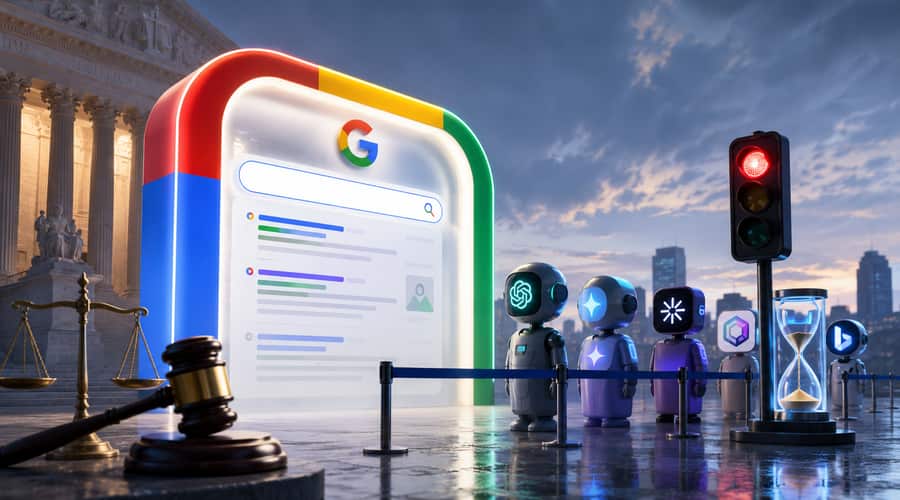
Google is trying to unwind the search monopoly ruling that could reshape who gets access to the internet's most valuable distribution points.
Google's appeal is not just another legal filing in a long antitrust fight. It is a delay button on one of the most important questions in AI search: whether challengers can get a fair shot at the default positions, search data and user pathways that helped make Google almost impossible to dislodge.
Alphabet's Google asked the U.S. Court of Appeals for the District of Columbia Circuit on Friday to reverse Judge Amit Mehta's ruling that it illegally maintained monopolies in online search and related search advertising. As Reuters reported, Google argues that Mehta made legal errors in his 2024 decision and that its agreements with companies such as Apple did not stop those partners from promoting rival search services.
That argument matters because the original case was built around distribution. Google paid billions of dollars a year to be the default search engine on browsers and devices, including Apple's Safari. Users could switch, but most did not. In search, defaults are not small conveniences. They are traffic machines, data engines and habit-forming channels all at once.
For AI search companies, the timing is uncomfortable. Perplexity, You.com, OpenAI and other AI-native search products are trying to prove that the next version of search will feel less like a page of links and more like a useful answer engine. But even a better product has to find users. That is where Google's legal position still matters.
Mehta's September 2025 remedies ruling stopped short of the most aggressive measures the Justice Department wanted. Google did not have to sell Chrome or Android. It could still pay for placement. But the court barred exclusive arrangements for products including Search, Chrome, Google Assistant and Gemini, and ordered Google to share some search data with qualified competitors. That combination was modest compared with a breakup, but it still created a possible opening for rivals.
Google is now trying to close or narrow that opening. The company wants the appeals court to throw out the ruling, and it has also argued that generative AI companies such as OpenAI should not be able to receive data under the remedy. That is the part startup founders should watch closely. The legal fight is no longer only about yesterday's search box. It is about whether Google's search scale can feed its AI products while rivals are kept away from comparable inputs.
This is why the case has become so important for investors. AI search startups can raise money on product quality, model performance and distribution partnerships, but the largest market unlock would come from structural change. If default contracts become easier to contest, a startup can imagine bidding for placement on browsers, phones or assistants. If data-sharing rules survive, a younger company can improve results without spending years trying to recreate Google's feedback loop from scratch.
Google still has the practical advantage
The difficulty is that legal possibility is not the same as commercial reality. Google has the cash, the brand, the ad business and the operating relationships. Even if exclusivity is limited, a rival still has to make the economics work for a partner such as Apple, Samsung or Mozilla. A default search deal is not only about consumer choice. It is also a revenue line, and those partners are not likely to trade dependable payments for an experiment without a very clear reason.
That makes the appeal timeline important. Oral arguments have not been scheduled, and the case could stretch into late 2026 or beyond. Every month that passes gives Google more time to deepen Gemini inside its products, improve AI Overviews, and blend conventional search with answer-based interfaces. For challengers, the risk is that a remedy designed to open the market arrives after user habits have already moved into a new Google-controlled layer.
The Justice Department and a group of states have also appealed parts of the remedies decision, arguing that Mehta did not go far enough. That creates an unusual situation. Google wants the monopoly finding and data-sharing obligations wiped away. Enforcers want stronger medicine. The appeals court could preserve the current approach, weaken it, or send the case back in a way that keeps uncertainty hanging over the market for years.
For founders, the practical lesson is simple. Do not build an AI search company that only works if the courts fix distribution for you. The better bet is to use the legal uncertainty as upside, not as the business model. Perplexity's direct consumer push, OpenAI's integration of search into ChatGPT, and You.com's focus on productivity-style search all point in the same direction: own a use case first, then fight for placement from a position of demand.
The appeal will not decide the future of search overnight. But it will shape the terms on which the next generation competes. If Google's remedies survive, AI search startups may get a rare chance to buy, access or earn distribution that has been locked away for years. If Google wins, challengers will have to prove that the answer engine can beat the default engine without much help from the courts.
Also read: Waymo’s flood pause shows robotaxis still have a weather problem • Howie Liu is backing founders building AI agent companies • Howie Liu is turning Hyperagent credits into a seed-stage weapon