A Hangzhou startup says its AI collar can turn barks and meows into human sentences, but the bigger story is whether consumers will trust an emotional promise that science has not yet independently verified.
Meng Xiaoyi has found a very fast way to make pet owners stop scrolling: promise them that the sounds coming from the living room are no longer a mystery. The Hangzhou startup's PettiChat collar is being pitched as an AI translator for cats and dogs, with a preorder price of 799 yuan, about $118, and more than 10,000 units reportedly reserved after preorders opened on May 15.
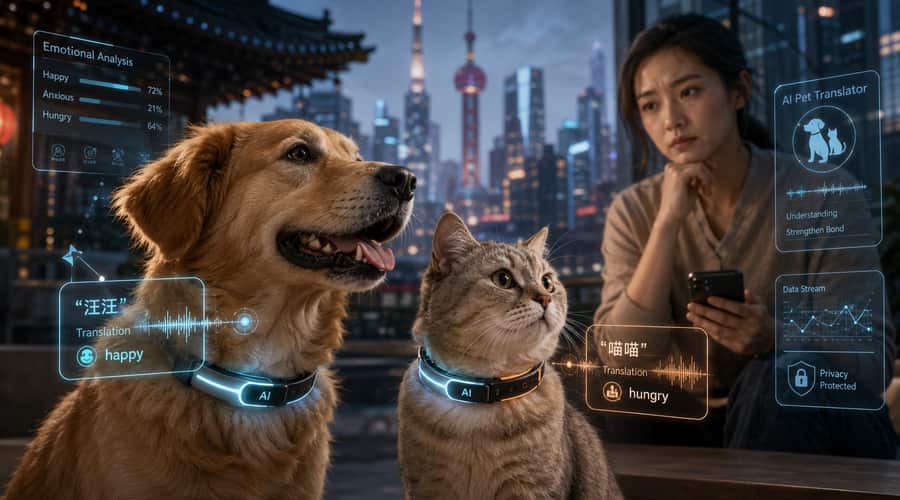
The device is small enough to sound plausible as a consumer gadget rather than a laboratory tool. Chinese reports put it at about 27.2 grams, worn around the neck and connected to a phone app. It uses microphones to capture pet sounds, combines that with behavior signals, and then turns the result into short human phrases that are meant to describe hunger, fear, excitement, anxiety, discomfort and other everyday states.
As Dexerto reported this weekend, the company says the system uses Alibaba Cloud's Qwen model technology and accumulated pet voiceprint data to recognize vocalizations, behavior and emotions with accuracy near 95%. Chinese coverage gives the more exact claim as 94.6%, tied specifically to emotion recognition rather than a literal word-for-word translation of animal language.
The appeal is obvious. Pet owners already behave as if their animals are speaking. They infer moods from a look, a sound, a movement toward the food bowl or a refusal to move at all. PettiChat packages that daily guessing game into a cleaner interface: the animal makes a sound, the app returns a sentence, and the owner gets the satisfying feeling of being understood.
That is why this product has traveled so quickly online. It sits at the intersection of three strong markets: pet care, wearable devices and consumer AI. China has a large urban pet population, and domestic media recently pointed to industry data showing more than 126 million urban cats and dogs in the country in 2025. If even a small share of those owners are willing to pay for emotional convenience, the business case is not difficult to see.
There is also a broader AI angle. A collar like this does not need to prove that animals have grammar in the human sense to become commercially useful. It only has to convince owners that it can classify emotional states better than intuition alone. That is a lower bar, but it is still a meaningful one. A reliable stress or discomfort signal could have practical value, especially if it helps owners notice health or behavior problems earlier.
The evidence is still thin
The problem is that the strongest claim is also the least settled. Meng Xiaoyi says the 94.6% figure is real, but public reports say the company has not released independent studies or third-party testing that would let outsiders judge the methodology. That matters because accuracy in a controlled setting can look very different from accuracy in an apartment with background noise, multiple animals, visitors, traffic, a television and a distracted owner.
Animal behavior specialists have raised a more basic point as well: pets communicate through far more than sound. Body posture, tail position, ear movement, eye contact, pacing and context often carry the meaning. A bark near the door is not the same thing as a bark beside an empty bowl, even if the audio file looks similar. A system that reduces all of this to a neat sentence may be useful as a cue, but risky if owners treat it as fact.
That distinction is where many AI consumer products now live. They are not always useless, and they are not always breakthroughs. They often sit in the middle, good enough to entertain, sometimes helpful, and occasionally misleading when marketing outruns the evidence. PettiChat's own pitch includes two-way communication, location tracking and adaptive learning, which makes the collar feel less like a novelty app and more like a broader pet-tech platform.
The price also changes expectations. At 799 yuan, this is not a free joke download. It is more expensive than many ordinary smart collars, so buyers are being asked to pay for interpretation, not just tracking. If the translations feel generic, owners may quickly decide they bought a clever script generator. If the product consistently matches observable behavior, the market will be more forgiving of the imperfect science behind it.
For startups, that is the useful lesson here. AI is moving into intimate categories where the product is not just solving a task, it is selling a feeling. In this case, the feeling is that a pet is finally easier to understand. PettiChat's next test is not whether social media keeps laughing at the idea. It is whether real owners, after the novelty wears off, find enough truth in those short translated sentences to keep the collar on.
Also read: TeamPCP shows why trusted developer tools are now the target • Hyperscaler Debt Flood Brings Derivatives Bonanza • Putting The Senses In AI