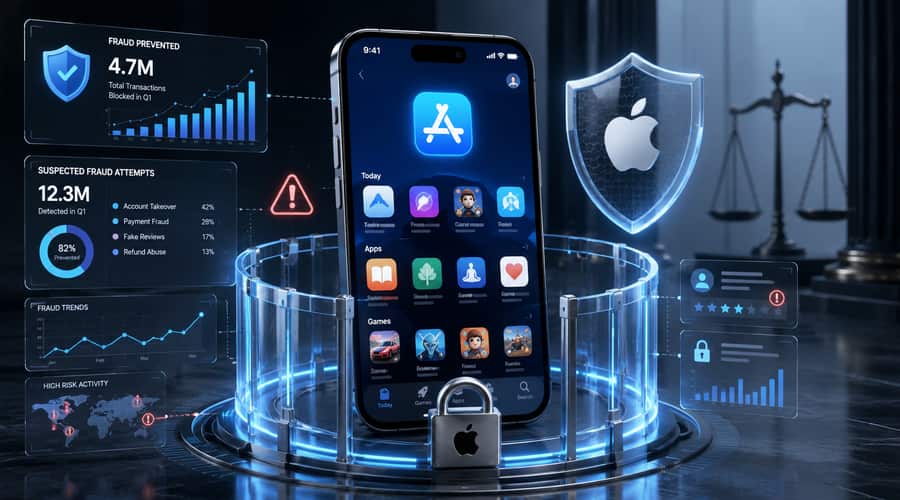
Apple says the App Store stopped more than $11.2 billion in potentially fraudulent transactions over six years, but the bigger story is how that figure strengthens its case for keeping tight control over iPhone software and payments.
Apple’s latest fraud numbers arrived at a very useful moment. The company says it blocked more than $2.2 billion in potentially fraudulent App Store transactions in 2025 alone, taking the six-year total past $11.2 billion, while regulators and developers are still pressing it to loosen its grip on app distribution and in-app payments.
That is not just a security update. It is part of the argument Apple has made for years: the App Store is not only a marketplace, it is a controlled environment that keeps bad actors away from users and gives developers a safer place to build. For founders, especially those building consumer apps, fintech products, subscriptions or marketplaces on iOS, the message is clear. Apple can protect access to a wealthy global user base, but it also decides the rules of entry.
According to Apple’s latest App Store fraud prevention report, the company rejected more than 138,000 fraudulent developer enrollments in 2025, terminated 193,000 developer accounts over fraud concerns and rejected more than 2 million app submissions for failing to meet App Store Review Guidelines. It also said it rejected 1.1 billion fraudulent customer account creations and deactivated 40.4 million customer accounts tied to fraud or abuse.
Those figures show the scale of the problem, but they also show the scale of Apple’s power. A startup does not simply submit software to a neutral shelf. It enters a system where Apple can block an account, reject an update, remove an app, stop a payment path or decide that a business model creates too much risk. Sometimes that is exactly what users need. Sometimes it is exactly what developers fear.
The strongest version of Apple’s case is easy to understand. Mobile fraud has become more organized, more automated and harder for users to detect. Fake accounts can manipulate rankings and reviews. Scam apps can imitate real services. Stolen payment credentials can move quickly through digital storefronts. A marketplace with millions of apps and hundreds of millions of users needs serious defenses.
Apple is not alone in making that case. Google said earlier this year that it blocked more than 1.75 million policy-violating apps from Google Play in 2025 and banned more than 80,000 bad developer accounts. Google also said Play Protect’s enhanced fraud protections blocked 266 million risky installation attempts from high-risk apps outside Google Play. The comparison matters because both companies are dealing with the same market reality: smartphones are now payment devices, identity devices and work devices. That makes app stores a natural target.
The difference is that Apple’s model is more tightly controlled. On iPhone, the App Store has historically been the central route to users, with Apple’s review process and payment rules sitting between developers and customers. In the European Union, the Digital Markets Act has forced Apple to allow alternative app marketplaces and new payment options. In the United States, the long-running Epic Games case continues to challenge how much control Apple can keep over external payment links and commissions.
That is why the fraud report is more than a set of operational metrics. It gives Apple a public answer to a political and legal question. If regulators push platforms to open up, who absorbs the extra fraud risk? Apple wants the answer to be obvious. It believes it already does that work, and it wants credit for it.
Startups still have to read the fine print
For founders, the practical takeaway is not that Apple is right or wrong. It is that App Store risk is now business model risk. If an app depends on subscriptions, digital goods, creator payments, financial services or external checkout, the rules around distribution and payments can shape revenue as much as product-market fit does.
A small app can survive one review delay. A larger startup with paid acquisition, investor expectations and customer support queues may not. If an update gets rejected before a launch, or if an account is flagged during a growth push, the operational damage can be real. That is why teams building on iOS need to treat compliance, review documentation, account hygiene and payment architecture as early product decisions, not paperwork to clean up later.
The tension is especially sharp for fintech and consumer subscription companies. Routing payments through Apple can offer users familiarity and a trusted checkout experience, but it can also affect margins and limit the direct customer relationship. Routing users outside the App Store may improve economics where allowed, but it brings more friction, more regulatory complexity and more responsibility for fraud controls.
This is where Apple’s fraud numbers cut both ways. More enforcement can make users safer and improve trust in the ecosystem. It can also make developers more dependent on opaque decisions from a company that competes, charges fees and controls distribution at the same time. That is the central argument regulators are still trying to unwind.
The next phase will not be decided by one fraud report. It will be decided by courts, regulators and developer behavior. If alternative payment routes and app marketplaces grow without major consumer harm, Apple’s control argument gets weaker. If fraud spikes outside the App Store, its position gets stronger. For startups, the smartest move is to build with both outcomes in mind, because the iPhone remains too important to ignore and too controlled to take for granted.
Also read: Solana builders are moving faster than the SOL price suggests • An AI pet collar turns animal talk into China's newest test of trust • TeamPCP shows why trusted developer tools are now the target