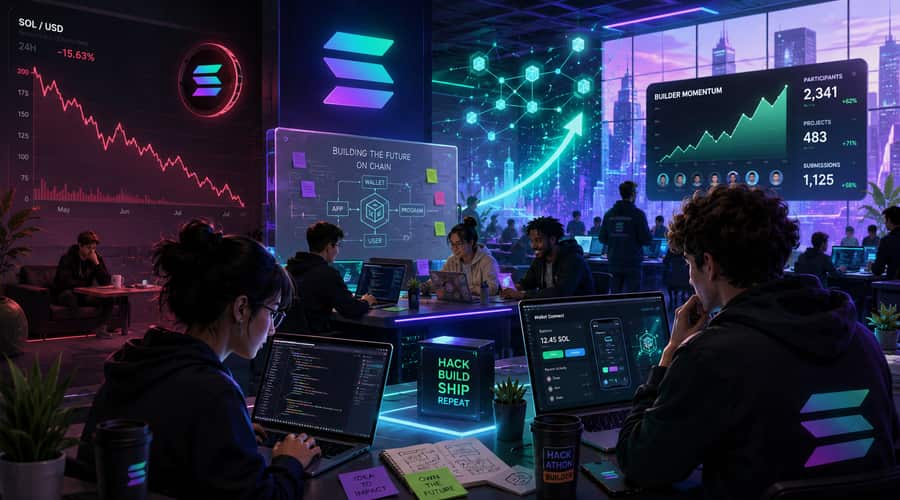
Solana's Frontier Hackathon pulled in 2,857 submissions, turning weak token price action into only part of the story. The stronger signal may be what builders are doing while the market is looking elsewhere.
Solana has a familiar problem, and for once it is not network stability or transaction costs. The token is quiet, trading around the mid-$80 range, while the developer pipeline around it looks anything but quiet.
The latest evidence is Colosseum's Frontier Hackathon, which ended after a five-week online run from April 6 to May 11 and produced 2,857 project submissions. According to Crypto Briefing, Colosseum has now made the directory of those projects searchable, giving investors, founders and ecosystem teams a public window into what was built across DeFi, consumer apps, infrastructure, AI platforms and social tools.
That number matters because crypto markets often treat token price as the quickest read on an ecosystem's health. It is convenient. It is also incomplete. A layer-one network can have weak price momentum and still be accumulating developer energy, and early-stage investors who miss that distinction risk looking at the most visible signal while ignoring the one that usually compounds more slowly.
Frontier was not just a weekend experiment with a few demos and a Discord channel. Colosseum's own site says the event is now in judging, with more than 19,000 builders in the arena and winners expected to be announced by June 23. The official rules set judging around functionality, code quality, market impact, novelty, user experience, open-source composability and business plan. Those are the right filters, because project count alone can flatter an ecosystem if the submissions never turn into durable companies.
The headline figure gives Solana a useful counter-narrative at a difficult moment. SOL was recently quoted at about $85.94 on Crypto.news, leaving the token well below the kind of speculative levels that usually dominate retail attention. Yet builders appear to be treating the quieter market as a window to ship rather than a reason to leave.
That is important for venture capital because the best crypto companies are rarely born at the moment when prices are highest. They are usually formed when infrastructure is good enough, users are reachable and the noise level is low enough for serious teams to find each other. A hackathon directory with nearly 3,000 entries is not proof that Solana has solved every business-model problem in Web3, but it does show that the network still has enough gravity to attract teams across multiple categories.
The strongest categories are worth watching. DeFi and payments are natural fits for Solana because speed and low fees are part of the network's basic pitch. Consumer apps are harder, but potentially more valuable, because crypto still needs products that normal people use without caring which chain runs in the background. AI-adjacent tooling is also appearing in the mix, not as a separate thesis from crypto, but as another way founders are trying to automate, personalize and simplify on-chain interactions.
The Accelerator Pipeline Is The Real Story
The more interesting question is what happens next. Hackathons create attention, but accelerators decide whether that attention becomes company formation. Colosseum describes itself as a three-part engine: hackathon, accelerator and venture fund. Its accelerator gives selected founding teams an upfront investment of $250,000, combines two weeks in San Francisco with six weeks online, and ends with a private demo day for venture investors.
That structure gives Solana a practical advantage if it works as intended. It can capture promising teams before they drift to Ethereum layer twos, Sui, Aptos, Base or other ecosystems willing to offer grants, distribution and technical support. In early crypto startups, the chain decision is often less ideological than outsiders imagine. Teams follow users, capital, tooling and the people who help them survive the first six months.
There is still a quality question. A record submission count can include half-finished ideas, AI-generated prototypes and teams that disappear after judging. That does not make the figure meaningless, but it does mean investors should look past the total and ask which projects get follow-on funding, which ones keep shipping after June, and which products bring new activity to Solana rather than recycling existing crypto users.
For the Solana Foundation, the priority is clear. The best Frontier teams need fast routing into grants, accelerator slots, technical mentorship and customer discovery. If the ecosystem waits until winners are announced and then treats the directory as a trophy case, it will waste the most valuable part of the event. The better use is as a live map of founder intent.
The market may still judge Solana by SOL's next move, especially while crypto remains sensitive to liquidity and sentiment. Builders are judging it differently. Frontier suggests they still see enough room to create new DeFi rails, consumer products, payment tools and AI-linked applications on Solana infrastructure. The next signal to watch is not the submission count, but how many of those teams are still alive when the hackathon glow fades.
Also read: Solana builders are moving faster than the SOL price suggests • Strategy may sell Bitcoin before 2026 ends. • A $4,000 bounty shows DeFi still prices security too cheaply.