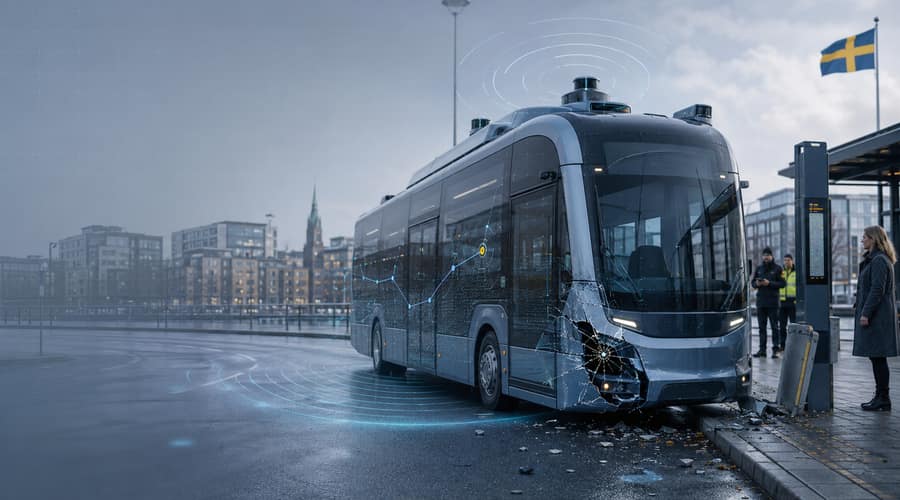
A self-driving bus in Gothenburg was hit by a tram on its first day carrying passengers, turning a local trial into a wider warning for autonomous transit.
The promise of autonomous public transport is simple: safer streets, lower operating costs and more frequent service without adding more drivers. Gothenburg just offered a reminder that the hard part is not making a vehicle move by itself. The hard part is making it behave predictably in the middle of a living city.
On Monday, May 25, a self-driving bus operating in central Gothenburg braked and was struck from behind by a tram. No injuries were reported, but Västtrafik, the regional public transport operator, took the vehicle out of service for inspection. That is a small operational pause for one bus, but a larger reputational problem for a technology that depends heavily on public trust.
According to Reuters, the vehicle was made by Turkish manufacturer Karsan and had started carrying paying passengers just about an hour before the collision. Other reports from Swedish media said the bus had been running without passengers since late March, which makes the timing uncomfortable for everyone involved. Testing had happened. Permission had been granted. A safety driver was on board. Then the first public service still produced the exact kind of incident that municipal buyers and regulators worry about.
The bus was not some small campus shuttle tucked away from city traffic. It was part of Västtrafik's Gårda autonom project, running as line 169 in Gothenburg. The Karsan Autonomous e-ATAK, automated with ADASTEC software, has been described by the companies involved as a Level 4 automated bus designed to operate on open public roads. The route links the central station area with Liseberg Station and passes through a busy urban district with intersections, tram lanes, pedestrian crossings and regular traffic.
That matters because the economics of autonomous buses only become interesting when they work in places like this. A fixed route is easier than a robotaxi roaming an entire city, but it is still not simple. Trams follow rails, buses stop suddenly, cyclists appear at awkward angles and human drivers make decisions that are obvious to other humans only because they are used to the local rhythm. A system can pass a defined approval process and still meet situations that are technically legal but operationally messy.
In this case, the available reports point to the tram hitting the bus from behind after the bus braked. That does not automatically mean the autonomous system caused the crash. It does make one question more urgent: will other road users understand how an automated bus behaves, especially if it brakes more conservatively than a human driver would? Safety is not only about whether the bus can detect danger. It is also about whether its behavior fits the traffic around it.
The rear warning sign shown in Swedish media reportedly told drivers to keep their distance because the bus may brake sharply. That is a practical admission of a real deployment challenge. If the vehicle needs surrounding traffic to adapt to its caution, cities need to decide whether they are introducing a transport service or asking the street to absorb a new kind of risk.
Why founders and investors should pay attention
For entrepreneurs in autonomous mobility, the Gothenburg crash is not a reason to write off the sector. It is a reason to be more precise about what is being sold. The customer is not just buying autonomy. A city is buying uptime, liability clarity, passenger confidence, insurance coverage, maintenance discipline and political calm. One highly visible incident can weaken all of those at once.
That is especially important in Europe, where autonomous public transport is still moving through tightly controlled local trials rather than broad commercial approval. The Swedish Transport Agency had allowed passengers on the Gothenburg trial, which was scheduled to run until July 31, 2027, according to reports from The Local and AFP. That kind of permission is valuable, but it is not the same as market acceptance. Regulators can approve a pilot. Passengers, unions, insurers and city councils have to live with the consequences.
Insurance is one of the less glamorous parts of this market, but it may become one of the most important. Public transit incidents create complicated questions even when nobody is hurt. Was the bus software too cautious, or was the tram following too closely? Did the safety driver have enough time and information to intervene? Did the operating company, vehicle maker, software supplier or city infrastructure play the decisive role? The fewer real-world miles the industry has, the harder it is for underwriters to price that chain of responsibility.
Municipal procurement teams will also be watching. Cities do not buy buses the way consumers buy gadgets. They buy them through long cycles, public budgets and risk committees. A self-driving bus that saves money on paper can become less attractive if it requires extra supervision, slower rollouts, more public communication and higher insurance premiums. The technology has to beat the existing system after all those costs are counted.
There is still a strong case for automation in public transport. Driver shortages are real in many markets, electric buses are becoming more common and fixed-route services are a logical place to test autonomy. But the winning companies will be the ones that treat deployment as a civic operating problem, not just a software milestone. Gothenburg's incident was low harm. That is fortunate. It was also high signal. The next phase for autonomous buses will be judged less by launch announcements and more by how quietly they handle the ordinary chaos of city streets.
Also read: NuExtract3 gives startups a smaller path to document AI • TSMC workers are testing the price of the AI chip boom • SoftBank is turning AI euphoria into retail debt capital