
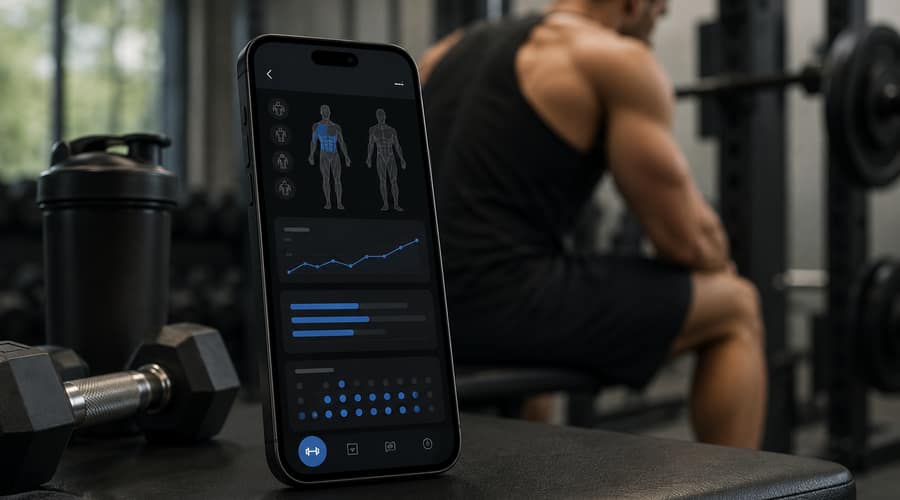
FitLogX is a privacy-first fitness app built for serious gym-goers who want to log workouts and track progress without subscriptions, ads, or giving up their data.
Most fitness apps make a familiar bargain: use the app for free, give up your data, and brace for the moment a subscription paywall appears between you and your own workout history. Andreas Gregoriou built FitLogX because he got tired of that deal.
Gregoriou is a software engineer and lifter who wanted something straightforward, a place to log sets, track progress, and understand what is actually happening with his training over time, without background data collection or a monthly fee waiting around the corner. When he could not find an app that matched that brief without compromise, he built one himself.
FitLogX launched on Android in May 2026, which makes this less a mature platform story than an early look at a product trying to win a very specific corner of the fitness market. AppAgg's store tracking lists FitLogX Tracker as released on May 12, 2026 and updated on May 23, 2026, with the app currently available free on Android.
The pitch is deliberately simple. The app is free, carries no ads, requires no account, and stores workout information locally on the user's device. According to FitLogX's own privacy policy, the current public version does not upload workout data to the developer's servers and does not require a name, email address, or account registration.
The core of the app is workout logging. Users can create routines, log exercises with sets, reps, and weight, and track performance over time. That sounds basic until you consider how many fitness apps have buried basic logging inside social feeds, coaching upsells, streak mechanics, or premium tiers. FitLogX is built around what a lifter actually does during a session, not around turning every workout into another engagement loop.
Beyond logging, FitLogX includes progress views for strength trends and routine planning for structured training. Its store listing points to upper and lower body splits, pre-selected programs, and common compound lifts such as bench press, squats, deadlifts, pull-ups, and rows. That matters because serious gym users tend to care less about generic motivation and more about whether the app helps them see progression clearly.
The offline-first approach is the most meaningful product choice here. Gym basements, crowded commercial facilities, and patchy mobile coverage are not edge cases. They are normal training conditions. A workout tracker that keeps working without an internet connection removes a small but real source of friction, especially for users who do not want their training log tied to cloud sync or an account system.
There is one important caveat. Some third-party listings mention Google Drive backup, while FitLogX's privacy policy says a Google Drive backup option may appear in settings as a planned future feature but is disabled in the current public version. That distinction is worth making because privacy-focused apps live or die on trust. If backup becomes active later, users will want clear controls and plain language around what leaves the device.
FitLogX sits in a crowded category. Strong, Hevy, JEFIT, FitNotes, and a long list of newer workout logs already serve lifters with different combinations of tracking, sync, analytics, and subscriptions. FitLogX is not trying to beat every one of them on feature count. Its argument is narrower: some users would rather keep a clean local record than rent access to an increasingly complicated fitness platform.
That narrowness may be the point. The best early audience for FitLogX is not the casual user looking for meal plans, coaching, or wearable integrations. It is the lifter who already knows their program, trains consistently, and wants a private log that opens quickly between sets. For that person, fewer features can feel like better design.
For now, FitLogX remains Android-only, and its next test is whether a free, privacy-first tracker can keep improving without drifting toward the same monetization model it was built to avoid. The market has plenty of workout apps. What it has less of is software that treats a training history as something the user owns outright.