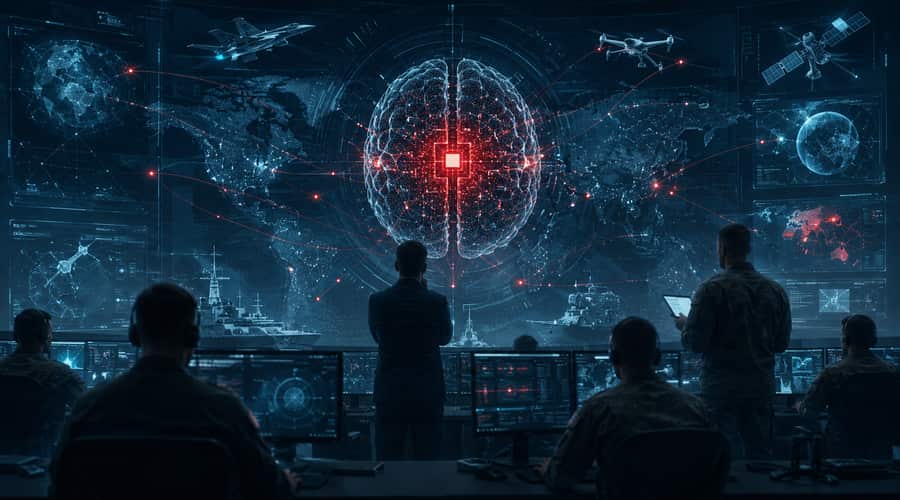
AI is no longer being treated as a distant technology problem. At Singapore's top defense gathering, it has moved into the same strategic conversation as nuclear weapons, cyber conflict and great-power deterrence.
The important story from Singapore is not that military leaders are suddenly interested in artificial intelligence. They have been for years. The change is that AI risk is now being discussed as a central security problem in its own right, not as a software procurement issue or a productivity tool for analysts.
That shift matters because defense policy usually moves slowly until it does not. Nuclear weapons shaped national security thinking for decades because the danger was obvious, concentrated and backed by formal treaties. Advanced AI is different. It spreads through cloud platforms, model APIs, autonomous agents, cyber tools and battlefield systems at the same time. That makes it harder to define, harder to monitor and much harder to contain once governments and private companies start racing each other.
According to Bloomberg reporting around the Singapore defense forum, senior officials have begun framing advanced AI as a more immediate and less manageable concern than older categories of strategic weapons. That does not mean nuclear risk has disappeared. It means policymakers are starting to admit that AI can touch every layer of national security, from intelligence analysis to cyberattacks, drone targeting, disinformation and command decisions under pressure.
The timing is not accidental. The IISS Shangri-La Dialogue runs in Singapore from May 29 to May 31, bringing together defense ministers, military chiefs, diplomats and security officials at a moment when the region is already tense over China, Taiwan, subsea cables, missile programs and conflicts in Europe and the Middle East. Pete Hegseth's closely watched address focused on US military posture in Asia and the balance of power in the Pacific, while other officials warned that trust between states is weakening just as new technologies make escalation faster.
AI fits directly into that anxiety. A nuclear weapon is a known category of danger, even if the politics around it are terrifying. Frontier AI is still changing shape. A model that helps a company write code can also help an attacker scale phishing, scan targets, automate malware testing or generate convincing influence campaigns. A system that helps a military planner process intelligence can also introduce false confidence if it is wrong at the worst possible moment.
Singapore has been moving in that direction already. Earlier this month, its Cyber Security Agency told critical infrastructure operators to review their defenses in light of AI-enabled threats, while telecoms and financial institutions were also pushed to raise their cyber posture. Coordinating Minister for National Security K. Shanmugam warned that the country needs a whole-of-country response. That is the right framing. AI risk is not just a defense ministry problem, and it is not just a technology ministry problem.
For companies building and deploying models, this is where the commercial conversation starts to change. Enterprise buyers care about compliance, privacy and reliability. Defense officials care about adversaries, escalation and loss of control. Those are not the same questions. A model can pass a corporate security review and still raise serious concerns if it is being adapted for military use, cyber operations or crisis decision-making.
AI Labs Are Being Pulled Into Security Policy
The pressure on AI developers is already visible. The Pentagon has expanded access to advanced AI tools on classified networks through agreements involving companies including Nvidia, Microsoft, Amazon Web Services, OpenAI, Google, SpaceX and Reflection AI. That tells us defense demand is not theoretical. Governments want the capability, and they want it inside sensitive systems where speed and access matter.
At the same time, the clash between the Pentagon and Anthropic earlier this year showed how uncomfortable this market can become. Anthropic has built much of its public identity around AI safety, but defense officials pushed back against restrictions that they viewed as operationally limiting. The dispute exposed a larger problem for the industry: if a frontier AI company sells to governments, it may be asked to support use cases that do not fit cleanly inside its public safety principles.
This is the business risk hiding inside the policy debate. AI labs are no longer just competing for developers, cloud customers and enterprise contracts. They are being asked to define their role in national security. Some will lean in, especially where defense contracts are large and strategically useful. Others will try to draw sharper boundaries around surveillance, autonomous weapons and nuclear decision support. Either path carries consequences.
The hardest part is that governments are not moving together. The US, China, Singapore, the EU and other major players all talk about AI safety, but the rules remain fragmented. The US and China have discussed guardrails around AI and nuclear command decisions, and earlier commitments between major powers emphasized human control over nuclear launch decisions. But those statements are not the same as a durable enforcement system. They are signals, not a working regime.
That is why Singapore is important. It is a venue where defense officials can talk plainly outside the formal treaty machinery, and it sits at the center of a region where US-China competition is felt every day. But there is no sign yet that this week's forum has produced binding AI commitments. For now, the most meaningful development is the change in language. AI has moved from the innovation agenda to the threat agenda.
Investors and founders should pay attention to that change. The next phase of AI regulation will not only come from privacy officials or competition authorities. It will come from defense departments, intelligence agencies and critical infrastructure regulators that see model capability as a strategic risk. The companies that understand this early will build stronger governance before they are forced to. The companies that treat it as a public relations problem may find themselves explaining their systems to people who think in terms of national survival.
Also read: GitHub is making Copilot costs harder for founders to ignore • Huawei says US chip controls helped China build faster • Nvidia is bringing its AI chip fight to Windows PCs next week