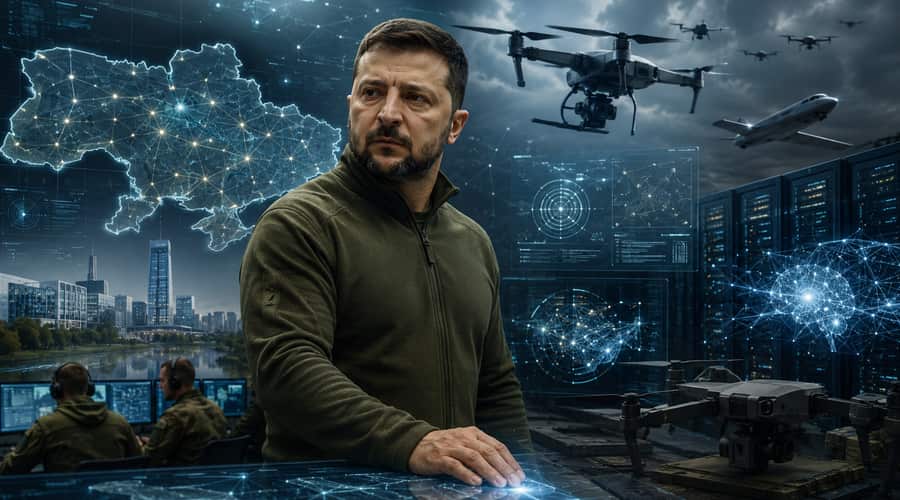
Ukraine is offering Silicon Valley something defense startups cannot easily buy: battlefield feedback in real time. Zelenskyy wants American AI companies to bring the software, while Ukraine brings the war-tested drone experience.
Volodymyr Zelenskyy is making a direct pitch to the part of Silicon Valley that has stopped pretending defense is someone else's business. Ukraine has spent more than four years turning cheap drones, electronic warfare and battlefield improvisation into a core part of modern war. Now its president wants that experience paired with American artificial intelligence.
In a CBS News Face the Nation interview aired on May 31, Zelenskyy said American technology companies have AI capabilities Ukraine does not, while Ukraine has battlefield knowledge those companies do not. That is the trade. Not a loose partnership, not a conference talking point, but a practical exchange between software builders and soldiers who have learned what survives under Russian jamming, artillery and air attacks.
As Business Insider reported after the interview, Zelenskyy's message to U.S. defense startups was blunt: Ukraine is ready to move from discussion to action. That matters because the war has become one of the world's most demanding laboratories for drones, counter-drone systems, autonomous targeting support and electronic warfare. A product that works on a test range in California can fail quickly near the front line in Ukraine.
The attraction for startups is easy to understand. Defense technology companies need feedback, and Ukraine can provide it at a speed peacetime procurement systems rarely allow. A drone can be tested, jammed, damaged, adapted and returned to the field in cycles that look more like software iteration than traditional military acquisition.
Ukraine has already built formal channels for this. Its Brave1 defense technology cluster launched the Test in Ukraine platform in 2025, giving foreign companies a way to trial drones, ground robots, naval drones, AI tools and electronic warfare systems in real combat or near-combat conditions. Ukraine's Ministry of Digital Transformation described the program as a route for international developers to test systems in conditions no laboratory can truly recreate.
That is not just a selling line. Reports from Ukraine have shown foreign companies using the program to test and refine systems after discovering that battlefield conditions were harsher than expected. Hardware has to survive mud, battery limits, signal loss, heat, shock and Russian electronic warfare. Software has to help operators without slowing them down. In war, clever technology that is too fragile is not clever for long.
For Silicon Valley's defense sector, this is a rare opportunity and a serious warning. Companies such as Anduril and Shield AI have already helped make autonomy, sensors and uncrewed systems central to the new defense conversation in the United States. But Ukraine's experience suggests the winners will not be the companies with the sleekest demos. They will be the ones whose systems keep working when GPS is unreliable, communications are contested and operators have seconds to make decisions.
The AI race is moving into defense
The timing is important. The U.S. AI boom has pushed enormous capital into chips, cloud infrastructure and model development. At the same time, the Pentagon is under pressure to move faster on autonomous systems, cheaper weapons and software-defined capabilities. Ukraine sits at the center of those two forces because it has shown how low-cost systems can change the economics of war.
A $500 drone forcing a far more expensive air defense response is not just a battlefield anecdote. It is a procurement problem. It asks whether old defense budgets are prepared for a world where volume, adaptability and software updates matter as much as exquisite platforms. That is why Ukraine's pitch is so powerful. It is not asking Silicon Valley to imagine future warfare. It is offering access to the present version.
The hard part is that AI in war is not a normal startup market. Every advance raises questions about accountability, escalation and human control. Tools that help identify targets, guide drones or resist jamming may save Ukrainian lives, but they also push militaries closer to a world where machine speed shapes battlefield decisions. Investors may see a growth market. Governments have to see the policy burden that comes with it.
Still, Ukraine has little reason to wait. Russia continues to adapt, and drone warfare has already become a contest of software, supply chains and constant redesign. If Ukraine can deepen ties with American AI companies, it may gain better tools for navigation, detection, coordination and defense against mass drone attacks. If those companies learn from Ukraine, they may build products that are far more useful than anything developed in isolation.
The market implication is clear. Defense AI is moving from promise to field pressure, and Ukraine is becoming one of the places where that pressure is most visible. The next phase will not be judged by pitch decks or valuation rounds. It will be judged by what can be deployed quickly, updated constantly and trusted when the battlefield does not cooperate.
Also read: Erin Brockovich says data center secrecy is fueling a backlash • Europe wants access to Anthropic's Mythos before AI risk widens • AI borrowing is starting to reshape the global bond market