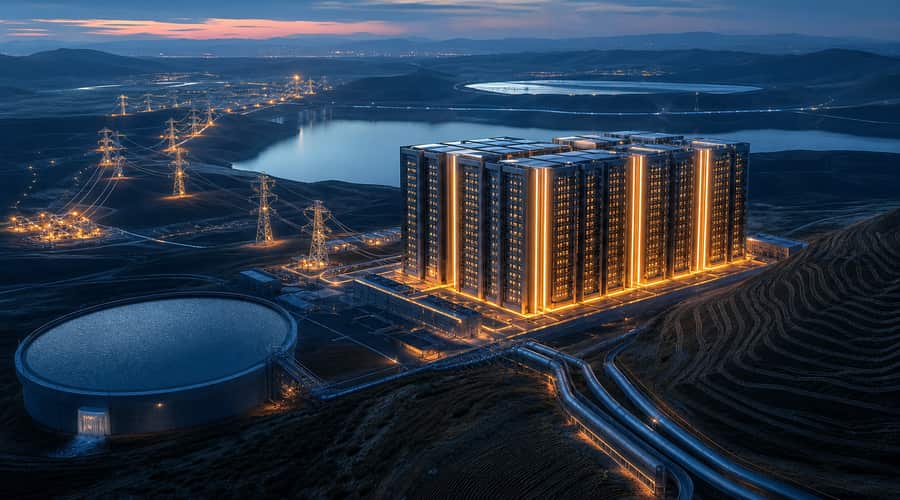
AI’s environmental footprint is no longer a vague concern about future servers. It is already large enough to compare with major economies, and the next fight will be over power, water and disclosure.
The AI boom has spent the past two years being measured in GPUs, model releases and capital budgets. A new United Nations University report makes the same boom look very different. It puts data centers beside countries, not companies, and that changes the conversation fast.
According to AP’s report on the United Nations University Institute for Water, Environment and Health study released on June 3, global data centers used 448 terawatt-hours of electricity last year, more than all but 10 countries. That power use produced about 208 million U.S. tons of carbon dioxide, or 189 million metric tons, roughly comparable to Argentina. Producing the electricity also consumed about 1.2 trillion gallons of water, around 4.5 trillion liters.
Those numbers matter because AI infrastructure is moving from a finance story to a resource story. Investors can still talk about Nvidia chips, hyperscaler capex and cloud margins, but the constraint that decides the next phase may be whether a project can get power, water, transmission capacity and local approval at the same time.
The report projects that data center electricity demand could roughly double by 2030. Reuters put the 2030 estimate at 945 terawatt-hours, while AP’s account of the report cited 935 terawatt-hours, with both pointing to nearly 3% of projected global electricity use. Either figure puts the industry close to the annual power consumption of a large industrial economy.
AI is not the whole data center market, but it is becoming a much larger part of it. The study says AI accounts for about 20% of data center energy use today and could reach 40% by 2030. That is the real shift. Traditional cloud growth was already heavy, but generative AI adds dense server racks, high utilization, more cooling needs and a product model where every user prompt creates a small but repeated physical cost.
This is also why efficiency alone will not settle the issue. Better chips and cooling systems can reduce the cost of each query, but if cheaper inference makes companies put AI into every search box, support desk, office tool and video workflow, total demand can still rise. The technology can become cleaner per action and larger in aggregate at the same time.
For startups, that distinction is not academic. A founder building on large models may never see the power plant or the cooling system behind an API call, but they will see the bill. If utilities charge more for new capacity, if grid interconnection takes longer, or if regulators force more detailed environmental reporting, those costs will move through cloud contracts and inference pricing.
Disclosure becomes part of the moat
The companies that can prove where their electricity comes from, how much water their facilities use and how they manage local impact will have an advantage. That applies to Amazon Web Services, Microsoft Azure and Google Cloud, but it also applies to neocloud providers selling access to specialized AI compute. Cheap GPUs are less attractive if the provider cannot explain the environmental and permitting risk around the facilities running them.
There is already pressure in that direction. Investors have pushed large technology companies for more site-specific data center disclosures on power and water use, and local governments are asking harder questions before approving new campuses. The United Nations report adds weight because it frames the issue across carbon, water, land, e-waste and environmental justice, not just electricity.
That broader accounting could change how AI customers choose infrastructure. A bank, hospital or consumer brand using AI at scale may eventually need to know not just whether a model is accurate and affordable, but whether the compute behind it creates reporting exposure. In sectors where sustainability claims are regulated or closely watched, invisible infrastructure is becoming a weak answer.
The water question is especially difficult because it is local. A terawatt-hour is easy to compare across countries. Water stress is not. A data center in a wet, cool region with low-carbon power has a different impact from one built in a dry region where cooling and electricity generation compete with households, farms and existing industry. The same AI workload can carry a very different footprint depending on where it runs.
That is why the next layer of AI competition may look surprisingly unglamorous. It will involve power purchase agreements, cooling design, wastewater rules, grid queues, substations, land use and community negotiations. These are not side issues. They are becoming the operating system for the AI economy.
The practical takeaway is simple. AI companies that treat environmental accounting as compliance work will be late. The ones that treat it as infrastructure strategy can win permits faster, reassure customers sooner and defend margins better when resource costs rise. The model race is still real, but the companies that can run intelligence responsibly at scale may end up with the stronger business.
Also read: Google makes Gemma 4 12B a local AI bet for startups • Amazon is putting AI images inside shopping search suggestions • Lila Sciences is testing how much investors will pay for automated labs