AI infrastructure is no longer just a power story. Water is becoming a harder constraint for data centers, investors and the cities asked to host them.
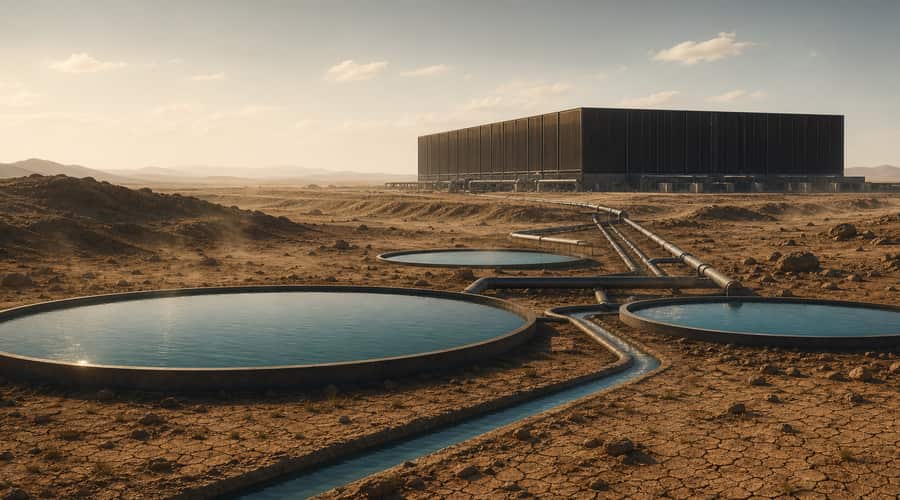
The AI buildout has been sold as a race for chips, land and electricity. Now another scarce input is moving to the center of the conversation: water. A new United Nations University report warns that data centers supporting artificial intelligence could more than double their water and energy footprint by 2030, putting the industry on a collision course with cities, farmers and regulators in places already under stress.
That matters because the physical side of AI is getting bigger faster than most planning systems were built to handle. The models may live in the cloud, but the cloud still sits on land, plugs into a grid and often depends on cooling systems that draw heavily on local water supplies. For entrepreneurs, infrastructure investors and anyone watching the next leg of AI spending, the question is no longer only whether demand will keep rising. It is whether the places chosen for that demand can actually support it.
According to reporting from the Associated Press on the United Nations University findings, global data centers used 448 terawatt-hours of electricity last year, more than all but 10 countries, and producing that energy consumed about 4.5 trillion liters of water. By 2030, the report projects data center electricity use at roughly 935 terawatt-hours. Spanish newspaper El Pais reported the same study as finding that AI-related water consumption by 2030 could equal the basic domestic water needs of 1.3 billion people in Sub-Saharan Africa.
Those numbers are not just environmental talking points. They are operating assumptions. If a data center cannot get reliable water access, its cooling strategy becomes more expensive. If a county starts questioning whether a project will compete with residents during a dry year, the permitting timeline changes. If water is underpriced today but politically sensitive tomorrow, the cost model becomes less stable than the spreadsheet suggests.
For the past two years, most of the AI infrastructure debate has centered on electricity. That made sense. Training and running large models requires enormous computing capacity, and that has pushed cloud companies into power purchase agreements, utility negotiations and grid upgrade discussions. But energy and water are tied together more closely than many investors like to admit.
Data centers use water directly in cooling, especially where evaporative systems help keep servers from overheating. They also use it indirectly when electricity generation consumes water upstream. That means a supposedly clean operating profile can look different once the full footprint is counted. The United Nations University report makes that point clearly: the AI stack is not only software and servers, it is also cooling, power generation, land use, hardware supply chains and waste.
The most exposed geographies are the obvious ones. Hot and dry regions can be attractive for land, tax incentives and proximity to fast-growing markets, but they are also where water politics can turn quickly. Parts of Arizona and Texas have already become central to the U.S. data center map. Spain has drawn attention for projects in Aragon. India and Indonesia are also seeing hyperscale interest while dealing with local water constraints in some regions. None of these markets is automatically off limits, but the diligence bar is rising.
Investors need to price the local risk
The investment angle is straightforward. AI demand may still be strong, but not every data center site deserves the same valuation. A campus in a region with abundant reclaimed water, cooler temperatures and a cooperative utility is not the same asset as one that depends on scarce freshwater in a drought-prone county. The market tends to compress those differences when growth is exciting. It separates them when bottlenecks appear.
That has implications for data center REITs such as Equinix and Digital Realty, as well as private infrastructure funds buying land, substations and powered shells around the AI boom. The old checklist focused heavily on fiber, power availability, tax treatment and customer demand. Those still matter. But water sourcing, discharge rules, cooling technology and community acceptance now have to sit beside them.
Hyperscalers also face a reputational problem. Amazon, Microsoft and Google have all made water and sustainability commitments while continuing to expand the physical footprint needed for AI services. That tension does not mean their projects stop. It means local governments are more likely to ask for site-specific disclosures, and shareholders are more likely to push for clearer reporting on water and power use. When infrastructure becomes visible to households through bills, restrictions or construction fights, the politics change.
The practical response is not to pretend AI growth can happen without resources. It cannot. The better answer is to push new projects toward less water-intensive cooling, recycled or non-potable sources, better heat management and locations where public systems can handle the load. Some of this will cost more upfront. That is the point. Cheap sites are not cheap if they carry hidden permitting risk.
For startups building around AI, the lesson is narrower but important. Infrastructure is part of the product now, even if someone else owns the building. If model costs rise because data center operators face higher cooling, power or compliance costs, those costs eventually move through the stack. They show up in cloud pricing, capacity limits and vendor negotiations.
The next phase of AI will not be decided only by who has the best model or the most GPUs. It will also be shaped by counties, utilities and water managers who decide what can be built, where and on what terms. Investors who understand that early will ask better questions. Everyone else may discover that the cloud has a local address after all.
Also read: Google makes Gemma 4 12B a local AI bet for startups • SpaceX is testing the public market price of frontier ambition • Uber cuts its HR ranks as tech chases leaner operations