
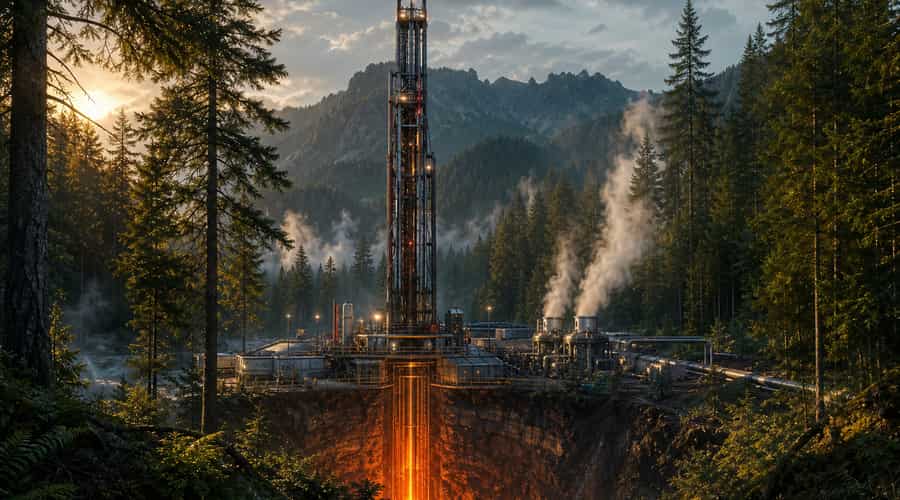
Quaise Energy just raised $134 million to prove superhot geothermal can move from a Texas granite test to a power plant in Oregon.
You've heard the AI power crunch story by now. Data centers eating gigawatts. Utilities scrambling. Nuclear plants getting a second life. Quaise Energy, a startup spun out of MIT, is chasing a different fix: skip the fuel entirely and drill down to heat that's already there.
On July 7, Quaise announced the first close of a $134 million Series B, led by Prelude Ventures with strategic backing from JERA and Idemitsu, two of Japan's largest energy companies, according to a release distributed on Businesswire. The round brings Quaise's total funding to roughly $230 million. More capital, both equity and debt, is expected to close soon.
How the drill works
What sets Quaise apart from the wave of geothermal startups chasing the same headline is how it drills. Conventional rigs grind through rock with a rotating steel bit, and that bit wears out fast once it hits granite miles down. Quaise's rig doesn't grind. It vaporizes rock with millimeter-wave energy, a technology born in MIT's plasma physics labs. No bit means no wear.
The company is chasing rock at 300 to 500 degrees Celsius, temperatures that typically sit beyond 5 kilometers underground. At that heat, geothermal steam carries a power density that starts to compete with nuclear, without fuel rods, waste casks, or the same kind of political fight that follows reactors into nearly every local hearing.
This isn't a slide deck. In 2025, Quaise drilled more than 100 meters through granite at its field site in Central Texas, the first time the technology had punched through basement rock at full field scale, the company says. That's real rock, not a lab bench. It's now closing in on a full kilometer there, which would be the deepest hole ever bored by millimeter-wave drilling, and by any non-contact drilling method, period.
Who's paying for it
The new money funds Project Obsidian, Quaise's push to build the world's first commercial superhot geothermal plant. It sits on federal geothermal leases in Oregon's Deschutes National Forest, land studied by geologists for decades. That's federal land, not a startup's back lot. The first phase targets about 50 megawatts of always-on power, scaling toward 250 megawatts as more wells come online, with gigawatt potential further out. First power to the grid is due by 2030.
Look at who's actually writing these checks. JERA is Japan's largest power generator, a joint venture of Tokyo Electric and Chubu Electric. Idemitsu is one of the country's biggest oil refiners, hunting for a second act as fuel margins shrink. Neither is a software VC chasing a multiple. They're energy incumbents that need baseload power they can build themselves, and Quaise is offering them a drill bit instead of a pitch deck.
That's the real story underneath the megawatt figures. AI has made electricity the scarcest input in tech, and hyperscalers from Microsoft to Amazon are shopping for generation that can run all day without waiting years for a grid queue to clear. Nuclear restarts get the headlines, Constellation's Three Mile Island deal with Microsoft chief among them. Geothermal gets less attention. It doesn't need a fuel cycle. It doesn't ask a town to host a reactor.
None of that makes the drilling easy. Reaching five kilometers into superhot rock at commercial scale is a problem nobody has solved yet, Quaise included. A kilometer through Texas granite is real progress. It is not five kilometers of Oregon basement rock, and that gap is where this bet gets decided.
Frankly, the next four years will tell you whether this works. If Quaise hits its depth targets on schedule, it will have done something no drilling company has ever done, backed by two Japanese energy giants who put real money on it. If it doesn't, 2030 starts looking a lot further away than a press release makes it sound.
Also read: Vendelux Raises 50 Million Dollars to Prove Trade Shows Actually Work • Re-Q Gives Every Audio Output Its Own EQ Instead of Forcing One Sound Everywhere • Hostie raises $12 million to bet restaurants will trust AI with the phone

