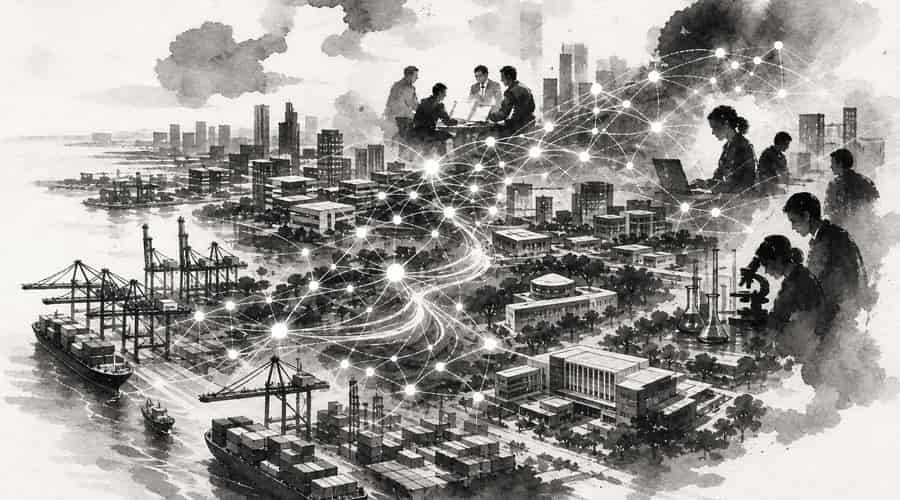
Anthropic is the latest frontier AI company looking at Singapore, and the timing matters. The city is turning AI ambition into a practical operating base for labs, enterprise teams and government-backed deployment.
Anthropic is not just another company opening a regional desk. The maker of Claude is looking to build a Singapore presence at a moment when the country has become one of the most crowded meeting points for global artificial intelligence firms, enterprise buyers and public-sector AI programmes.
The Straits Times reported on June 4 that Anthropic is looking to set up shop in Singapore and fill roles ranging from finance to product support. Its own hiring pages point in the same direction, with Singapore-based roles including product support specialists and finance and strategy for go-to-market work across ASEAN. That matters because these are not only research jobs. They are the jobs that usually appear when a company expects real customers, real revenue and real operational complexity in a market.
Singapore has spent years trying to make itself useful to the AI economy, but the recent pace has sharpened. OpenAI, Nvidia and KPMG have all announced or expanded AI initiatives in the country in the past few weeks, while Google DeepMind opened its Singapore research lab late last year. The government says more than 70 AI Centres of Excellence have now been set up in Singapore. That is no small number for a market of Singapore's size. It suggests the country is becoming less of a showcase venue and more of a deployment layer for global AI.
OpenAI made the biggest recent splash in May with a multiyear partnership committing more than S$300 million to Singapore and the launch of its first Applied AI Lab outside the United States. The lab is aimed at applied adoption, talent development and public access to AI tools, which tells you where the opportunity sits. This is not only about building bigger models. It is about getting those models into finance, healthcare, public services and digital infrastructure without breaking trust along the way.
Google DeepMind had already moved in that direction when it opened a Singapore research lab for Asia-Pacific in November 2025. Its Singapore work includes multilingual AI projects and multimodal research, which is exactly the kind of problem a region as diverse as Asia forces companies to confront. A model that performs well in English-language benchmarks still has work to do when users, laws, business customs and languages shift across borders.
Nvidia's role is different, but just as important. Singapore officials said at ATxSummit 2026 that Nvidia would launch an AI research lab in the country focused on embodied and efficient AI. That puts infrastructure, robotics and physical-world deployment closer to the centre of the story. If the first wave of generative AI was about chatbots and code assistants, the next wave is increasingly about agents, machines and systems that operate in messy business environments.
KPMG's move adds another layer. On May 25, KPMG launched a Trusted AI Centre of Excellence in Singapore, supported by the Economic Development Board. The firm says the centre is built around a Singapore-based team of AI and software engineers, solution architects, data analysts, product managers, business analysts and designers. That is a very consulting-shaped signal, but it is still meaningful. Most companies do not fail at AI because they lack access to a model. They fail because their data, governance, workflows and people are not ready.
Singapore is selling trust as much as talent
Singapore's pitch is not that it can outspend the United States or China on frontier model training. It cannot. Its pitch is that it can be a trusted place to build, test and deploy AI in sectors where mistakes are costly. Finance, logistics, healthcare, aviation and public services all fit that pattern. They need productivity gains, but they also need accountability.
That is why the number of AI Centres of Excellence matters. In her ATxSummit opening address, Digital Development and Information Minister Josephine Teo said Singapore had 70 AI Centres of Excellence and described the current strategy as a deeper push rather than a reset. The language is important. Singapore is trying to move from pilots to use cases that hold up under regulation, customer scrutiny and commercial pressure.
Anthropic fits neatly into that environment. The company has built its brand around safety, enterprise use and Claude's usefulness in complex work. A Singapore presence gives it a route into Southeast Asian customers and regulated industries, while also putting it near a government that has been unusually active in shaping AI adoption. For Anthropic, the attraction is not only local demand. It is the chance to prove Claude can work across a region where companies want practical AI but are cautious about risk.
There is also a competitive reason to move now. OpenAI already has a Singapore office and is putting serious money behind applied AI there. Google DeepMind has a research base. Nvidia is anchoring infrastructure and robotics work. KPMG, Sea and other major firms are building enterprise AI capability on the ground. If Anthropic waits too long, it risks letting rivals define the standards, partnerships and customer relationships that matter in the region.
The larger lesson is straightforward. AI leadership is no longer measured only by who has the strongest model release. It is also measured by who can bring that technology into banks, hospitals, manufacturers, schools and government agencies in a way people will actually trust. Singapore is betting that this is where it can win. Anthropic's move suggests the frontier labs are starting to agree.
What comes next is worth watching closely. If these centres become hiring hubs and product labs rather than ceremonial announcements, Singapore could become one of the most important AI deployment markets in Asia. If they remain showcases, the advantage will fade quickly. For now, the direction is clear: the AI race is moving closer to the customer, and Singapore has made itself hard to ignore.
Also read: AI data centers are turning electricity into the next growth constraint • Netflix is making AI search its next streaming advantage • Anthropic turns its safety reputation into enterprise leverage