Barcelona's THEKER has raised $85 million in Europe's largest-ever robotics Series A, with Samsung and LVMH writing their first checks into Spanish startups and existing backer Inditex doubling down on the robots it already uses.
The round closed this week, led by CRV in one of the American firm's first Spanish investments, with Samsung, LVMH, Cathay Innovation, 20VC, Henkel Ventures, and Mercadona joining alongside existing investors Inditex and Kibo Ventures. THEKER was founded in Barcelona in 2022 by Jiaqiang Ye Zhu and Carla Gómez Cano, two engineers who met building and competing with robots at the Polytechnic University of Catalonia, where they ran the university's robotics association PUCRA. As Tech.eu reported on June 11, the company has now gone from Spain's largest seed round to Europe's largest robotics Series A in under a year.
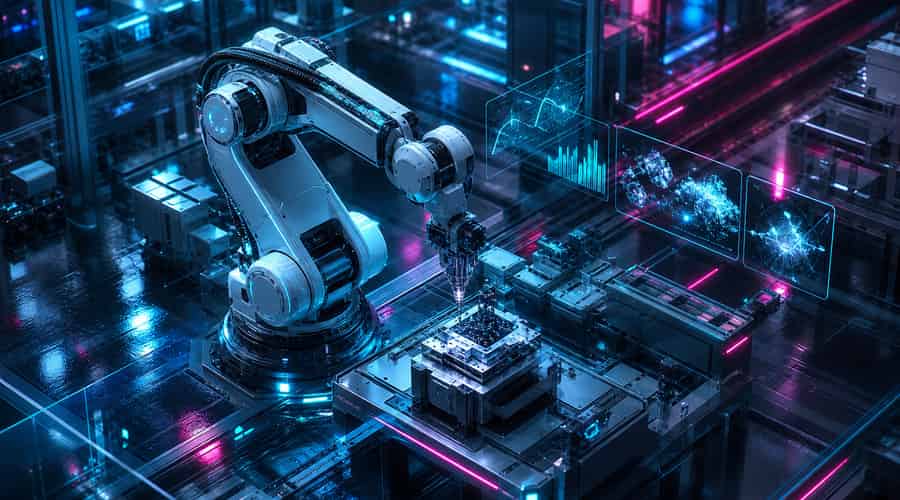
The case THEKER makes is straightforward, and it cuts directly against the model that has governed industrial robotics for decades. Traditional factory robots are rigid and task-specific: program one to weld a particular joint, and that is all it does. Changing the job means weeks of downtime, expensive integration engineers, and manual reprogramming that smaller manufacturers rarely budget for. THEKER's robots integrate advanced vision systems, control hardware, and large language models to operate without pre-programmed instructions, adapting in real time to mixed SKUs, irregular shapes, and variable workflows. They deploy in days. The commercial argument is not that THEKER makes a better version of the old robot. It is that the old model is the wrong model.
Inditex, the Zara parent and one of the world's largest fashion retailers, validated that argument at production scale. The company backed THEKER at seed stage and used its robots in high-variability logistics operations, exactly the environments where rigid automation breaks down. A fashion supply chain runs on constant variability: seasonal collections, returns, mixed-size shipments. If THEKER's robots handle that, they handle most things. Inditex continuing as an investor in this round is a different kind of endorsement than a check from a VC who saw a demo.
Samsung's participation is worth examining closely. It marks the company's first-ever investment in a Spanish startup, and it is not a passive financial bet. Samsung runs consumer electronics and semiconductor manufacturing operations that face the same automation bottleneck THEKER addresses: factories that are difficult to staff, expensive to reconfigure, and increasingly dependent on processes too variable for task-specific robots to handle. LVMH, whose production network mixes handcraft with high-volume repetitive tasks in packaging and logistics, has a parallel interest. Both companies coming to Barcelona for their first Spanish investment, at this round size, is not coincidence. They are buying proximity to technology they intend to use.
CRV leading from the United States adds a dimension that goes beyond THEKER specifically. US venture capital has historically stayed close to home for hardware-intensive bets, where cost structures are harder to manage at distance. A US firm anchoring Europe's largest robotics Series A reflects something shifting in where the physical AI investment thesis is pointing. Large language models and vision models have absorbed investment capital for four years, but the real commercial deployment surface for AI is in the physical world, in the warehouses and factories and logistics networks that process actual goods. That is where THEKER operates, and that is where the money is now moving.
The legacy players in industrial robotics, FANUC, KUKA, ABB, built the dominant model and built it well. But the economic case for task-specific robots weakens every year that labour costs rise and production variability increases. THEKER's proposition does not require a manufacturer to overhaul the floor. Deploy into one workflow, prove the value, and expand from there. That incremental entry point matters as much as the underlying technology in converting manufacturers who have run the same automation stack for twenty years.
From a university robotics club in Catalonia to a company Samsung thinks is worth a first Spanish bet. The factories will decide whether the technology holds up at scale, but the capital says the question is now serious.
Also read: PIMCO declares AI has crossed a macroeconomic threshold while warning the credit loss cycle has already begun • Gopuff chose Grok over OpenAI and Anthropic, and said the cost was the reason • Adobe's record AI results could not outrun its growing leadership vacuum