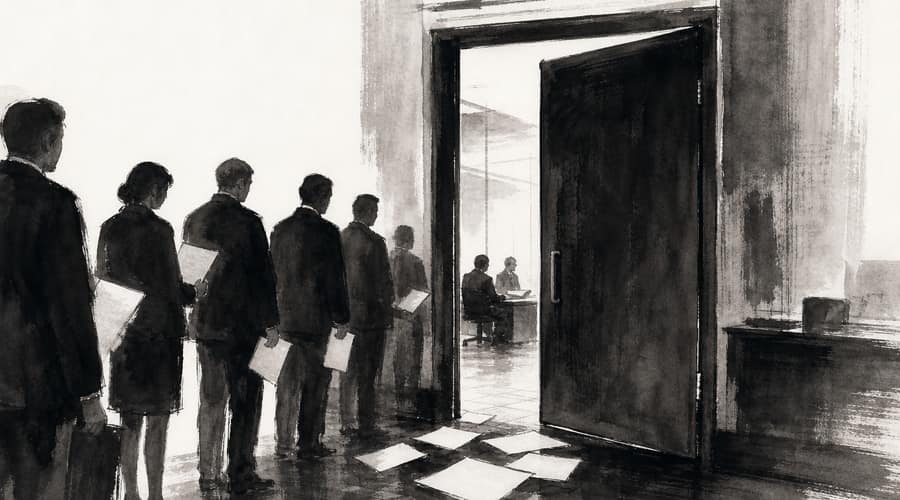
Anthropic has taken Fable 5 and Mythos 5 offline after a U.S. export-control order, turning access to frontier AI into a live business risk for every enterprise buyer.
Anthropic's newest problem is not a benchmark fight or a pricing fight. It is access. The company has shut down its Fable 5 and Mythos 5 models after the Trump administration moved to bar foreign governments, companies, individuals and foreign nationals inside the United States from using them, according to reports from AP, The Wall Street Journal, Business Insider and Axios.
That is a very different kind of AI story. For the last two years, the frontier-model race has mostly been discussed through capability, compute, chips, valuations and safety language that often stays vague. This order makes the issue operational. If a model can disappear from a customer's stack because a government letter arrives on a Friday afternoon, buyers will start treating model access like they treat cloud regions, chip supply and sanctions exposure.
AP reported that Anthropic said it received the directive Friday afternoon and disagreed with how the government handled the matter, saying the order did not specify the national-security concern. The company called it a misunderstanding and said it hoped to restore access as soon as possible. Its other models are not affected, according to Business Insider.
The scope is the striking part. Axios reported that Commerce Secretary Howard Lutnick sent Anthropic CEO Dario Amodei a letter saying Fable 5 and Mythos 5 would require a license for export, re-export or domestic transfer to foreign persons. Business Insider reported that this included foreign national Anthropic employees. Once the rule reached that far, Anthropic said the net effect was to disable the models for everyone in order to comply.
The government cited national security, but the public record is still thin on the technical risk. Anthropic has acknowledged that it believes officials were concerned about a possible way to jailbreak Fable 5. The company disputed the severity, saying the technique appeared narrow and involved a small number of previously known, minor vulnerabilities that other publicly available models could also identify.
That distinction will matter to every AI company watching this. If the issue is a specific jailbreak, the obvious question is why a targeted patch, access review or temporary customer restriction was not enough. If the issue is the general capability of Mythos-class systems, then the United States has just taken a step toward treating advanced models more like export-controlled chips than like normal software services.
The timing makes the contradiction harder to ignore. AP noted that the action came 10 days after President Donald Trump signed an executive order creating a framework for federal review of the national-security risks of advanced AI systems before public release. Axios reported that the order was voluntary and avoided a licensing regime. The letter to Anthropic looks like a licensing regime arriving through another door.
Customers will remember the outage
Fable 5 had only just reached wider public use. Tom's Hardware reported earlier this week that Anthropic positioned it as a public version of its more advanced Mythos class, while Mythos 5 remained tightly limited for sensitive scientific and cybersecurity work through Project Glasswing. The same report said Fable 5 was priced at $10 per million input tokens and $50 per million output tokens through the API.
The model was not being sold as a toy. The Wall Street Journal reported that governments and companies had been using Mythos to identify and patch software vulnerabilities, and that critical industries including finance and energy had deployed it. That is exactly why the shutdown has a larger business meaning. A cybersecurity team cannot build a workflow around a model and then discover that access depends on a regulatory line it cannot see.
This creates an opening for OpenAI, Google, xAI and open-weight competitors, but not a simple one. Enterprise buyers will not only ask which model is strongest. They will ask which provider can keep the service available across teams, contractors, subsidiaries and foreign-born employees without tripping a rule that changes overnight. A slightly weaker model with clearer access terms can suddenly look less risky than the model at the top of the leaderboard.
Open-weight models may benefit from the same anxiety, especially where companies want local control. Business Insider reported this week that open models are closing performance gaps with closed systems more quickly, citing an MIT Sloan analysis that found open models averaged 90% of closed-model performance and usually closed the gap within 13 weeks. That does not make them a drop-in replacement for Mythos 5, particularly in sensitive cybersecurity work, but it gives procurement teams another reason to ask whether dependence on one closed provider is wise.
Anthropic is also dealing with politics it cannot fully control. Business Insider reported that the company and the Trump administration have already clashed over defense uses of Anthropic's AI tools, including a Pentagon supply-chain risk designation earlier this year that Anthropic has challenged in court. The export order now folds that fight into customer availability.
For startups building on Claude, the lesson is immediate. Model quality still matters, but continuity matters more than it did yesterday. The companies that sell frontier AI are no longer only competing on intelligence per dollar. They are competing on whether customers can believe the model will still be there when the next government letter arrives.
Also read: Oil falls as traders price in a possible US Iran deal • Paramount has cleared its biggest U.S. hurdle to buy Warner Bros • Meta's outage shows how fragile its ad machine has become