Anduril has plenty of capital and a fast-growing order book. Its next fight is with the export rules that decide where allied weapons can actually be built.
Brian Schimpf is putting a sharper question in front of Washington: if the US wants allies to field more American-designed weapons, why are they still treated mainly as buyers rather than producers?
According to the Financial Times, the Anduril chief executive said America needs an export control reset that lets allied nations help produce US-origin weapons, not only purchase them after a long approval process. The target is ITAR, the International Traffic in Arms Regulations regime built to protect sensitive American military technology. Schimpf's point is not that controls should vanish. It is that drone warfare, autonomous aircraft and commercially derived systems have changed the practical problem. The west does not only need better weapons. It needs more factories able to make them quickly.
That is an uncomfortable argument because Anduril is not a small insurgent begging for attention anymore. The company raised $5 billion in May at a $61 billion valuation, in a round led by Thrive Capital and Andreessen Horowitz, according to the Financial Times and Business Insider. Its 2025 revenue reached $2.2 billion, roughly double the prior year, and the company expects more than $4.3 billion this year. It is still lossmaking, and Schimpf ruled out an IPO this year. That combination says a lot about the defence tech boom: investors have accepted a long spending cycle because the market now looks enormous.
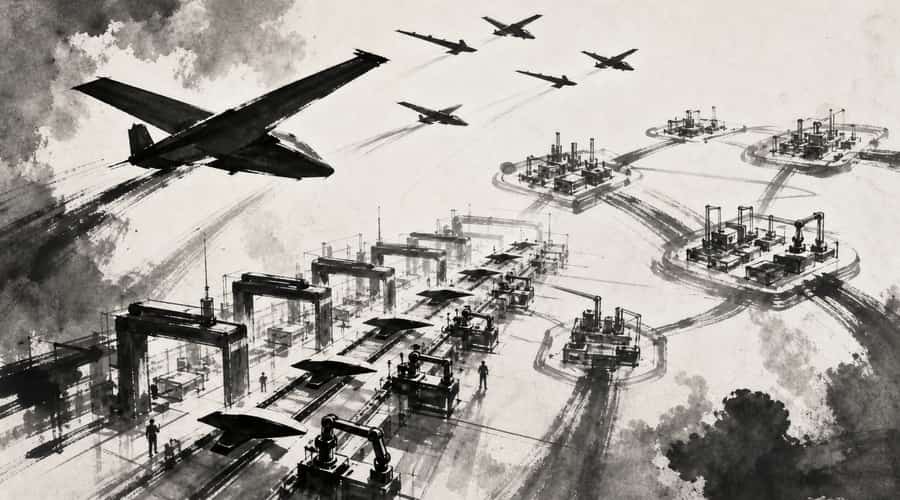
Anduril's argument becomes clearer when you look at Arsenal-1, the 5 million-square-foot facility it is building near Rickenbacker International Airport in Pickaway County, Ohio. Axios reported when the project was announced in January 2025 that the site was meant to produce autonomous vehicles, sensors and weapons at scale. The Associated Press later reported that the project carries a planned July 2026 opening, a 500-acre site, and a promise of about 4,000 jobs.
Those details matter because Anduril's pitch has moved beyond software. Lattice, its AI-enabled command and control system, is still central to the company's identity. Its drones, surveillance towers, Barracuda missile family and Fury autonomous aircraft still carry the story. But the harder test is whether a venture-backed defence company can build industrial capacity fast enough to matter in a conflict where small drones are lost by the thousands and munitions stocks are measured against daily burn rates.
Ukraine has made that point brutally clear. Cheap drones did not replace high-end weapons, but they changed the volume question. A country can have excellent missiles and still struggle if production lines cannot replace what gets fired, jammed, intercepted or destroyed. That is the gap Schimpf is pointing at when he says allied nations should contribute to total supply. A factory in Ohio helps. A network of allied factories would help more, if the law lets the designs, components and technical data move with enough speed.
Europe wants capacity, but not dependence
The European angle is where the politics get harder. The Financial Times reported that Anduril is considering a European Arsenal-2 and already works with Rheinmetall on variants of the Barracuda cruise missile and Fury autonomous air vehicle. That gives the idea a real industrial partner rather than leaving it as a conference-stage slogan.
Still, European governments are not simply waiting for US defence start-ups to arrive with a blueprint. Many are trying to rebuild national industrial bases after years of underinvestment, and the war in Ukraine has made dependence on overseas supply chains feel like a strategic risk. If Anduril wants local production, it will have to fit into that politics. A German or Polish factory producing US-origin autonomous systems would not just be a procurement decision. It would involve jobs, sovereignty, technology transfer and the question of who controls upgrades in a crisis.
President Donald Trump opened part of this debate in February with an America First Arms Transfer Strategy, according to federal records. The direction sounds friendly to faster arms transfers, but speed and control pull against each other. ITAR exists because military technology leaks are not theoretical. At the same time, a rulebook built around Cold War assumptions can look strangely slow when the weapons in question include modular drones, software-defined systems and commercially available components.
Anduril has chosen a good moment to press the issue. Its valuation gives it a louder voice. Its Ohio factory gives it a concrete example. Its Rheinmetall work gives it a European path. But the company's own numbers also raise the stakes. A $61 billion defence start-up with more than $4 billion in expected annual revenue cannot live forever on the idea that the old primes are too slow. It has to prove that its own model can scale through regulation, allies, factories and politics.
This is the real constraint now. Capital has arrived. Software talent has arrived. The open question is whether the US export system can move from guarding every piece of technology as if allies are merely customers, to deciding which systems are common enough, urgent enough and industrially necessary enough to be built with them.
Also read: AI data centers are becoming a 2026 campaign liability • Bill Gates warns Washington is changing the rules for tech • Disney is turning AI coding into an operating discipline