Plaud has turned a $159 recorder into a subscription business with $250 million in recurring revenue, and it did it without venture capital. That is the part of the AI hardware story you should pay attention to.
Bloomberg reported on June 16 that Plaud, the company behind the card-sized PLAUD Note recorder, has passed $250 million in annual recurring revenue and is aiming for $500 million in total 2026 sales. The company has shipped more than 2 million devices, sells in 170 countries, and has not taken venture funding. In a market full of AI startups burning cash to rent attention, Plaud sold people a small object they actually use, then charged them for the software around it.
That sounds simple. It isn't.
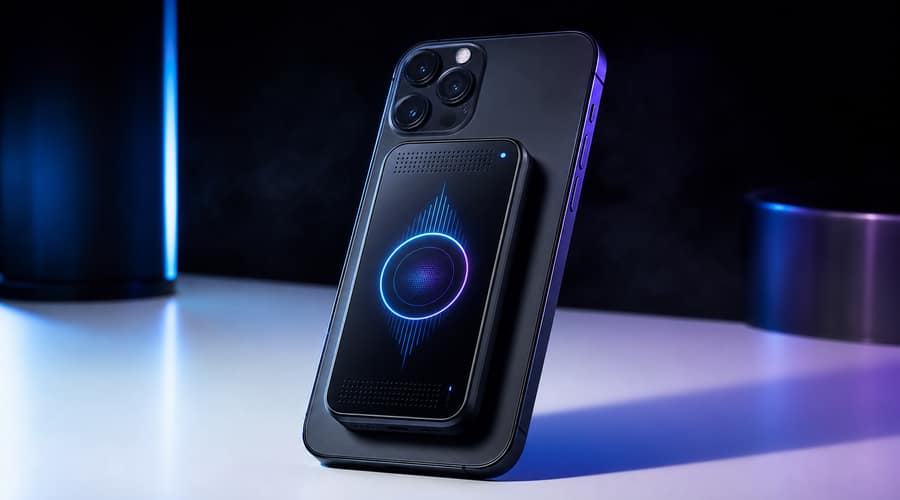
The PLAUD Note is a thin recorder that magnetically attaches to the back of a phone. Press a button, record a meeting or call, and the app produces a transcript and summary. The device starts at $159. The paid plans unlock more recording time and richer AI features. You don't need to admire the hardware business to see the trick here: once the recorder becomes part of your meeting routine, the subscription stops feeling like an add-on and starts feeling like the product.
Most AI software startups today buy growth before they prove habit. Plaud did the less fashionable thing. It sold hardware first, used that cash to fund expansion, and reached profitability without handing over equity. According to Euromonitor data cited by the company, Plaud is now the world's top AI note-taking device brand by volume. That gives Nathan Xu a kind of advantage a pitch deck can't fake: a base of users with the device already sitting on their desk, clipped to their shirt, or stuck to the back of a phone.
The sharper comparison is Limitless. The Financial Times reported in December 2025 that Meta acquired the AI pendant startup, which had raised more than $33 million and was backed by investors including Andreessen Horowitz and Sam Altman. Limitless said it would support existing pendant customers for at least a year but stop selling the product to new buyers. For Plaud, that removed one direct rival from the shelf. It also showed you what the next phase looks like. The serious competition is no longer only another pendant startup. It is Meta, Google, Apple, and OpenAI circling the same ambient AI market.
Look at what those companies want. They want the device that hears the meeting, sees the room, remembers the errand, and gives the AI enough context to be useful before you ask. TechRadar reported in late May that Meta is working on an AI pendant and new smart glasses after buying Limitless. Google used its 2026 developer cycle to push Android XR and smart glasses with Gemini baked in. The Times has reported that OpenAI's work with Jony Ive is aimed at a new screen-free AI device. Plaud is not competing with sleepy incumbents. It is standing in the lane Big Tech has decided it wants.
That makes the $500 million sales target a real test, not a vanity number. Plaud's case is that focused hardware can beat a platform when the job is narrow and annoying enough. Meeting notes are exactly that kind of job. If you've ever left a call with ten action items, three half-remembered promises, and no clean record of who agreed to what, you understand why a dedicated recorder can feel less silly than another AI chatbot tab.
The NotePin S, shown at CES 2026 and priced at $179, is Plaud's attempt to push that habit beyond the phone. The Verge reported that the new wearable keeps the original NotePin shape but adds a physical button, after users complained the older squeeze control could be unreliable. T3 reported that it can record continuously for up to 20 hours, has 64GB of encrypted storage, and syncs through Bluetooth or WiFi. Those are not glamorous details. They matter because this category fails the moment recording feels uncertain. If you don't trust the button, you don't trust the transcript.
The company is also teasing another AI wearable later in 2026, reportedly designed to work with AI agents rather than only transcribe audio. That is the harder jump. A recorder can be judged on whether it captured the meeting. An agent has to decide what to do with it. Frankly, that is where Plaud's discipline will matter more than its current revenue number, because bad agent features can turn a useful device into a noisy one very quickly.
The privacy question sits right beside the growth story. Ambient AI devices work by collecting conversations, and conversations often include people who never bought the gadget. Meta's glasses already face regulatory scrutiny over how captured images and video may be used for AI systems. Plaud can talk about encrypted storage and user control, but trust will be earned in settings far messier than a product demo: doctor's offices, sales calls, classrooms, interviews, and family rooms. If you build a business around remembering everything, you also inherit the burden of explaining what should not be remembered.
What Plaud has proved so far is narrower and more impressive than the usual AI hardware claim. It has not proved that everyone wants an always-on assistant. It has proved that millions of people will pay for a dedicated capture device when the transcript is useful, the battery lasts, and the software saves them from doing work they hate. That is enough for now.
The next question is whether Nathan Xu can keep that focus once Apple, Google, Meta, and OpenAI arrive with bigger ecosystems and subsidized hardware. Plaud has the cleaner product. The platforms have the distribution. You don't need to know the winner yet to see why this story is current: a bootstrapped company has reached the kind of revenue most funded AI startups only put in their forecasts.
Also read: Mobileye bets its sensor stack can make the leap from supplier to robotaxi operator. Bland AI raised $40 million after 180 investors said voice would be dead in a year. Bond markets are absorbing $570 billion in AI debt and nobody knows if the revenue will arrive