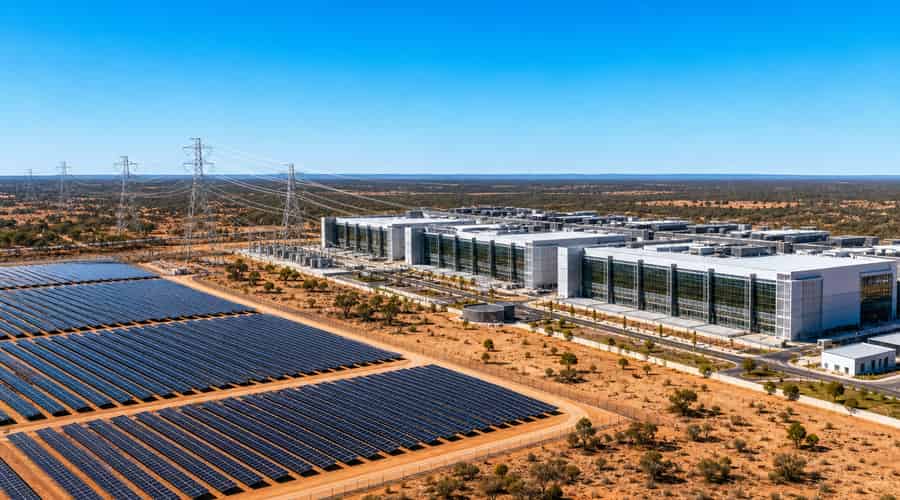
AI infrastructure has moved from the data center into your bond fund, and the repayment math now matters as much as the technology.
The AI buildout was sold as a technology race. It is now a credit story. Morgan Stanley's June 10 forecast puts global debt issuance tied to artificial intelligence on track to reach $570 billion in 2026, after AI-related issuers sold roughly $236 billion of bonds globally by the end of May, about four times the volume from the same period in 2025. That is a lot of faith being written into fixed-income portfolios before the revenue has fully arrived.
The pace has not cooled. Axios reported on June 16 that Nvidia had set out to sell $20 billion in corporate bonds, even though Nvidia is not one of the hyperscalers building the largest data center estates. Goldman Sachs analysts, cited in the same report, said consensus estimates now point to $770 billion of hyperscaler capital expenditure in 2026, roughly equal to their operating cash flow. When companies this profitable still need the bond market to keep the buildout moving, you should pay attention.
Man Group has been making the same point from the credit side. Debt from Amazon, Microsoft, Meta, Alphabet and Oracle now accounts for nearly 4% of the US investment-grade corporate bond index, according to the firm. The broader technology sector is about 10% of the Bloomberg investment-grade corporate bond index, up from 9% in 2024. That sounds small until you remember who owns these bonds. Target-date funds held about $4.8 trillion in assets in 2025, according to Morningstar data cited by MarketWatch, and many of those funds track broad bond benchmarks. If your 401(k) owns a plain bond fund, you may already own a slice of the AI buildout.
That is not automatically reckless. Amazon, Microsoft, Meta and Alphabet still produce enormous cash flows, and investment-grade credit is not the same thing as venture capital. But the bond market is being asked to finance assets whose useful life, energy cost and revenue payback are all moving targets. Power is the awkward part of this story. Data centers need electricity before they need poetry about artificial intelligence, and Man Group's April update warned that power availability and a possible supply glut are becoming harder to ignore.
Credit investors do not get paid for dreams. Equity investors can look at AI and imagine a decade of new software margins. Bondholders get interest payments and their principal back, or they get a problem. Man Group's argument is blunt: spreads are not yet compensating investors for the infrastructure risks underneath the AI trade. Frankly, that is the right way to look at it. The question is not whether AI changes how people work. The question is whether the companies borrowing to build the capacity can earn enough, quickly enough, to service the debt without squeezing everything else.
The risk is sharper outside the largest issuers. Bloomberg data showed that 18 companies raised nearly $13.6 billion from convertible and equity-linked securities through February 18, up more than 556% from the same point in 2025. US convertible issuance reached about $34 billion in the first four months of 2026, more than double the same period a year earlier. These are often smaller AI-adjacent companies that cannot borrow like Microsoft or Alphabet, so they use equity optionality to keep coupon costs down.
That works beautifully while investors want exposure. It becomes much less comfortable when the revenue cycle slows. A convertible bond lets a company borrow more cheaply because investors get the chance to convert into stock later. If the stock falls and the business is still burning cash, the cheap financing starts looking like a temporary discount on a real liability.
The buyers are getting nervous. A Bank of America survey in February found that 23% of bond investors cited an AI bubble as their top risk, up from 9% in December 2024. Bond investors are not usually the loudest people in the room. When nearly a quarter of them name the same risk, and the share more than doubles in two months, it is not market gossip. It is a warning from the part of finance that gets paid to worry first.
The hardest part is the customer chain. Hyperscalers are spending at capital intensity levels of 45% to 57% of revenue, ratios that look more like utilities or heavy industry than the software businesses investors grew used to owning. Some of the biggest buyers of compute, including OpenAI and Anthropic, are still burning capital as they race for scale. Cambridge Associates has flagged the risk plainly: AI infrastructure can become obsolete if the largest buyers of compute miss their own revenue targets.
For startups, the easy-money signal is misleading. Capital is still available, and Bank of America analysts have lifted their 2026 hyperscaler debt forecast to $175 billion from $140 billion. But the terms are starting to show more caution. Spreads on AI-related bonds have widened by as much as 40 basis points relative to the broader investment-grade index since September 2025. That is not a crisis. It is the market asking for a little more protection.
The bond market is not voting on whether AI is useful. It is asking whether the debt stack has been built faster than the cash flows that are supposed to support it. Those are different questions. If you are exposed through a bond fund, a retirement account or a startup that depends on cheap compute, you should care about the second one more than the first.
Also read: Databricks is closing in on Snowflake and the numbers make that case plainly • Asia's chip stocks are beating Nvidia because the real AI bottleneck was never the GPU • OpenAI is asking public investors to fund a company that loses three dollars for every dollar it earns