Australia's Labor government has put AI data centres on notice: if you want the servers, you pay for the power, the grid connection, the water burden, and the rights to the creative work your models train on.
The July 15 announcement is a hard line in a debate most governments have handled with guidelines and careful hedging. Prime Minister Anthony Albanese said large data centres should underwrite new power supply, pay their full share of grid connection costs, and stop costs being passed on to homes or businesses. Worth noting that. He also put the copyright fight in plain language: Australian books, music, art and news aren't up for grabs.
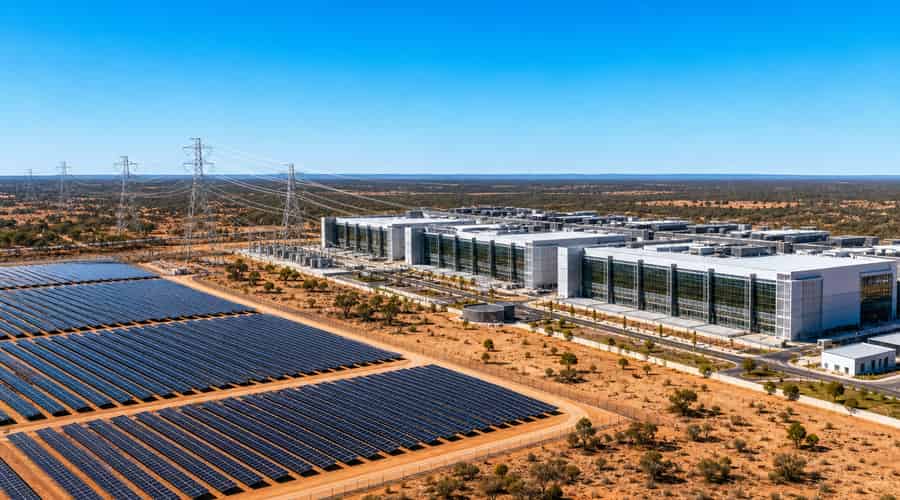
That's the point. AI infrastructure doesn't arrive as a clean abstraction. It arrives as steel, water, transmission lines, planning approvals, energy contracts and copyright claims. If you live near the proposed site, pay a power bill, write songs, publish news or make images for a living, the question isn't whether Australia should be open to AI investment. The question is who carries the cost.
According to the Prime Minister's July 15 media release, the government will introduce Australian Standards for AI, building on its Data Centre Expectations. The rules would legally require large data centres to underwrite their own new power supply, pay connection costs, reduce power use when needed to strengthen the grid, and be as water efficient as possible. The Office of AI was also established inside the Department of Prime Minister and Cabinet, effective the same day.
That is not a small administrative move. It pulls AI policy into the centre of government, where energy, copyright, investment and community planning can no longer be treated as separate conversations.
The copyright fight is harder
The energy rule will cost hyperscalers money. Microsoft, Google, Amazon and colocation operators looking at Australia will have to model generation, grid access and water infrastructure into any serious expansion. That's a real cost. But it's still the part companies know how to price.
Copyright is different. Australia's position is a direct rejection of the carve-out AI companies have been pushing for globally: take the data first, settle the rights problem later if anyone forces the issue. ABC News reported before the speech that Anthropic had argued in a Treasury briefing that negotiating with major rights holders was possible, but licensing the long tail of smaller creators was too difficult. Rights-holder groups rejected that argument, pointing to licensing deals already used in music, news and other sectors.
Good. Difficulty isn't a defence. If an AI company can raise billions of dollars and lease land for data centres, it can also negotiate for the work that makes its product valuable. The music industry has spent decades building licensing machinery. News publishers have been through their own bargaining fights. Authors, artists and performers don't need another lecture about innovation from companies whose models were trained on other people's archives.
This is where the earlier draft had the facts wrong. Scott Farquhar, the Atlassian co-founder and Tech Council of Australia chair, has not been a voice for stronger creator protections. Mediaweek reported in June that Farquhar argued Australia's copyright framework made it effectively impossible for AI developers to operate legally, drawing sharp criticism from APRA AMCOS and ARIA. The Guardian and ABC have also described him as pushing for copyright reform that would make AI training easier, not as a champion of creator control.
So don't put him on the wrong side of the argument. It matters.
The law is still coming
The standards aren't law yet. Albanese said the government would seek agreement from premiers and chief ministers at National Cabinet in August 2026, with legislation expected early in 2027. The government also says the framework will be the first of its kind to be legislated by a government worldwide, which is a narrower and more careful claim than saying Australia already has mandatory standards in force.
That distinction matters because this is where lobbying does its work. A pledge in July can become a softer bill in February. A clear copyright principle - one that looked non-negotiable in the original announcement - can quietly turn into a permit scheme that lets companies self-certify and move on. Watch for that. If you want to understand whether Australia has really changed the terms of AI investment, don't just read the speech. Read the bill when it lands.
There is already pressure from more than one side. ABC Four Corners reported in June that the federal government had been accused of retreating from consumer-facing AI regulation as US tech companies planned Australian investments. On July 20, ministers separately announced AI consumer safety priorities covering young people, workers, discrimination, deepfakes and misinformation. That tells you the July 15 package doesn't settle the whole AI safety question. It doesn't pretend to.
Still, on the specific terrain of physical AI infrastructure, Australia has put down a serious marker. Data centres can no longer be sold only as jobs, investment and national capability. They also draw power, use water, need transmission capacity and rely on creative work their owners often didn't make.
Frankly, the creator rule is the test. Energy costs can be financed, grid connections negotiated. But if the final law still says Australian creators must have real control before their work is used to train commercial AI systems, then Australia will have given other governments something concrete to copy. If that clause gets watered down, the rest starts to look like infrastructure policy dressed up as an AI settlement.
Also read: Meta AI arrives in Threads DMs for half a billion users as the inbox becomes its new battleground • Dario Amodei says he doesn't want open-weight AI banned but fears what China just released for free • The EPA just gave AI data centers a pollution exemption that may not survive a courtroom