Christophe Fouquet has confirmed direct talks with Elon Musk about Terafab, but the real story is not Musk's ambition. It is whether ASML has enough machines to sell.
There is one company every advanced AI chip plan eventually runs through, and it isn't Nvidia. It is ASML, the Dutch lithography company whose extreme ultraviolet machines sit at the narrowest point of the semiconductor supply chain. If you want the most advanced chips, you need the tools that print them, and ASML is the only company selling EUV systems at commercial scale.
That is why Christophe Fouquet's comments about Elon Musk matter. Reuters reported on May 20, 2026, that the ASML chief executive had spoken directly with Musk about Terafab, the proposed semiconductor project tied to SpaceX in Grimes County, Texas, and said Musk was "very serious" about it. Fouquet also made the more important point: new projects are an opportunity only if ASML is not short on supply.
That is not a throwaway line. It is the ceiling over the whole AI buildout.
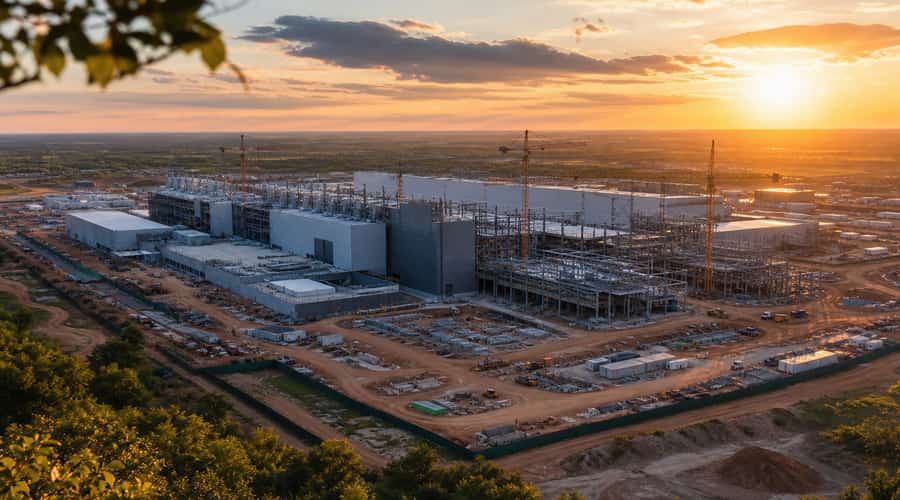
Terafab is not a normal factory proposal. CNBC reported in May that documents filed in Texas described an initial $55 billion semiconductor facility, with later phases that could take the total investment far higher. The filing placed the project in Grimes County, a rural area northwest of Houston, and linked it to SpaceX's push to secure more control over the chips needed for satellites, robotics, vehicles and AI systems. Intel has also been reported as a manufacturing partner in the plan.
Look at the timing and the problem becomes obvious. Every large chip buyer wants the same thing at once. TSMC is expanding in Arizona while pushing ahead with advanced nodes in Taiwan. Samsung is fighting to keep its foundry business relevant at 2nm. Intel is trying to prove that its next process roadmaps can win back customers instead of just promising they will. Musk entering that queue with a project measured in tens of billions of dollars does not create new lithography capacity by itself. It creates another claim on machines that were already spoken for.
ASML's own numbers show why Fouquet is being careful. The company reported first-quarter 2026 net sales of 8.8 billion euros and said it expected full-year 2026 sales between 36 billion and 40 billion euros, according to its April results. That is strong demand by any normal standard. But EUV is not software. You don't add a few engineers and double output by the next quarter.
Each EUV system is a factory-sized object with a long supplier chain behind it. ASML has described its most advanced machines as highly complex systems built from tens of thousands of parts, shipped in large numbers of containers and assembled across months, not days. High-NA EUV, the newer generation Intel has been first to install, is even harder to scale. That is the part investors need to pay attention to. Demand can move with a press release. Supply moves with mirrors, lasers, precision stages and suppliers that have to hit tolerances most industries never touch.
Terafab also arrives in a market where the first places in line already belong to companies with years of orders, roadmaps and supplier relationships behind them. TSMC, Samsung and Intel are not casual buyers. They are ASML's core advanced-node customers, and their schedules underpin everything from Apple chips to Nvidia accelerators. If Terafab becomes real construction rather than a filing and a conversation, ASML has to decide how much room it can give Musk without disappointing customers who have been planning around EUV allocations for years.
Frankly, the chip industry would be foolish to dismiss Musk outright. Starlink proved he can turn a hardware-heavy infrastructure idea into a deployed network at a scale skeptics underestimated. Tesla did the same with charging infrastructure when much of the auto industry was still treating electric vehicles as a side project. But "very serious" is not the same as financed, permitted, staffed, equipped and producing wafers on schedule.
That distinction is the story.
The easy version is to call Terafab another sign that the AI infrastructure boom has no upper limit. The harder version is that the boom now depends on a handful of companies that cannot magically expand. ASML benefits from every new megafab on paper, but only if it can actually deliver the machines. Otherwise, the opportunity becomes an allocation fight, and allocation fights decide which chip roadmaps slip.
Fouquet did not need to attack the project to make the point. He only had to name the constraint. In an industry that often talks as if capital can buy time, ASML is a reminder that some bottlenecks are physical. A fab without lithography tools is just a very expensive building in Texas.
Also read: Canada's pension giant bets $741 million on India's data center boom as US and European pipelines stall • DeepL buys Mixhalo's voice technology and cuts 250 jobs on the same day • Uber, Lucid, and Nuro pick Houston as their second robotaxi city and set a mid-2027 launch date