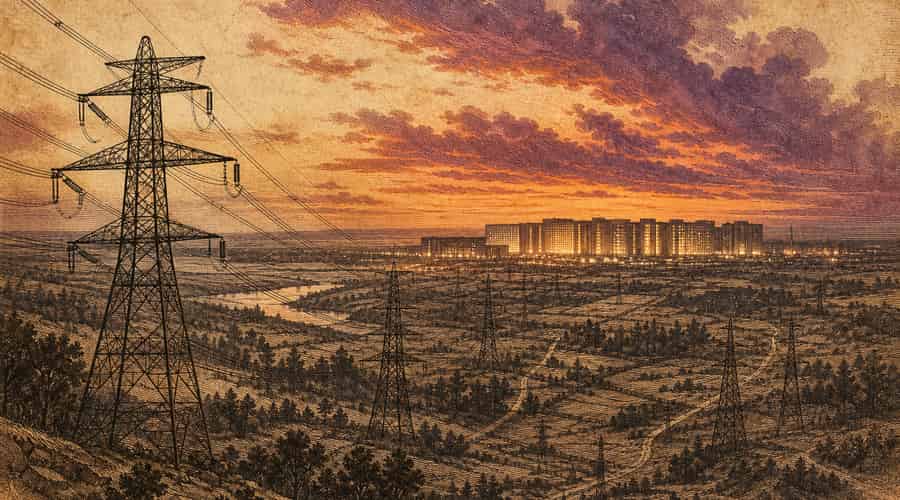
NextEra Energy's planned Dominion deal is not a side story to the AI boom. If you want to understand who profits when data centers need power, you have to look past the chip rack and down to the grid.
The cleanest way to read NextEra Energy's proposed Dominion Energy deal is this: AI companies can buy GPUs, leases and fiber, but they can't run a data center on a press release. They need electricity in the places where the servers actually sit. Dominion gives NextEra a direct claim on one of the most important of those places, Northern Virginia.
NextEra and Dominion announced the all-stock deal on May 18. The companies put the equity value at about $67 billion, and several reports described the combined business as the world's largest regulated utility by market value if regulators let it close. The Guardian reported that the combined company would serve around 10 million utility customer accounts across Florida, Virginia, North Carolina and South Carolina. Axios reported that it would own 110 gigawatts of generation capacity.
Those are not decorative numbers. They explain why a utility merger now belongs in the same conversation as cloud capex. Dominion's Virginia business serves the area around Northern Virginia, the densest data center market in the world. If you are Amazon, Microsoft, Alphabet or Meta, the hard part is no longer only getting enough chips. It is getting enough powered land, enough transmission and enough reliable supply for facilities that cannot blink off when demand spikes.
That is the point investors keep underpricing. NextEra is not suddenly a software company, and pretending it is one would be silly. It is still a regulated utility with commissions, allowed returns, rate cases and political risk. But the customer demand landing on the grid is now being driven by the biggest technology capital cycle in modern business. You don't have to call that a tech stock to see the exposure.
Look at the spending behind it. Business Insider reported in February that Amazon, Alphabet, Microsoft and Meta were preparing more than $600 billion in 2026 capital expenditures, much of it tied to data centers and AI infrastructure. Amazon's planned capex was put at $200 billion, while Alphabet was aiming for $175 billion to $185 billion at the time. MarketWatch later reported that Alphabet raised its 2026 capex guidance to $180 billion to $190 billion. These companies are not waiting for perfect returns on AI before they build. They are building first, then fighting over returns later.
Someone still has to wire the buildings.
That is why the NextEra and Dominion combination is more than a conventional scale deal. The Wall Street Journal reported that NextEra CEO John Ketchum told analysts the combined company would have a 130-gigawatt pipeline of large prospective customers, roughly three times New York's installed generation capacity. That is the line in the story you should sit with. It tells you the deal is being sold not only as a utility consolidation, but as an answer to a physical bottleneck in the AI economy.
There is a price to that ambition. The transaction still needs shareholder and regulatory approvals, and utility mergers do not move at the speed of cloud spending. State commissions will care about bills, reliability, local control and whether data center demand pushes costs onto ordinary customers. The Guardian noted that the companies proposed $2.25 billion in bill credits over two years after closing, which tells you the affordability argument has already begun.
Frankly, that fight is where the story gets more interesting. AI boosters talk about model capability and chip supply. Households talk about power bills. Those two conversations are now colliding inside the same grid. If a hyperscaler wants a giant campus in Virginia, the utility has to build for it, but voters still notice when monthly bills rise. A regulated utility can be a gateway to AI infrastructure, but it also has to survive public utility politics.
NextEra's bet is that scale wins that argument. It already owns Florida Power and Light, one of the largest electric utilities in the United States, and NextEra Energy Resources has long been a major player in renewables and storage. Dominion brings the Virginia data center load, plus regulated operations in the Carolinas. Put together, the company would sit across states where population growth, industrial demand and AI infrastructure are all pulling on the same system.
That does not make the deal automatically smart. Big infrastructure cycles have a way of attracting confident projections just before costs, delays and politics start chewing through them. AI workloads may become more efficient. Regulators may push back harder than investors expect. Customers may ask why data center growth should be allowed to dictate the pace of grid expansion in their communities.
Still, the strategic point is hard to dismiss. If you believe AI demand keeps rising, you cannot stop your analysis at Nvidia, cloud providers and model labs. Power is not a background service here. It is the constraint that decides where capacity can actually be built.
NextEra is trying to own more of that constraint. Regulators now get to decide whether it can.
Also read: OVHcloud is training frontier AI models and the Anthropic export ban just made its pitch a lot easier • Swiss AI startup Prem is raising $100 million as Anthropic's export ban makes on-premise infrastructure look essential • Dream raises $260 million at a $3 billion valuation as sovereign cybersecurity AI hardens into its own asset class