OpenAI's Pentagon deal after Anthropic's Washington fight was never just a contract story. It showed you how quickly AI safety principles get tested when the federal government becomes the customer everyone wants.
The timing is still the part you can't ignore. In late February 2026, Defense Secretary Pete Hegseth gave Anthropic a deadline to drop limits on domestic mass surveillance and fully autonomous weapons. Anthropic refused. The Associated Press reported on February 27 that President Trump ordered federal agencies to stop using Anthropic technology after the clash, with a six-month phase-out. The next morning, OpenAI announced its own agreement with the Department of Defense.
That is a hard sequence to dress up. Anthropic held the line on contract language. OpenAI moved into the space that opened. Sam Altman said two of OpenAI's core safety principles were prohibitions on domestic mass surveillance and human responsibility for the use of force, including autonomous weapon systems. Those were close to the same red lines Anthropic had been pressing. So either the Pentagon could live with those limits after all, or it was more willing to hear them from OpenAI than from Dario Amodei's company. Neither version makes Washington look especially principled.
The legal record has already made the government's position look weaker. The Guardian reported in March that U.S. District Judge Rita Lin temporarily blocked the Pentagon's punitive measures against Anthropic, saying the department's conduct appeared likely unlawful and arbitrary. Anthropic's lawsuit argues that the designation was retaliation and violated its First Amendment rights. You don't have to love every Anthropic safety argument to see the problem here. If a federal agency can turn a contract dispute into a supply-chain scarlet letter, every AI vendor now knows what disagreement can cost.
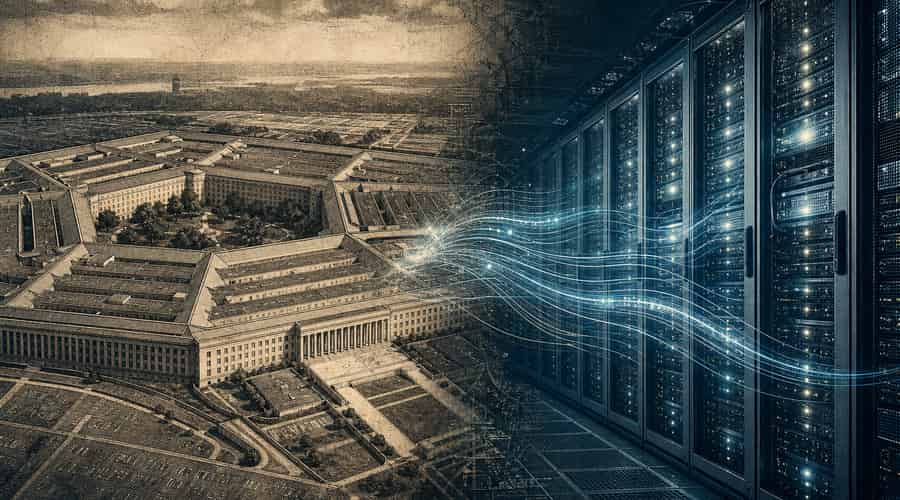
Then came May 1. The Guardian reported that the Pentagon reached classified AI agreements with SpaceX, OpenAI, Google, Nvidia, Reflection, Microsoft, Oracle and Amazon Web Services. The companies agreed to let the military deploy their technology for "any lawful use," according to the Pentagon. Anthropic was not on the list.
That list matters because it is becoming the approved lane for defense AI. It is not a leaderboard of model quality. It is a map of companies Washington is comfortable bringing onto classified networks. Google, Microsoft, AWS and Oracle have spent years building that comfort through cloud contracts, certifications and lobbying. OpenAI got there fast, but it still understood the basic rule: the Pentagon buys trust before it buys benchmarks.
Frankly, that is the part founders should pay attention to. Government customers do not behave like enterprise software buyers testing three demos and picking the cleanest dashboard. They care about control, procurement history, security posture, political reliability and whether a company will become a public headache. Anthropic tried to negotiate from a principle. OpenAI negotiated from access.
The story did not stop in February, which is why the article is still current. In June, Anthropic's Fable 5 and Mythos 5 models became the center of another Washington fight. The Verge reported that on June 12 the Trump administration ordered Anthropic to suspend access to the models for foreign nationals, after concerns that Fable 5 could be jailbroken. Anthropic took the models offline more broadly while it dealt with the order. The Guardian's Bruce Schneier noted that Fable launched on June 9 as a constrained version of the more powerful Mythos model. The same company Washington punished for refusing certain military uses was now being treated as dangerous because its newest models were too capable.
There is irony in that, but there is also a warning. Anthropic is not outside government work. Its Claude Gov models were already aimed at national security customers, and Project Glasswing gave selected partners access to Mythos for cybersecurity work. The cleaner fact is more awkward: Washington is not rejecting powerful AI. It is deciding which firms get to provide it, on what terms, and with how much obedience built into the relationship.
Cohere has been quick to understand the opening. The Financial Times reported in April that Cohere agreed to acquire Germany's Aleph Alpha in a deal valuing the combined company at about $20 billion, with support from the German and Canadian governments and a $600 million funding round led by Schwarz Group. That is not just startup finance. It is sovereign AI becoming a procurement category. If you are a government worried about U.S. export controls, Trump administration pressure or dependence on a handful of American cloud vendors, a Canada-Germany AI stack starts to look less like a nice alternative and more like insurance.
Cohere still has to prove the window is durable. It is not in the Pentagon's classified AI group, and Anthropic's court fight may restore some of what February took away. But Cohere and Aleph Alpha are selling a different promise: local control, friendly governments and fewer surprises from Washington. In 2026, that is a real product feature.
The OpenAI-Pentagon deal was not simply opportunistic. It was a lesson in how the next AI market will be sorted. The companies that win federal contracts will still need strong models, but strong models alone will not carry them. They will need the patience to become trusted infrastructure and the appetite to work inside political constraints. Anthropic found out what happens when you push back. OpenAI found out what happens when you arrive at the right door one morning later.
Also read: The Anthropic blackout showed every AI startup what export control authority over models actually looks like • Enterprise AI budgets hit a wall and the reckoning is reshaping how companies spend and how founders pitch • Old EV batteries are quietly becoming the cheapest way to power AI data centers