Dubai Holding's interest in Hscale is not a stray data center bet. It's another move by Gulf capital to buy the AI economy's physical bottleneck while Europe is still struggling to build it.
Dubai Holding is looking at Hscale because the scarce asset in AI is no longer just the model or the chip. It's the permitted site, the power contract and the grid connection. Bloomberg reported on June 24 that Dubai's government-owned investment company is working with an adviser as it weighs a stake in Hscale, the hyperscale data center platform majority owned by Bain Capital. The talks are early. No stake size has been disclosed. But you don't need the final term sheet to see the point.
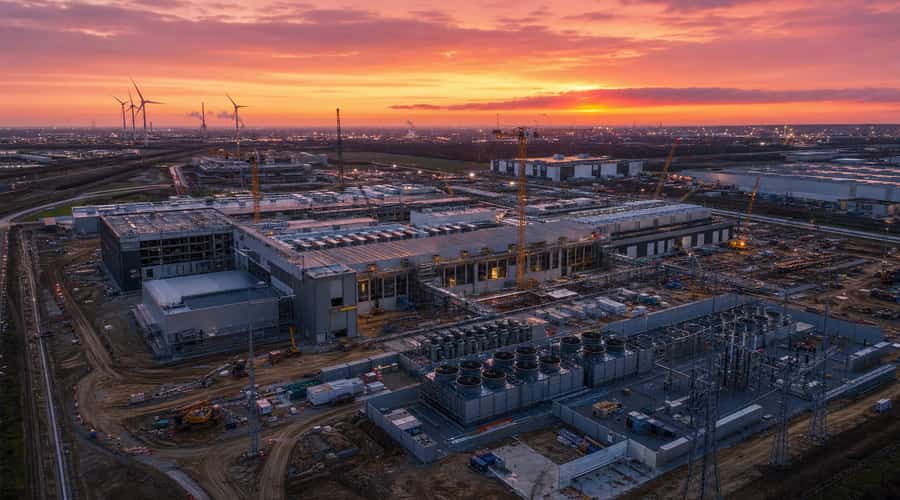
Hscale was launched in May 2025 as an 80/20 joint venture between Bain Capital and Aquila Group, after Bain bought AQ Compute, Aquila's data center business, in October 2024. Oliver Schiebel, formerly of Mainova Webhouse, runs the platform. Hscale says it has a 1GW pipeline across Norway, Spain, Germany, Switzerland and Dubai. The biggest named project is a €2 billion Milan campus targeting 250MW. In Oslo, OSL1 has 6MW live and another 12MW under construction. In Barcelona, BCN1 has 10MW under construction and 50MW planned. Madrid has 192MW in development.
That's why this story matters. This isn't a press release about wanting to be part of AI. These are actual locations, actual megawatts and actual years of permitting work that a new entrant can't simply buy off the shelf tomorrow.
The Gulf pattern is already clear. Axios reported this week that MGX, the Abu Dhabi AI investment firm launched by Mubadala and G42 in 2024, raised roughly $50 billion for AI and technology investments. In October 2025, a consortium tied to BlackRock's Global Infrastructure Partners, MGX and other backers agreed to buy Aligned Data Centers from Macquarie Asset Management in a $40 billion deal. The UAE has also been discussing a 5GW AI campus with the US, involving G42 and American technology companies. According to Global SWF, sovereign investors put $66 billion into AI and digitalization last year, with Middle East funds leading the field.
Dubai Holding moving toward Hscale fits that record, but with a sharper European angle. A stake would give Dubai exposure to an operating platform in markets where power, land and permits are getting harder to secure. You can talk all day about AI strategy, but the cloud provider still needs a campus with enough electricity to run the machines. Frankly, that is where a lot of the real leverage now sits.
Europe is awkward, which is exactly why Hscale is interesting. Demand from hyperscalers is rising, but new data center projects run into local planning rules, grid queues and political resistance over power use. Hscale's spread across Scandinavia, Iberia, Germany and Switzerland is not random. Norway brings hydropower. Spain brings large sites and renewable supply. Germany and Switzerland bring enterprise demand and proximity to customers who don't want all their compute sitting in northern Virginia or Texas.
Power is the asset
The old way to read a data center deal was to look at the real estate. That misses the better question. Who has power, who has permits, and who is already far enough along that a hyperscaler can sign a serious lease?
Hscale has an advantage because Aquila Clean Energy sits close to the platform as its renewable energy supplier. That doesn't make every project easy. Nothing about European grid access is easy. But it does mean the platform was built around the constraint that now defines the sector. AI servers need electricity in quantities that turn ordinary development delays into strategic problems.
Sovereign investors are well suited to this kind of asset. A government-backed investor can sit through construction, wait for a campus to fill and hold through ten or fifteen year customer agreements. A conventional fund often has to think harder about exit timing. That patience changes the price a buyer is willing to pay before the platform is fully mature.
Dubai also has its own reason to look outward. The emirate has been pushing itself as a regional AI and technology hub, with Dubai AI Campus saying it has attracted more than 400 companies. A European Hscale stake would give Dubai Holding something different from local branding: a financial claim on the infrastructure that European AI users may need before they can scale.
The deal may still fail. Early talks often collapse once valuation becomes real, and Bain controls 80% of Hscale, so it doesn't look like a forced seller. But if Dubai Holding wants this exposure, it will probably have to pay for it. The cheap moment in AI infrastructure passed once everyone learned that chips are useless without somewhere powered to put them.
Also read: Figma turns its design canvas into a coding environment at Config 2026 • Meta is the last major AI lab standing outside the White House's voluntary review program and the gap is closing fast • The AI model that broke into NSA systems is now the one the NSA cannot use