
AI revenue has finally cleared the industry's depreciation bill for a second straight quarter. That's real progress, but you shouldn't confuse it with proof that the whole buildout now pays for itself.
For two years the central question hanging over the trillion-dollar AI buildout wasn't whether the technology worked. It was whether anyone could pay for it. Bloomberg reported on Wednesday, citing research from Exponential View, that global AI revenue outside China reached $25 billion in the first quarter of 2026, above roughly $21 billion in estimated annualized depreciation tied to chips and data centers.
That is the industry's cleanest answer so far.
Call it a milestone if you want. Don't call it victory. Depreciation alone still eats more than two-thirds of that $25 billion, and depreciation is the kindest cost line in this argument. It doesn't include power, engineers, leases, financing costs, grid upgrades, or the painful delay between ordering hardware and earning money from it. Clear that hurdle and you've shown the machines are no longer pure promise. You haven't shown the business is throwing off cash.
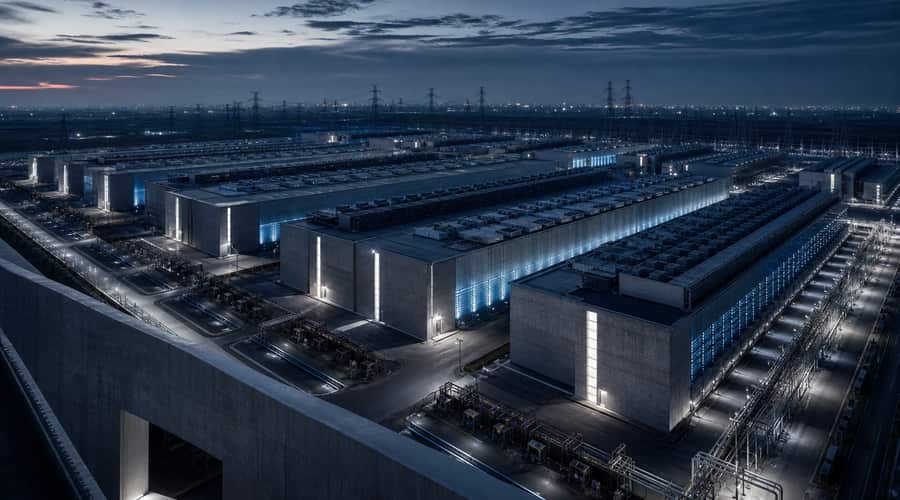
The size of the bet is the problem. Tom's Hardware, drawing on Financial Times data from first-quarter earnings, reported that Microsoft, Amazon, Alphabet, and Meta are on track to spend about $725 billion in capital expenditure in 2026, up 77% from last year's $410 billion. Boards don't approve figures like that because a chatbot writes a decent email. They do it because the cost of missing the AI infrastructure cycle now looks more frightening than the cost of carrying too much debt.
The new revenue figure gives those boards something better to say on earnings calls. Meta has lifted its 2026 capex guidance to $125 billion to $145 billion, after citing higher data center and component costs. Amazon has told investors it plans about $200 billion in capital expenditure this year. Microsoft and Alphabet are also spending at a scale that would have looked absurd before the AI boom made server farms, chips, memory, and power contracts the new strategic weapons.
You can see why the bulls have been waiting for this number. A $25 billion quarter outside China is not a demo, a pilot, or a founder's forecast. It is revenue. It suggests that cloud inference, API access, AI software subscriptions, and enterprise tools with AI features are growing fast enough to cover the most visible wear and tear on the infrastructure behind them. That matters because it moves the debate away from whether there is demand at all. There is.
Frankly, that still leaves a lot of room for the skeptics.
Goldman Sachs has projected that AI spending by Meta, Microsoft, Amazon, and Alphabet could reach $5.3 trillion by 2030, according to Business Insider. The International Monetary Fund has also warned this year about systemic risks from AI-linked financial structures and AI-enabled cyber threats. The warning isn't just about science fiction risk. It is about concentration, circular financing, debt, shared infrastructure, and the possibility that one failure travels through the same small group of companies financing and supplying the boom.
The productivity evidence is no kinder. A National Bureau of Economic Research working paper published in February surveyed nearly 6,000 executives and found that roughly 89% of firms reported no productivity impact from AI over the previous three years, while 90% reported no employment impact. Those same firms still expected AI to lift productivity by about 1.4% over the next three years. Hope is doing plenty of work there.
An MIT Media Lab report cited by The New Yorker made the corporate return problem even sharper, finding that 95% of organizations in its sample were getting no measurable return from generative AI projects. That doesn't mean AI is useless. It means the revenue showing up at infrastructure providers hasn't yet translated into broad, measurable gains for the companies buying the tools. If you're paying for AI inside a normal business, that distinction matters more than any hyperscaler chart.
So the honest read is narrow. Q1 2026 shows that the revenue side of AI is no longer theoretical. It also shows how thin the case remains once you move below depreciation and start counting the rest of the bill. The bulls can point to two straight quarters above the depreciation line. The bears can point to trillions of dollars still being committed before the customers have proved they can earn those tools back.
Both sides now have better evidence. Neither side has won.
For Microsoft, Amazon, Alphabet, and Meta, the next test isn't whether AI can produce revenue. Bloomberg's $25 billion figure says it can. The test is whether that revenue grows fast enough to meet the infrastructure already being ordered, financed, powered, cooled, and depreciated. If it does, this quarter may look like the moment the AI economy started to stand on its own feet. If it doesn't, the same number will look much smaller beside the spending plans already in motion.
Also read: Apple's price hikes are the clearest sign yet that AI infrastructure is eating the consumer electronics industry • Apptronik's Apollo robot has left the lab and is now working factory shifts at Mercedes-Benz • IBM's 0.7nm chip puts nearly 100 billion transistors on a fingernail and resets the AI silicon calculus