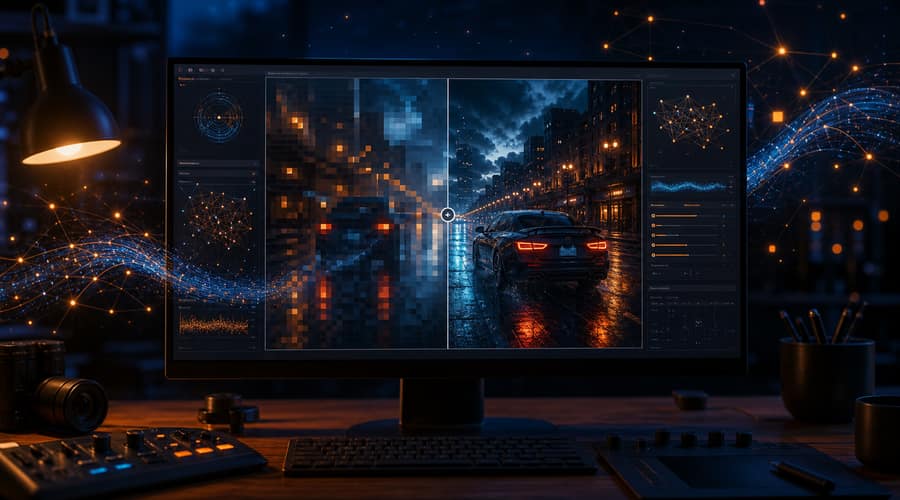
Adobe isn't buying Topaz Labs for a logo on the splash screen. It's buying years of hard, specific work on local AI enhancement, because rebuilding that inside Creative Cloud would take too long.
Adobe has sold Photoshop subscriptions for 35 years. Topaz Labs has spent two decades making the kind of software that cleans up, sharpens and rescues images and video after the first pass is done. Now Adobe is buying the company outright, with TechCrunch reporting on June 25 that deal terms were not disclosed and the transaction is expected to close in the second half of 2026, pending regulatory review.
That is the real story here. A company that could once wait, copy and bundle its way through most creative software threats has decided it needs to buy a specialist. If you use Photoshop, Premiere Pro, After Effects or Lightroom, this is the kind of deal that quietly changes what your tools can do before it ever shows up as a big product launch.
The asset Adobe wants most is NeuroStream, Topaz's proprietary inference technology. It was built for a plain problem: video upscaling and image retouching models can demand more compute than most desktop creators have sitting under the desk. Topaz says NeuroStream cuts VRAM usage by up to 95%, allowing models that would usually lean on cloud infrastructure to run locally on consumer-grade GPUs without a meaningful loss in output quality.
In May 2026, Topaz shipped NeuroStream 2. The company said the update made image processing two to four times faster and gave video work at least a 20% acceleration gain. Those are not showroom numbers if they hold inside Adobe's apps. They affect whether an editor waits, whether a retoucher stays in flow, and whether AI enhancement feels like a native part of the work rather than a trip out to a server farm.
Topaz is also bringing Astra, its video upscaling model, and Wonder, its image retouching model. Both were already inside Adobe's orbit before the acquisition, available as partner models in Firefly Boards. Astra let users upscale low-resolution footage without keeping a separate Topaz workflow open. Adobe has already seen the technology in its own environment, which makes this less like a speculative AI bet and more like buying the team whose model already passed the first audition.
Eric Yang, Topaz Labs' CEO, will remain to lead the team after the deal closes. That detail matters. You don't buy an inference stack and then treat the people who built it as interchangeable. The models are only part of the value. The hard part is knowing where the speed, memory use and visual quality tradeoffs can be pushed without breaking the result.
Adobe needed speed, not another promise
Adobe's position is uncomfortable because the pressure is coming from more than one side. Canva has been buying aggressively, adding Affinity, Leonardo.ai and MagicBrief, then MangoAI and motion design tool Cavalry in early 2026. Blackmagic Design keeps DaVinci Resolve available as a free download, which puts pressure on Adobe from the professional video end. You can see the problem. A Creative Cloud subscription has to feel indispensable, not just familiar.
Firefly is Adobe's answer, but generative AI alone isn't enough. Cloud-based generation brings latency, usage costs and dependence on a connection. Local enhancement is different. If a creator can upscale video, repair images or sharpen archive footage on the machine already running the edit, the feature starts to feel like part of the tool rather than a service bolted onto it.
Topaz has proof that professionals already take its output seriously. The company won a 2025 Emmy Award in the AI Image and Video Enhancement category for high-quality television catalog restoration. That is a useful fact because it keeps this deal grounded. Adobe isn't buying a pitch deck with a few demos. It's buying technology that broadcasters and studios have already trusted on real restoration work.
The harder part comes after the press release. Adobe has acquired plenty of technology over the years, and integration is where these deals either become useful or disappear into a menu nobody opens. Premiere Pro, After Effects, Lightroom and Photoshop all have different workflows and different expectations from users. If Topaz's models arrive as slow panels, awkward exports or confusing credit meters, the deal will feel smaller than the announcement.
For now, Topaz's standalone products will remain available through the company's website after the deal closes. That is the right move. Topaz has users who bought its tools because they solved a specific problem cleanly, and Adobe doesn't need to punish them while the engineering work happens. Frankly, it would be foolish to damage the trust it just paid to acquire.
The lesson from this deal is not that every creative software company needs an AI story. They all already have one. The sharper point is that the useful pieces are getting bought before they become impossible to buy. Canva is doing it. Adobe is doing it. Anyone defending a subscription business now has to decide which AI capabilities are worth building, and which ones are too important to leave outside the walls.
Topaz Labs, based in North Texas, spent years working on the unglamorous part of AI that users actually feel: speed, memory use and output quality. Adobe could try to rebuild that from scratch. It chose not to. That choice tells you where the creative software market is now.
Also read: AI revenue has finally outpaced the cost of building the infrastructure behind it • Apple's price hikes are the clearest sign yet that AI infrastructure is eating the consumer electronics industry • Apptronik's Apollo robot has left the lab and is now working factory shifts at Mercedes-Benz