
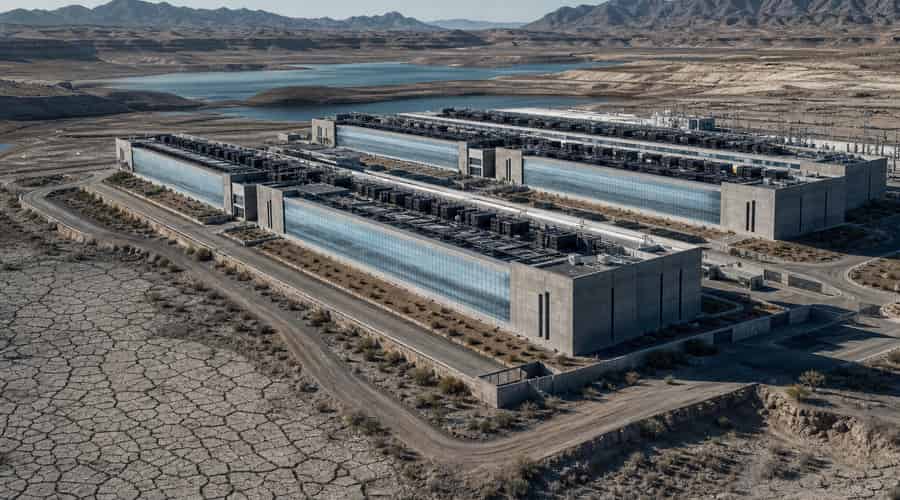
Arizona wants more Colorado River water while data centers are multiplying across the desert. You don't need to be anti-AI to see the problem with that math.
Lake Powell and Lake Mead are still nowhere near healthy, and Arizona is trying to defend its water future at the same time it courts one of the thirstiest infrastructure booms in the country. Governor Katie Hobbs has urged federal officials to recognize data centers, semiconductor plants and space operations as essential industries in Colorado River talks. That is the ask. The harder fact is that the state has 98 operating data centers and 86 more planned or under construction, according to Pew Research Center figures cited by Axios.
Those two sentences should not sit comfortably together.
The Colorado River rules that guide Lake Powell and Lake Mead operations expire at the end of 2026, and the basin states still have no durable replacement. The Guardian reported in May that a federal plan under discussion could cut deliveries to Arizona, California and Nevada by as much as 3 million acre-feet a year, with the Central Arizona Project potentially hit especially hard. Grist has reported that the proposal could amount to a 77% reduction in Arizona's Colorado River allocation. If you run a business that depends on cheap desert land, low-cost power and a dependable water supply, that is not background noise. It is the ground moving under the site plan.
The data center numbers are not abstract either. Grist reported that AI projects now under construction in Arizona could push data center water demand up 67%, to roughly 5 billion gallons a year, and that water use from data center cooling in the Phoenix area could rise 870%. Across the wider Colorado River Basin, the combined water demand from on-site cooling and power generation could reach 89,700 acre-feet annually by 2035. You can call that a rounding error only if you're not the city, farm or aquifer being asked to round it off.
Tucson has already shown what refusal looks like. Project Blue, a 290-acre data center proposal from Beale Infrastructure in Pima County, became a local fight after Arizona Luminaria reported that county documents linked the project to Amazon Web Services financing. The Guardian later reported that Beale wanted the site annexed into Tucson so it could use Tucson Water, and that the city council voted unanimously on August 6 to stop annexation talks after residents organized against the project. The proposed buildout included up to 286 megawatts of power, enough to make it one of the largest developments in southern Arizona.
That vote mattered because it took the argument out of policy papers and put it in a council chamber. No Desert Data Center organizers pushed residents to show up. Tucson officials heard the anger. Beale executives left without the water path they wanted. The company later shifted to a design it described as using a closed-loop system with minimal water loss, and it has continued looking for another approval route. Frankly, that is the useful part of the story: the technology changed only after the politics did.
Arizona's water rules make this even messier. Sharon Megdal, director of the University of Arizona's Water Resources Research Center, told Al Jazeera that data centers can add another straw to the aquifer without facing the same replenishment obligations applied elsewhere. Mesa, Avondale and Phoenix have moved to cap industrial water use or require supplemental supplies above certain thresholds. Hobbs has gone further, backing a penny-a-gallon fee on data center water use and questioning the sales tax exemptions that helped attract the industry. The Associated Press reported that she called those exemptions a $38 million corporate handout.
That is a real turn. Hobbs has not become hostile to data centers, and Arizona is not walking away from semiconductors or cloud infrastructure. But she is now trying to charge the industry for a resource the state spent years treating as a recruitment tool. You should read that as a warning to every hyperscaler site team looking at the Southwest: water is no longer a line item someone else absorbs.
The industry has answers, but they are unevenly deployed. Microsoft has said it will use zero-water cooling designs in new Arizona data centers, relying on closed-loop liquid cooling and drawing municipal water only for limited purposes. Nvidia has promoted liquid-cooling systems that reduce water use inside AI infrastructure. Project Blue's own redesign shows developers can move away from evaporative cooling when a city blocks the old plan. The issue is not whether lower-water designs exist. They do. The issue is whether companies adopt them before residents force the decision.
For site selectors and CFOs, Tucson is now part of the model. A project can have land, capital, political support and a power application, then still run into a wall because residents don't believe the water story. You can dismiss that as local resistance once. You should not dismiss it when Arizona has dozens of projects in the queue and the Colorado River negotiations are entering their most consequential year in decades.
AI companies have treated water as a logistics problem. Arizona is showing you it is a permission problem too. If the next Colorado River rules cut deeply into the state's supply, some of those 86 planned or under-construction facilities will have to prove they can run without leaning on a river that is already overdrawn.
Also read: Domo is selling itself after burning through a billion dollars chasing growth it never found • Qualcomm unveils Dragonfly C1000 and signs Meta to reshape how AI gets processed from pocket to data center • AI's power hunger is turning energy infrastructure into the hottest new IPO category