
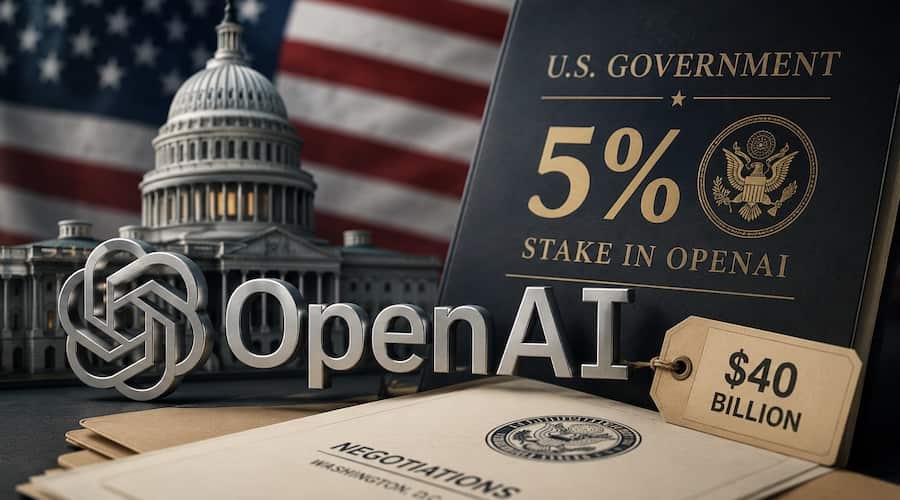
Most companies that want a friendlier hearing in Washington hire lobbyists or donate to campaigns. OpenAI, according to a report in the Financial Times last Thursday, has proposed something quite different: handing the United States government around 5 per cent of the company.
At the valuation OpenAI reached after its March funding round, somewhere near $852 billion, that would be worth roughly $40 billion. However you look at it, that is not a small gesture.
The reported aim is to clear political obstacles. AI firms have been under growing scrutiny, and the politics around the technology have become more complicated for the companies building it. From OpenAI's point of view, giving the government a direct financial interest in its success is a straightforward way of bringing the two sides closer together. If the company does well, the government does well too, and regulators tend to be less keen on rules that damage something they own a part of.
That probably accounts for a good deal of the thinking behind it.
The more difficult question is what it means for everyone else.
A government holding equity in a private AI company is not the same thing as a government handing out a contract or buying software for its departments. Equity is a form of ownership. It brings access to information, some degree of influence, and a claim on the big decisions the company makes. The same officials whose job is to regulate AI would, in effect, become part-owners of one of the firms they regulate.
That is a real tension, even if it is managed carefully.
There is also the competitive side to consider. OpenAI's rivals do not, as far as has been reported, seem to be offering Washington anything similar. If the company that gives the government a place at its table is treated more gently than the companies that do not, then the stake begins to look less like an investment and more like an advantage. The firms best placed to buy themselves a quieter regulatory life will be the ones that are already winning.
The Financial Times noted that the discussions are still at an early stage.
That is worth bearing in mind. There is a long way between a proposal of this kind and a finished agreement, and a good many ideas on this scale quietly change shape, or simply fade away, before they get anywhere near completion. It is entirely possible that this particular arrangement never comes about in the form being described.
Even so, the broader direction is what matters here.
For a while now, the largest AI companies have occupied an awkward position. They are private businesses, answerable to their investors, but the technology they produce is treated as a matter of national importance. That tension was always going to be settled in one direction or another. Offering the government a stake is one of the more direct ways of settling it, at least from the company's side.
Whether it settles things for anybody else is another matter.
A government with $40 billion riding on OpenAI's success has a clear interest in seeing the company do well. It has rather less interest in strict rules that might slow the company down. When the regulator and the regulated end up on the same balance sheet, the arrangement usually holds up well enough, until the moment it doesn't.
None of this is to say that the proposal is a bad one.
Washington was always going to want something in return for allowing this industry to grow up on its watch, and an open stake is at least more transparent than the quieter kinds of influence that usually shape these relationships. It may even be, on balance, the most sensible option a company in OpenAI's position has.
What stayed with me, though, was simpler than any of that.
Once a government has owned a part of its leading AI company, it seldom stops there. The holding can grow. The arrangement can be extended to other firms. And the line between the state and the technology that more and more of daily life depends on becomes a little harder to make out with each year that passes.
OpenAI may simply have offered Washington a deal. The bigger thing on offer is a precedent, and precedents tend to outlive whichever company first suggested them.