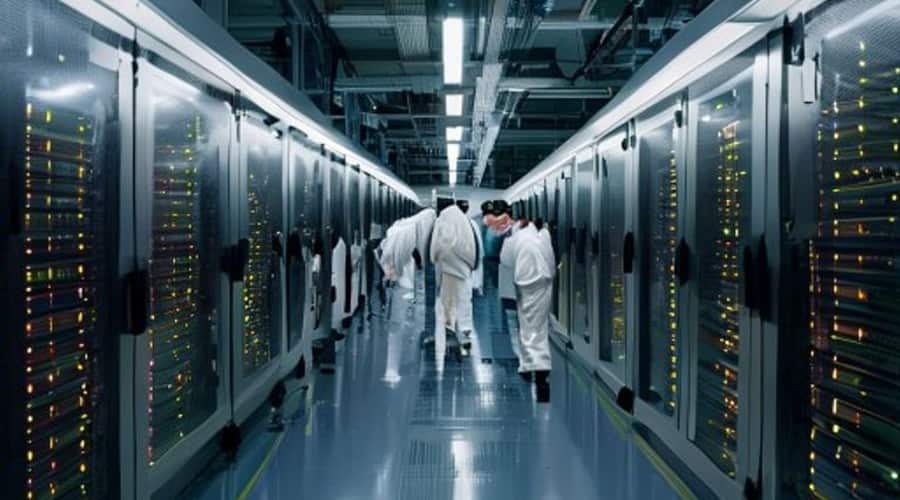
Foxconn just had its best June ever, and the company building Nvidia's server racks still won't say plainly what worries it about the world outside the factory floor.
Hon Hai Precision Industry, the Taiwanese company most people know as Foxconn, reported second quarter revenue of T$2.513 trillion, or about $78.71 billion, for April through June. That's up 39.8% from a year earlier and ahead of the T$2.372 trillion analysts had penciled in, according to Reuters, which cited an LSEG SmartEstimate that weights forecasts from analysts with the strongest track records.
June alone did even more work. Revenue for the month hit T$821.8 billion, up 52.1% year over year and a record for that calendar month, Reuters reported. Foxconn didn't need much explanation for where the money came from. Its cloud and networking products division, the unit that builds AI server racks for Nvidia, posted the strongest growth of the quarter, while the smartphone assembly business that made Foxconn famous, the one still stamping out iPhones for Apple, grew too, just less dramatically.
Foxconn is not a bystander in the AI buildout. It holds roughly 40% of the global market for assembling AI server racks, and AI servers now make up about 40% of the Cloud and Networking segment's own revenue, according to Digitimes. That's a bigger share of the business than the iPhone lines that defined the company for three decades. Foxconn raised its full year revenue target to NT$11 trillion, or about $350.5 billion, a 36% increase for 2026, and said it expects AI server rack shipments to more than double over the course of the year.
All of that came with a hedge. In its earnings statement, Foxconn said it remains necessary to monitor the impact of the volatile global political and economic situation, without elaborating further, Reuters reported. It's the same line the company has attached to its last several quarterly reports, and it stays vague on purpose. Frankly, you don't need Foxconn to spell it out. The company assembles most of its AI hardware in China and Taiwan, the two places most exposed if cross strait tensions or tighter U.S. export controls disrupt the supply chain.
Foxconn has been hedging against exactly that risk for years, building out capacity in the U.S., Mexico, India and Vietnam while keeping its Taiwan and China operations running at full tilt. No contract manufacturer of its size is diversifying this aggressively. There's also a narrower problem sitting inside China itself. Huawei's Ascend 950PR chip is gaining ground with Chinese hyperscalers, who are increasingly buying servers from domestic suppliers instead of the Western supply chain Foxconn feeds. That doesn't threaten Foxconn's business in the U.S. or Europe, but it does put a ceiling on how much of China's own AI buildout the company can ever capture.
Foxconn's factory floor and Oracle's balance sheet are telling different stories
Foxconn's results say the physical hardware underneath the AI boom is still selling as fast as it can be built. Oracle's most recent numbers say the money paying for that hardware is getting harder to justify. Oracle closed its fiscal year with capital expenditures of $55.7 billion, above its own $50 billion guidance, and its free cash flow deficit widened to $23.7 billion, up from a deficit of just $394 million the year before, Bloomberg reported. Oracle's backlog of contracted AI business, its remaining performance obligations, jumped 325% to $553 billion. The demand behind that backlog is real. Whether Oracle can fund the buildout without piling on debt at increasingly unfriendly rates is a separate question, and it's one Foxconn's earnings report doesn't have to answer.
That's the split running through AI infrastructure right now. Every component maker feeding Nvidia, Foxconn included, is booking record quarters. The hyperscalers writing the checks are the ones whose spending has started to draw scrutiny. Foxconn's next earnings call lands in the fall, and by then the market should have a clearer read on whether Huawei and other domestic Chinese chipmakers have started cutting into the Western server pipeline in a way that actually shows up in the numbers.
Also read: Moonbeam abandons Polkadot for Base and bets its future on AI agents • What to make of OpenAI offering Washington a stake • Nvidia Has Quietly Become the Bank Behind the AI Boom