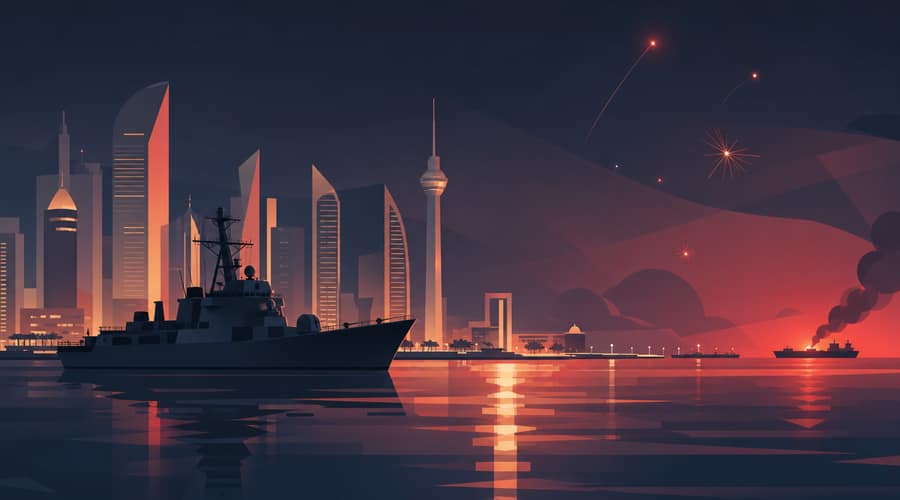
Iran hit Bahrain and Kuwait with missiles again before dawn on July 8, and President Trump called the ceasefire that was supposed to end the war "over." The Gulf economy is right back where it started a month ago.
Sirens sounded across Manama and Kuwait City in the early hours. Bahrain hosts the US Navy's Fifth Fleet. Kuwait hosts American Army installations. Iran's Revolutionary Guard Corps acknowledged targeting US military sites in both countries, according to NPR, and it wasn't the first time this year those two capitals have taken the hit for a fight between Washington and Tehran. Late last month brought a nearly identical round of strikes on the same two countries. That repetition is the story here. This isn't escalation from zero. It's a pattern that keeps resetting.
Qatar got pulled in too. The Qatari LNG tanker Al Rekayyat was struck by a projectile roughly eight nautical miles off Oman's Limah coast while transiting the strait, according to Arab News and Reuters reporting, and the resulting engine room fire left the vessel at risk of exploding. Doha called it an "unacceptable attack" on international navigation and held Iran fully legally responsible, per reporting from The Tribune. Qatar has spent months trying to broker talks between the US and Iran. The National reported that role is now under real strain, since it's hard to mediate for a country that just set your own ship on fire.
Trump's language matched the moment. He declared the ceasefire, agreed under a June 17 memorandum that had set a 60 day window for final terms, dead as of Wednesday, and he didn't soften it. "They're scum, they're sick people, they're led by sick people, and they're vicious, violent people," he said of Iran's leadership, according to the Washington Post and CBS News. US forces struck Iran for a second straight day afterward, following the Guard's attacks on three tankers in the Strait of Hormuz.
Oil markets did what oil markets do. Prices jumped roughly 6% on the fresh threat to Hormuz shipping, NPR reported. That's a modest move set against what the strait has already put the market through this year. Brent crude spiked as much as 65% in March alone during the worst of the fighting, and the International Energy Agency has described the disruption as the largest the global oil market has ever recorded. Wall Street analysts have floated $200 a barrel as a live scenario if the strait closes for good, not a talking point but a number people are actually modeling.
Here's the thing worth sitting with. Bahrain, Kuwait and Qatar aren't combatants in this war. They're hosts, mediators and shipping lanes, and they keep absorbing the consequences of a fight they didn't start. A Bloomberg opinion piece this week put it plainly: the ceasefire was built to fail. You don't need to agree with that framing entirely to see the evidence. A truce signed with a 60 day runway for negotiation didn't make it three weeks before Trump tore it up on a NATO summit stage.
NATO allies are now discussing the Hormuz tensions directly with Gulf Arab states, a sign that the burden of containing this is shifting outward from Washington and Tehran alone. About a fifth of the world's oil trade still needs to pass through that strait every day. Until Gulf capitals get a ceasefire that survives more than a few weeks, they're the ones left holding the risk, the tankers and the sirens.
Also read: Anthropic Says China Was Never Authorized to Use Claude Code Anyway • Illinois Becomes the First State to Mandate Annual AI Safety Audits • India and Japan team up to make Indian warships harder for China to detect