India and Japan just signed their first-ever joint defence hardware project, and the goal is simple: make Indian warships harder for Chinese radar to find.
The deal, unveiled by Prime Minister Narendra Modi and his Japanese counterpart Sanae Takaichi at their 16th annual bilateral summit in New Delhi this month, centers on a single piece of hardware called UNICORN, the Unified Complex Radio Antenna. Japan built it for its own navy first. Now India wants it too.
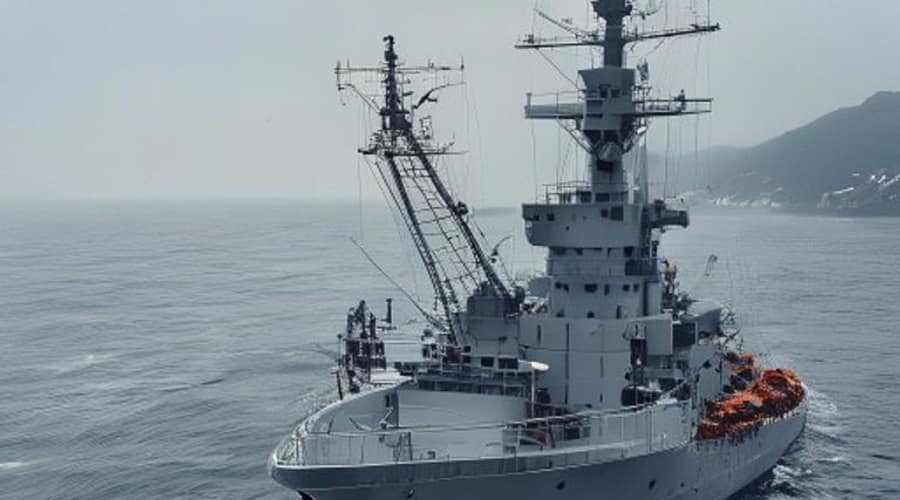
UNICORN works by folding a warship's various communication antennas into one compact, radar-resistant mast instead of the cluttered array of dishes and rods that normally stick up from a ship's superstructure. Fewer exposed surfaces means less for enemy radar to bounce off. Industry estimates cited in reporting on the deal suggest the design can cut a vessel's radar cross-section by as much as half compared with a conventional mast. The system currently equips Japan's Mogami-class frigates, the same stealth-hulled ships the Japan Maritime Self-Defense Force has been rolling out to counter Chinese naval expansion in the East China Sea.
Modi called it the first-ever co-development project between India and Japan, and that framing matters. Decades of talk about defence cooperation between the two countries had mostly stayed on paper, joint exercises, port calls, the occasional equipment sale. This is different. Bharat Electronics Limited, India's state-run defence electronics giant, is expected to work directly with Japanese partners to integrate and manufacture UNICORN masts under India's Make in India program, rather than simply buying finished units off a Japanese production line.
Look at the timing. India's relationship with Washington has been under real strain. The United States slapped 50 percent tariffs on Indian goods in 2025, among the steepest rates it imposes on any trading partner, and the fallout wasn't just economic. According to reporting from the Council on Foreign Relations, the tariff fight has put decades of strategic partnership at risk, and trust between the two capitals has taken a genuine hit. Things have eased somewhat this year. Tariffs came down to 18 percent and Modi and Trump have spoken by phone most months of 2026. But the underlying lesson landed in New Delhi regardless. You don't build your entire defence posture around one partner who can change the terms overnight.
Japan offers something the US can't easily replicate right now, a defence-industrial partner with its own China problem, no tariff leverage over India, and a navy actively engineering stealth into new hulls. Tokyo has watched China push into the East China Sea and around the Senkaku Islands for years. Modi and Takaichi used their joint statement to voice concern over the militarisation of disputed features in the East and South China seas and to oppose what they called unilateral attempts to change the status quo by force or coercion. That's two governments hedging against the same rising power, not just signing a technology contract.
There's a third country shaping this calculus, and it isn't in the room. Pakistan is taking delivery of Hangor-class submarines built with China, the first of which was commissioned in April 2026 at China's Sanya Naval Base before sailing to Karachi. Pakistan's navy has also absorbed a run of Chinese-built Type 054A/P frigates, giving Islamabad a fleet with real anti-submarine and air-defence teeth. For the Indian Navy, that raises the stakes on detectability. A stealthier mast on Indian frigates and destroyers is a direct answer to adversaries who are getting quieter and better armed at the same time.
None of this happens overnight. UNICORN still has to move from paper agreement to integrated hardware on actual hulls, and Bharat Electronics hasn't published a manufacturing timeline. The two countries have also lined up joint naval exercises pairing a Japan Maritime Self-Defense Force destroyer with an Indian Navy vessel, building on this year's JAIMEX drills and Japan's participation in the International Fleet Review at Visakhapatnam.
What's clear already is the shift in posture. India spent decades treating Japan mainly as a trade partner and the US as its default security hedge against China. Now it's building the hardware for that hedge somewhere else too, one radar-evading antenna at a time.
Also read: Trump Rings NYSE Bell From the Oval Office and Says Nobody Understands Bitcoin's Power • Nvidia Has Quietly Become the Bank Behind the AI Boom • Modi opens India's first commercial chip packaging plant in Sanand