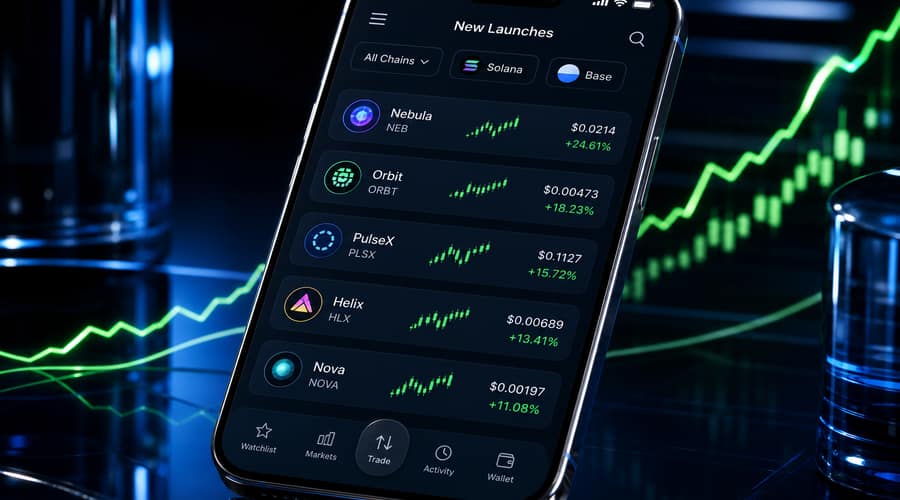
Coinbase's New Launches tab pulls the messiest part of onchain trading into its app, giving users fast access to Base and Solana tokens while leaving a harder question for later: how much risk can a regulated exchange make feel ordinary?
Coinbase isn't asking token issuers to apply for a listing. That is the point. When a new token appears on Base or Solana, Coinbase's systems can detect it, run it through third-party risk filters, and show it in the app through the New Launches tab. Coinbase markets the feature as access to tens of millions of tokens moments after they become available onchain, while its own FAQ says newly created assets can become tradable within hours.
That is the shift. Not a faster listing committee. Not another queue for token projects trying to win exchange access. Coinbase is taking the long tail of DEX trading, the place where users normally copy contract addresses, check liquidity, and hope they're not about to buy the wrong thing, and putting it closer to the same screen where they already hold Bitcoin, USDC, and cash balances.
Solana gets Coinbase's front door
For Solana trades, Coinbase uses Jupiter, the Solana aggregator that routes orders across liquidity venues to find better execution. The Block reported in December that Coinbase's broader push includes stocks, prediction markets through Kalshi, Solana DEX trading through Jupiter, custom stablecoins, and other products under its Everything Exchange strategy. The New Launches tab is the part of that plan that matters most to the meme coin crowd.
You can see why Coinbase wants it. Solana's new-token market moves fast, and it has trained traders to expect immediate access rather than formal exchange listings weeks later. Pump.fun made that habit mainstream on Solana. Then Pump.fun launched PumpSwap in March 2025, replacing Raydium as the default landing place for tokens that graduate from its bonding curve. Research from The Digital Markets Network said Pump.fun and PumpSwap averaged $279 million in daily volume in the final week of the first quarter of 2025, compared with Raydium at $334 million.
Raydium is still large. Its own liquidity page recently showed about $1.15 billion in total value locked. But the center of gravity changed once Pump.fun kept more of its trading funnel in-house, and Coinbase is now stepping into that same early-token market with a distribution advantage the native Solana venues can't match.
Here's the thing: Coinbase users don't have to behave like old-school DeFi traders for this product to matter. Coinbase says DEX trading still requires users to create a self-custody wallet before trading, so this isn't the same as buying a fully listed Coinbase asset from the exchange's own order book. But the user experience is still wrapped in Coinbase's app, data, filters, balances, and warnings. That changes who feels comfortable pressing buy.
For Solana, that matters more than another burst of meme coin volume. The chain has never lacked speculation. What it has wanted is a cleaner route from ordinary retail accounts into onchain activity without making the user feel as if they've wandered into a separate financial system. Coinbase gives it that route. It also gives Base, Coinbase's own layer-2 network, a stronger reason to exist inside the main consumer app rather than off to the side as developer infrastructure.
The regulatory question is still there
Coinbase is a public company that has spent years telling regulators it can apply judgment to crypto markets. New Launches complicates that story. Third-party filters can screen out known malicious contracts and obvious hazards. They can't reliably catch every clean-looking rug pull, every manipulated supply design, or every token created to drain attention in the first minutes after launch.
The company does draw a line between traditional listings and DEX assets. Coinbase's own DEX FAQ says it doesn't list or support DEX assets in the traditional sense. That sentence is doing real work. It tells you Coinbase knows the legal and reputational difference between a reviewed asset and a token that merely appears through a decentralized trading interface.
The risk doesn't vanish. A retail user who buys through Coinbase's app may still read the whole experience as Coinbase-approved, however many warnings sit nearby. That is where the product gets interesting and uncomfortable. Coinbase wants the volume and energy of instant onchain markets, but it also wants to keep the trust that comes from being the best-known regulated crypto exchange in the United States.
June's System Update raised the stakes. The Block also reported that Coinbase introduced a new SEC-registered, AI-powered advisor and other products tied to unified liquidity and options trading. Coinbase is moving toward a broader financial app, not a narrow crypto exchange. The more it does that, the less patience regulators and users will have for fine distinctions between what Coinbase lists, what Coinbase surfaces, and what Coinbase merely routes.
Frankly, the filters are a feature, not a solution. They improve the odds against the dumbest scams. They don't settle the bigger question of whether a regulated consumer platform should make unvetted assets feel this close to normal trading.
Coinbase has made its bet. Pump.fun and Raydium built the early-launch token machine inside Solana. Coinbase has imported access to it through Jupiter and placed it in front of a much larger retail base. If the product works, the next fight won't be about who has the best routing. It'll be about who owns the first tap.
Also read: Brian Armstrong tells crypto founders who pivoted to AI they got it backwards • Bitcoin's BIP-110 Fork Deadline Is Days Away and Almost No One Is Signaling Support • Triple-A's $11.8 million treasury drain shows licensed crypto payments firms are no safer than anyone else