Amazon's July 24 FCC filing is current, and the big point is narrower than the hype: Amazon wants 5,105 more satellites for direct-to-device service, but it still plans to work with mobile operators rather than make carriers disappear overnight.
The filing landed quietly. The implications didn't. Amazon Leo, the satellite business formerly known as Project Kuiper, has asked the Federal Communications Commission to approve a new direct-to-device constellation of up to 5,105 low Earth orbit satellites, with deployment beginning in 2028. The system is meant to deliver voice, messaging, data, IoT connectivity and emergency services straight to compatible phones and other devices in places where cell towers don't reach.
That's the story you should care about. Not because Amazon has solved mobile coverage from space already. It hasn't. The company has filed an application, and regulators still have to approve it. But the filing turns Amazon Leo from a broadband project into something much more dangerous for the telecom market: a network that wants to sit beside the phone in your pocket, not just the dish on your roof.
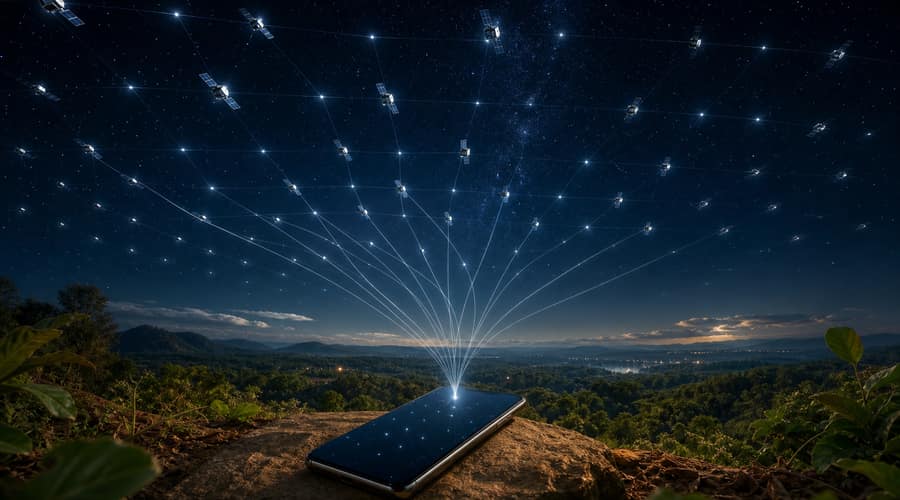
According to Amazon's own explanation of the filing, the new satellites would operate in five orbital shells between 510 and 580 kilometers above Earth. The company says the satellites will use L-band and S-band links for device connections, with Ka-band and V-band links carrying aggregated traffic back through ground stations. That is dry engineering language, but it matters. A standard smartphone has very little power to shout at a satellite. Amazon is telling the FCC it can make the math work by processing signals in orbit, using digital beamforming and routing traffic across the constellation with laser links.
We'll see.
Globalstar is the reason this filing has teeth
The spectrum behind the plan comes from Globalstar. Amazon announced on April 14 that it would acquire the satellite company in a deal valued at about $11.57 billion, and Globalstar's SEC filing lists the merger agreement date as April 13. That deal is expected to close in 2027 if it clears regulators. Until then, Amazon doesn't own the asset it wants to build around.
Globalstar's spectrum is the valuable part. The company holds mobile satellite service spectrum and also licenses Band 53 and n53 in the 2.4 GHz range. Its existing role matters too: Apple has used Globalstar infrastructure for satellite features on iPhone 14 and later, and Amazon said in April that it had signed an agreement with Apple to continue supporting satellite services for current and future iPhone and Apple Watch features, including Emergency SOS, Messages, Find My and Roadside Assistance.
Don't turn that into magic. A satellite feature on an iPhone isn't the same thing as replacing a mobile plan. Apple's current service is most useful when the normal network is gone. Amazon wants Leo to move further, into richer data and broader device connectivity. That is a harder job, and it won't be judged by a press release. It will be judged by battery drain, latency, capacity, indoor reliability and whether your phone can hold a usable link when the sky is partly blocked.
The carrier threat is real, but not simple
The draft version of this article overstated the carrier point. Amazon isn't saying it will route around mobile operators entirely. Amazon's April announcement said Leo will work with mobile network operators, and the new explainer says the same thing. That matters. If you write that Amazon doesn't need a T-Mobile or an AT&T to authorize the connection, you're going beyond the record.
Still, the carriers have a reason to watch this closely. SpaceX already has the first mover's position in the United States through Starlink's arrangement with T-Mobile. Ars Technica reported that the FCC approved SpaceX's supplemental coverage from space plan in November 2024, allowing Starlink satellites to use T-Mobile's 1910-1915 MHz and 1990-1995 MHz bands in areas outside normal cellular coverage. That service is basic compared with terrestrial wireless, but first steps count in infrastructure markets.
AT&T and Verizon haven't ignored the shift. AT&T has a commercial agreement with AST SpaceMobile that runs through 2030, and AT&T says it has already tested voice, text and video over AST satellites using AT&T spectrum. Verizon signed its own AST SpaceMobile commercial agreement in October 2025. Then, in May 2026, AT&T, T-Mobile and Verizon announced plans for a joint venture aimed at satellite-based direct-to-device coverage in underserved U.S. areas. The carriers know the ground is moving. They're trying to keep a hand on it.
Frankly, the threat isn't that Amazon launches a perfect phone network from orbit in 2028 and everyone cancels Verizon. That is fantasy. The threat is smaller and more practical: satellite service makes coverage gaps less acceptable, gives phone makers another strategic partner, and makes mobile operators explain why basic connectivity still disappears the moment you drive too far from a tower.
Market forecasts are noisy, as they always are in a young segment. Mordor Intelligence puts the direct-to-device satellite connectivity market at $5.03 billion in 2026 and $13.8 billion by 2031, a 22.37 percent compound annual growth rate. Other forecasts run higher. The exact number isn't the point. The direction is.
Amazon also has work to do on the original Leo broadband network. The FCC granted Amazon a waiver in June for the July 2026 deadline to launch half of its first-generation constellation, while keeping the July 30, 2029 deadline for the full 3,232-satellite system. Amazon says Leo now has more than 390 satellites in orbit, while the Financial Times reported that Starlink has more than 10,000 active satellites and service in more than 150 countries. That's a large gap. It won't close just because Amazon filed another application.
The better reading is this: Amazon is buying spectrum, preserving Apple's satellite path, asking the FCC for a 5,105-satellite D2D system and trying to make Leo a mobile layer before SpaceX and AST SpaceMobile define the market without it. You don't need to believe every performance claim to see why that matters. The next phone upgrade cycle will have a new question attached to it: whose satellite network does this device trust when the towers disappear?
Also read: Google AI Mode is now the default for a billion users and your startup's SEO playbook is already obsolete • Eromify and Higgsfield AI are built for completely different creators and the choice between them is obvious once you know what you actually need • Coinbase opens instant trading on millions of Solana and Base tokens without issuer approval