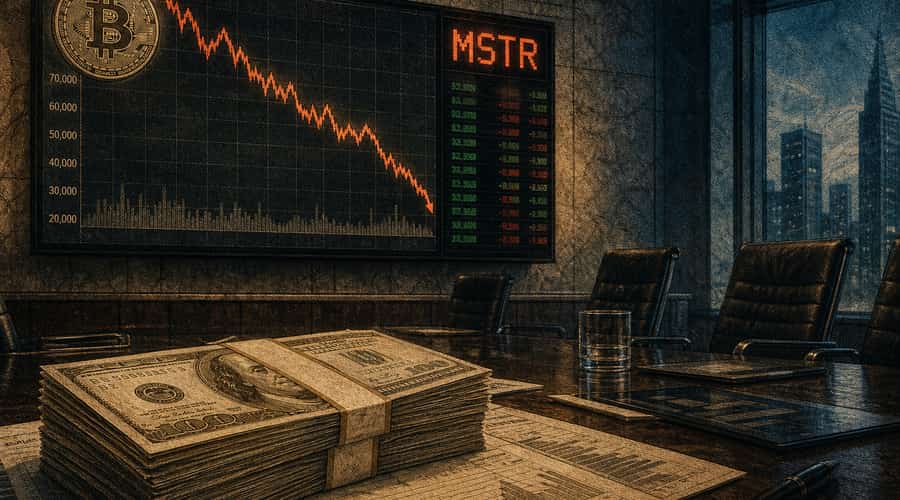

Crypto is not dead, but the old promise is. The market still moves, funds still raise money, and Bitcoin still trades, yet the story that sold ordinary people on a fairer financial system has been badly damaged.
Say the name out loud, because it no longer means what it used to mean. Crypto was supposed to rewire money, cut out the banks, shrink the middlemen, and give ordinary users a cleaner shot at wealth than the old system ever allowed. That was the pitch. It had power because people wanted to believe it.
Now look at the evidence in front of you. Bitcoin was trading near $62,000 on July 9, 2026, according to the Economic Times, and U.S. spot bitcoin ETFs still pulled in $143 million that day. So no, this is not a funeral for an asset class. It is something more specific and more uncomfortable: the death of crypto's moral story.
That distinction matters. A thing can keep trading long after people stop believing in why it exists.
The money found a louder story
Here is the blunt part. Crypto is no longer the main room where ambitious capital wants to be seen. Axios reported this month, using PitchBook and National Venture Capital Association data, that U.S. venture investment hit $412.7 billion in the first half of 2026, already more than any full year on record. The force behind that number is AI, especially large rounds for companies chasing compute, chips, models, and inference.
You can feel the shift without needing a spreadsheet. Three years ago, the engineer with options would build a wallet, an exchange tool, or a new layer one chain. Now that same engineer is building model infrastructure. Funds that once wrapped every deck in token economics are writing checks into AI companies with data center bills larger than some public companies' revenue.
Crypto still gets money. Fortune reported in May that Andreessen Horowitz's crypto arm launched a $2.2 billion fifth fund, led by Chris Dixon and others. That is real capital. But it also proves the narrower point: crypto has become one investment lane among many, not the movement that was supposed to swallow finance whole.
The center moved. You should notice that.
Bitcoin treasuries are no longer a clean faith story
Strategy is the useful example because it spent years making Bitcoin conviction part of its corporate identity. MarketWatch reported this month that the company sold 3,588 bitcoins over the prior week at an average price of $60,197, while disclosing an $8.32 billion second-quarter loss tied largely to Bitcoin. Michael Saylor's company did not abandon Bitcoin completely, but it did something more revealing. It treated Bitcoin as liquidity.
That is what happens when belief meets obligations. Preferred dividends, reserves, shareholder pressure, balance sheet management, you name it. The old crypto language was about never selling, escaping fiat, and holding through every storm. Corporate finance speaks a colder language.
Frankly, that is healthier than the old sermon. It is also less romantic.
For ordinary buyers, though, romance was part of the product. The nurse buying a little every payday was not buying a treasury management strategy. The student putting spare cash into a token was not underwriting a public company's capital structure. They were buying a story about escape.
The trust problem came from inside the house
The worst damage did not come from AI or quantum computers. It came from crypto itself.
The Washington Post reported in April that top buyers of President Donald Trump's meme coin attended a Mar-a-Lago crypto event, while the token had fallen roughly 97% from its early 2025 peak. You do not need to be anti-crypto to see the problem. When political access, celebrity attention, and meme coin trading collapse into the same spectacle, the ordinary buyer is not being invited into a fairer system. He is being asked to provide the liquidity.
That same pattern has shown up across celebrity tokens, influencer coins, and insider-heavy launches. The chain may be public, but public does not mean fair. If wallets are funded before the crowd arrives, if hype does the distribution work, and if the exit comes before most buyers understand the token, transparency only lets you watch the damage in real time.
That breaks people.
A market can recover from a fall in price. Trust is harder. Once users believe the famous, the early, and the connected are always three steps ahead, the old promise of decentralization starts to sound like branding.
Quantum is a real risk, but not today's executioner
The quantum argument needs care because it is often abused. Microsoft said this month that it is accelerating its Quantum Safe Program and wants its systems ready by 2029 because the risk horizon has moved closer. NIST finalized its first post-quantum cryptography standards in August 2024. Serious institutions are preparing.
That does not mean a quantum computer is breaking Bitcoin wallets this afternoon. It means the cryptographic foundation of modern systems, including parts of crypto, has an expiry problem that builders have to face before users are forced to care. A March 2026 paper by researchers including Dan Boneh and Google Quantum AI's Craig Gidney estimated that breaking elliptic curve cryptocurrency keys could become far less theoretical with enough fault-tolerant quantum hardware.
So the threat is not magic. It is work.
Crypto's failure is not that it faces technical challenges. Every serious technology does. The failure is that the industry spent too many years selling certainty while the foundations, incentives, and power structures stayed messier than the pitch admitted.
Crypto is not dead in the simple way a company dies. Bitcoin trades. Funds raise. Developers build. But the name was crypto when it meant a popular rebellion against a rigged financial order. If you are still buying, you should be honest about what you are buying now: an asset, a protocol, a speculation, maybe a useful tool in some cases. Not a guarantee of fairness. Not a rescue plan.
That promise has already been spent.