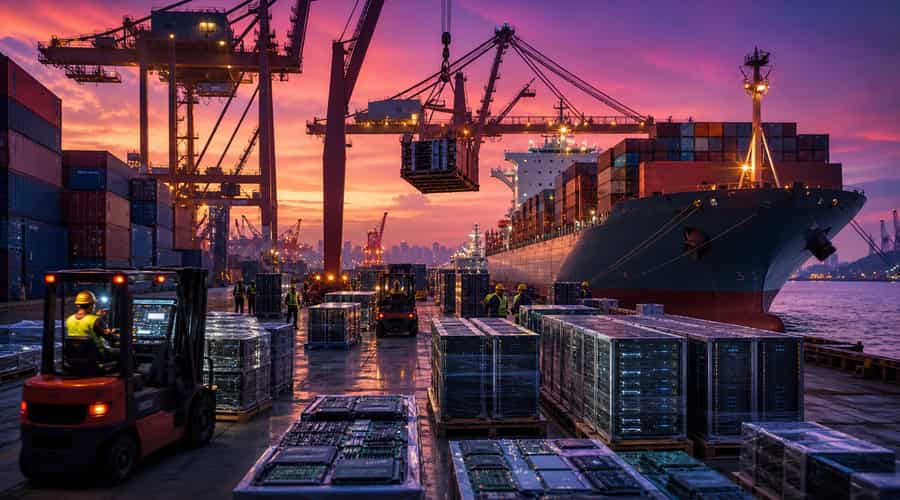
China's export engine is looking more like an AI hardware supplier by the month, and this week's trade data will show just how dependent that engine has become.
Economists polled by Reuters expect China's customs bureau to report June export growth of 18.2% year-on-year, down from May's 19.4% pace. Slower is still fast. Look underneath the headline number and one category is doing most of the heavy lifting: automated data processing equipment, the customs bucket covering servers, computer components and the guts of AI infrastructure, jumped 60% year-on-year in May, according to official figures cited by Reuters. Furniture exports, by contrast, grew just 1.9%.
That gap tells you where the real growth is. China's factories aren't selling more sofas to the world. They're selling hardware. The kind that trains and runs large language models. Demand for it barely blinked even as tariff threats and a cooling property market weighed on almost everything else. AP reported that China's official manufacturing PMI rose to 50.3 in June from 50 in May, with tech exports helping push the index back into expansion.
This is the uncomfortable part for Beijing. A trade machine once described through toys, clothes, furniture and low-cost electronics is now leaning heavily on the world's AI buildout. That gives China a stronger export story than its weak domestic demand would suggest, but it also ties growth to a spending cycle controlled by cloud providers and chipmakers, with regulators outside China holding real sway over how far it runs.
The memory squeeze is already visible
Want proof this isn't a one-month blip? Look at what SK Hynix's chief executive said the same week China's exporters were ramping up shipments. In an interview reported by Bloomberg and picked up by chip industry outlets, Kwak Noh-Jung said 2027 would be the worst year in the industry's history from the supply perspective. His warning doesn't stop there. Kwak said customer demand for memory chips will likely outstrip SK Hynix's production capacity beyond 2030, and buyers are locking in long-term supply contracts because they believe the shortage will last.
Keep the market detail straight. MarketWatch reported that SK Hynix's US-listed ADRs were priced at $149, opened around $170 and closed their first Nasdaq session up 12.8%, while the company raised $26.5 billion. That is hardly the backdrop for a cautious supply warning. It's the world's second-largest memory chipmaker telling investors it can't build capacity fast enough for a demand curve stretching into the next decade.
High-bandwidth memory for AI accelerators is the pressure point. When wafer capacity shifts toward HBM, ordinary DRAM used in phones and laptops feels it too - and so do cars. You then get a shortage that doesn't stay neatly inside the AI rack. It leaks into pricing, delivery schedules and the broader electronics supply chain, which is exactly the kind of pressure that can make China's export data look stronger than the rest of the economy feels.
The chokepoint still runs through Taiwan
Here's the part China's export numbers can't show you: how fragile the supply chain underneath them actually is. Taiwan's government is weighing tighter export controls on AI chips bound for China, according to Bloomberg, moving closer to US restrictions. Separately, the US Commerce Department has moved to close a loophole that let advanced chips, including Nvidia's Blackwell processors, reach Chinese firms through overseas subsidiaries, TrendForce reported in June. Neither move stops the AI buildout. Both make it more expensive and more political to keep running it through Chinese ports.
Frankly, that's the risk the trade data can't capture. China's export strength this year isn't really only about China. It's a readout of American and global cloud spending. Microsoft, Amazon, Google and their peers keep ordering chips and servers, and all the components that go inside them, assembled through Chinese supply chains, while Washington and Taipei keep deciding which parts can move where. If that pipeline tightens, China's export numbers slow with it, whatever growth target Beijing is chasing.
China's second-quarter GDP figures land July 16, against an official growth target of 4.5% to 5%. This week's trade release is the first real signal of whether that target holds on its own, or whether it now depends on how many AI servers the rest of the world keeps ordering. That's the number to watch.
Also read: JPMorgan Cuts MiniMax's Price Target a Second Time as Zhipu Pulls Ahead • Two npm attacks in four days show crypto's weak point is the supply chain • Google Delays Gemini 3.5 Pro Launch to July 17 After Scrapping Its Base Model