A startup building the wiring that runs through rockets, satellites and warships just raised $65 million to prove that one of aerospace manufacturing's last hand-built corners can finally be dragged into software.
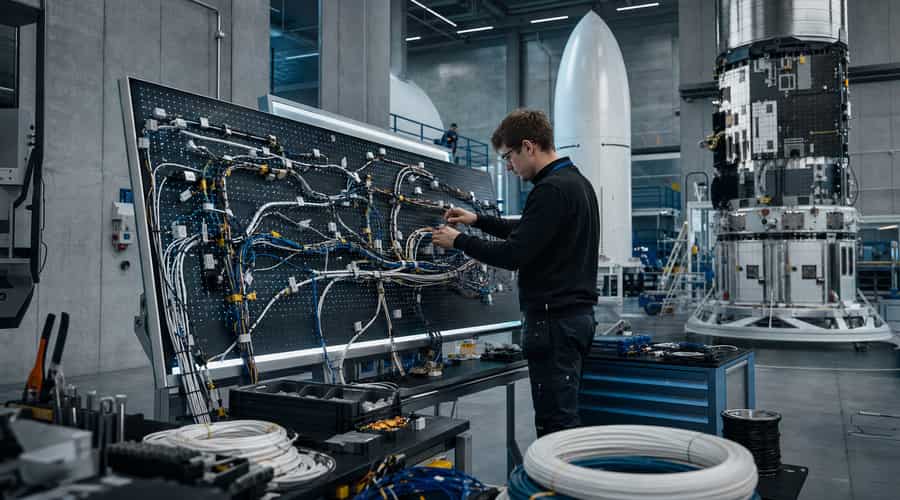
Senra Systems announced a $65 million Series B on July 15, co-led by Lowercarbon Capital and Interlagos, with Alumni Ventures, Andreessen Horowitz, Founders Fund and General Catalyst also backing the round. That brings the company's total funding past $112 million since it was founded in 2023. The pitch is plain enough. Senra makes wire harnesses, the bundles of cable and connector that carry power and data through aircraft, spacecraft, satellites and submarines. Engineers call them the nervous system of a vehicle. Most people never see them.
That's exactly why this is interesting. According to Axios, which reported the new round and Senra's factory plans, wire harnesses sit inside munitions, aircraft, satellites and cars, and CEO Jordan Black put the problem in one sentence: without wire harnessing, nothing turns on. You don't have to love aerospace manufacturing to understand the bottleneck there. A rocket can have the engine and the funding sorted, the software finished - it still needs a physical bundle of wiring built correctly enough to survive flight.
Black started Senra with Benjamin Shanahan in 2023 after both had worked close to the production problems the company is now trying to solve. Black ran electronics research and development at SpaceX and helped scale Starship wiring. Shanahan worked on scaling software for Starlink production. They began in an apartment. The company now runs two factories in California, about an hour apart, and is scouting the location for a third.
Senra's system is built around Amp, its proprietary software platform. Axios described Amp as tying together quoting, engineering, manufacturing, supply chain management and production. That sounds dry because the work is dry. It also matters. Wire harness manufacturing still depends heavily on technicians, routing knowledge, changing build instructions and physical floor discipline. If you can capture that work in software without pretending the factory disappears, you have something real.
The bottleneck is real
Wire harness failures are not abstract. Boeing's Starliner capsule was delayed in 2023 after engineers found flammable protective tape wrapped around wiring and a separate parachute issue. NASA and Boeing had to remove most of that material before the spacecraft could move toward its crewed test flight. That is what a wiring problem looks like in aerospace: not a line item, but a program delay.
Senra is selling into exactly that anxiety. Defense primes and space companies are trying to move faster, while the supply base underneath them still has old manufacturing habits in places where old habits get expensive. Here's the thing: you can call this reindustrialization if you want, but the useful version is not slogans about bringing factories back. That's the pitch, stripped down. It is a company taking one ugly, specific production problem and making it less dependent on memory, paperwork and heroic technicians.
Lowercarbon and Interlagos are not the obvious names you expect to see around wire harnesses, and that is part of the signal. The round is not just a bet on rockets. It is a bet that software has moved far enough into physical manufacturing that investors will fund factory capacity and tooling, not only dashboards - operators included. General Catalyst and a16z joining the deal, alongside Founders Fund, tells you hard tech has moved back into venture's field of vision. Not the glossy kind. The kind with buildings.
The factory test comes next
The company is also hiring as if the hard part is ahead. Senra brought on Ken Venner, SpaceX's former chief information officer, as chief technology and product officer. Venner built Warp Drive, the internal platform credited with helping SpaceX scale from roughly one booster launch a year to around 40. Before that he spent years at Broadcom as it grew from about 1,000 employees and $400 million in revenue to 10,000 employees and $8.6 billion, while absorbing dozens of acquisitions. That is not a maintenance hire.
A third factory is the next practical step. Software can standardize a process, but it can't conjure benches, tools, inventory or trained technicians. If Senra wants to move from today's two California factories to a much larger output, it needs more physical capacity and enough capital cushion to absorb mistakes. Factories do not scale like apps. You feel every bad assumption on the floor.
That is the real test for Senra. If Amp helps technicians build complex harnesses faster and with fewer undocumented workarounds, the company becomes a useful model for other manufacturing niches that have been ignored because they look too small, too manual or too dull. If it doesn't, the $112 million raised so far will have bought a costly reminder that some old aerospace processes stayed old for a reason.
For now, the story is current and concrete: a July 15 Series B, two operating California factories, a third being scouted and a production problem that sits inside nearly every serious aerospace and defense platform. You don't need to dress that up. The wiring either works, or the machine doesn't.
Also read: Moneybox becomes a British fintech unicorn without raising a single new pound • Daniel Ek's Body Scanning Startup Neko Health Raises $700 Million • Rime Raises $24 Million to Put Its AI Voice on Enterprise Phone Lines