Daniel Ek just raised $700 million to take Neko Health into the US, and investors are pricing the body scanning startup like it has already proved far more than it has.
Neko Health, the preventive health startup Ek co-founded with Hjalmar Nilsonne in 2018, has closed a $700 million Series C to fund its US push. According to the Financial Times, the round values the Swedish company at almost $7 billion, up from $1.7 billion when it raised $260 million in January 2025. That is a violent repricing in eighteen months.
The money came from the kind of names that make a funding round sound louder than the business itself. Lightspeed Venture Partners and OG Venture Partners led the deal, with returning backers including Atomico, General Catalyst and Lakestar. Mark Zuckerberg and Priscilla Chan invested too. So did Ari Emanuel, Maria Sharapova, Thierry Henry, Claudia Schiffer, Matthew Vaughn and Jimmy Iovine. A footballer, a supermodel, a Hollywood power broker and the co-founder of Beats are now attached to a clinic company that has not yet opened in America.
That matters. Ek is not just selling a scan. He is selling confidence in a version of healthcare where you pay upfront, get data quickly, and walk out with a doctor having already explained what the machine found. If you have watched Spotify turn a utility into a consumer habit, you can see why investors want to believe the same trick might work in preventive medicine.
What the scan actually does
A Neko scan costs £299 in the UK and 2,750 kronor in Sweden. The company says the appointment takes about an hour, uses no radiation, and combines full-body skin imaging, blood analysis, an ECG, grip strength testing and an in-person doctor consultation. The Financial Times reported that more than 100,000 people in the UK and Sweden have now taken one of its preventive health checks. That's no small sample.
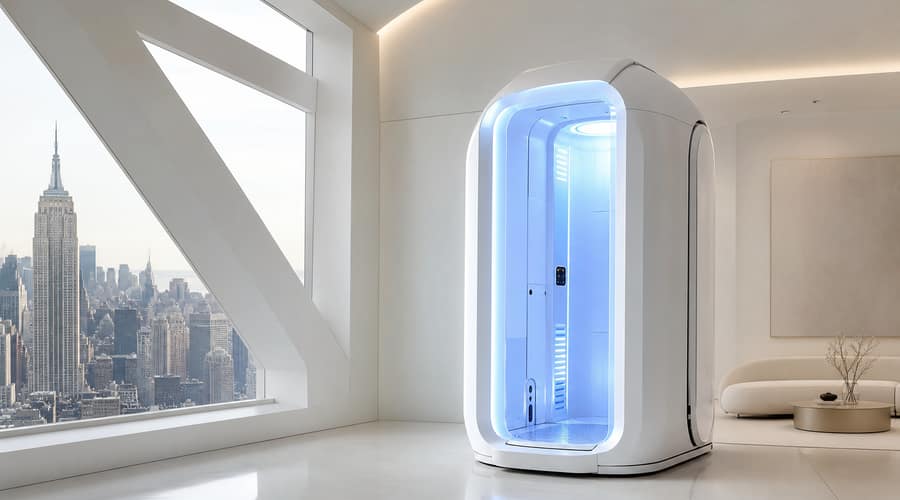
This is not an MRI business like Prenuvo, whose celebrity-backed scans can cost thousands of dollars. Neko has built its own medical imaging devices and sensors, then runs them inside its own clinics. That gives the company more control over the appointment, the data and the follow-up. It also means expansion is slower than software. You need premises, regulated devices, doctors, nurses and local approvals. You cannot push that into a new country with a product update.
The company now operates eight clinics across the UK and Sweden, according to The Verge, and its waitlist has climbed past 350,000 people. Its first US clinic is planned for New York this year, after what the Financial Times described as more than eighteen months of preparation and FDA approvals for several products. The US price has not been disclosed.
The hard part starts in New York
Frankly, the valuation is the most interesting part of the story because it shows how far venture capital has moved toward healthcare companies that look partly like AI, partly like hardware, and partly like consumer brands. Bejul Somaia of Lightspeed told the Financial Times the bet fits the firm's interest in companies at the intersection of AI and the physical world. That is a neat phrase. The physical world is still expensive.
Neko's challenge is not whether rich, health-conscious customers in London or Stockholm will pay a few hundred pounds for a scan. They clearly will. The sharper question is whether the company can keep the experience consistent when it leaves those early markets and enters the US, where healthcare regulation, physician costs, real estate and customer expectations all get heavier at once.
There is also a medical argument Neko cannot outrun with better design. Preventive full-body screening has long drawn criticism from doctors because it can produce false positives, anxiety and follow-up testing for findings that may never have harmed the patient. The company says its model includes doctor consultations and follow-up appointments where needed, but the concern does not disappear because the scanner looks better or the app is cleaner.
Still, you can see why the round happened. Neko has a founder with a consumer technology record, clinics with real throughput, more than 100,000 completed scans, and a waitlist large enough to make scarcity feel like demand rather than friction. Most health startups have one of those things. Neko has several.
The risk is that investors have priced the company as if the US rollout is already working. It isn't. New York is the test. If Neko can turn a first American clinic into repeatable demand without drowning in clinical cost, the $7 billion valuation will look less strange. If it cannot, this round will read like what it partly is: a very expensive bet that Spotify's consumer playbook can survive contact with American healthcare.
Also read: Rime Raises $24 Million to Put Its AI Voice on Enterprise Phone Lines • Indian Coding Startup Emergent Becomes a Unicorn in Just Over a Year • Kraken Technology Group becomes a defense unicorn as NATO backs robotic warships