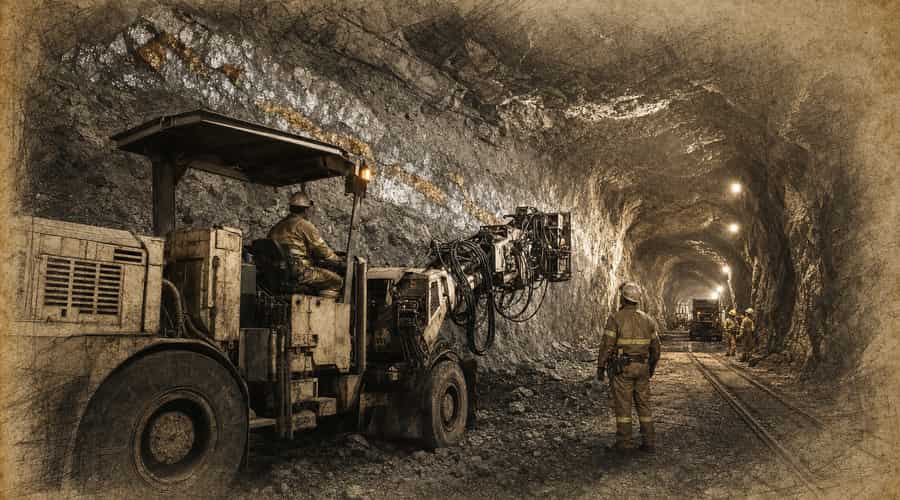
Sibanye-Stillwater is spending through a weak metals week because K4 is not a trade. It's a 48-year mine, and that is exactly why the risk is so large.
Sibanye-Stillwater, one of the world's largest primary producers of platinum group metals, is pushing ahead with a long-life South African platinum plan while traders are selling the very metals that have to carry it. The company has put roughly R20 billion, more than $1.1 billion, behind seven platinum group metal projects across its local operations, led by the K4 shaft at Marikana in North West province. That's the bet. It won't be settled this month, or even this decade.
Look at the timing. Platinum and palladium both fell this week. Gold is on track for its biggest weekly loss in six weeks, according to Energy News, as the U.S.-Iran conflict lifted oil prices and revived inflation fears. If you only watched the screen, Sibanye-Stillwater's spending would look badly timed. But mines don't work on a trader's clock. They punish companies that think too short, and they punish them again if the long view is wrong.
According to Mining Weekly, the K4 project is 77% complete. It still needs R964 million of remaining capital this year and next, out of total project capital of R4.4 billion in real 2026 terms. It carries a net present value of R17.6 billion and is on track for steady-state production in 2033. Once it gets there, K4 is expected to employ 4,380 people and run for 48 years.
That is a long wait.
K4 is not a new idea dressed up as a fresh growth story. Sibanye-Stillwater acquired it through the Lonmin deal in 2019, after the shaft had already been commissioned years earlier and placed on care and maintenance in 2012. The ramp-up restarted in the second quarter of 2022. Mining Weekly reported that steady-state output is expected to reach about 250,000 four-element PGM ounces a year, with monthly reef hoisting of 190,000 tonnes. These are not teaser numbers. They are the operational case for spending through a weak market.
The rest of the R20 billion plan is less dramatic and probably more useful near term. The Siphumelele and Thembelani extension reserves and the Kopaneng and Bathopele extension resources projects sit in Rustenburg, while East 3, East 4 and Saffy extend Marikana. Mining Weekly described the portfolio around these assets as brownfield work, much of it shallow and mechanised on the UG2 reef. That matters more than the slogan. Brownfield extensions use existing infrastructure, which is exactly what you want when capital is expensive and the metal price is not helping you.
The Market Is Not Cooperating
Kitco showed platinum at about $1,623 an ounce and palladium at about $1,247 on July 16, with both metals down on the day. Palladium has had the harder road. Electric vehicles don't use catalytic converters, and catalytic converters have been the metal's great demand engine. You don't need a grand theory to see the problem. Fewer exhaust systems mean less palladium demand.
Platinum has a better story, but not an easy one. It still matters in autocatalysts, jewellery, electronics and industrial uses, and Sibanye-Stillwater is clearly leaning into the argument that hydrogen electrolysers and fuel cells can add another leg of demand. That argument may be right. It may not be big enough fast enough. Here's the thing: a 48-year mine does not need next week's hydrogen headlines to look good, but it does need the hydrogen story to become real demand before investors lose patience.
Gold's selloff adds another uncomfortable detail. FXStreet, citing Reuters, reported that Iran had asked Yemen's Houthi militia to stand ready to close the Red Sea oil route if the United States strikes Iranian power infrastructure, with the Bab el-Mandeb Strait in focus. The Bureau of Labor Statistics also reported that June CPI fell 0.4% on the month and slowed to 3.5% year over year from 4.2% in May, the largest monthly drop since April 2020. Soft inflation data should have helped gold. It didn't. Traders cared more about oil, rates and the next shock.
That is the market Sibanye-Stillwater is walking into.
Stewart Owns the Long View Now
Richard Stewart officially became Sibanye-Stillwater's CEO on October 1, 2025, after Neal Froneman retired, according to the company's Johannesburg announcement. This project slate is now his problem and his opportunity. Froneman built Sibanye into a diversified precious-metals group through large deals. Stewart has to prove that the assets already inside the group can earn their keep.
Frankly, that is the right test. Anyone can call platinum a future-facing metal when prices are rising. The harder call is committing capital when palladium is weak and gold is being sold despite war headlines. Investors can find safer returns elsewhere without touching any of this. K4's 48-year life gives Sibanye-Stillwater room to be right late. It also gives the company plenty of time to be wrong in public.
The clean version of the story is that Sibanye-Stillwater is buying the dip in its own orebody. The rougher version is that it has little choice if it wants its South African PGM business to remain relevant beyond the current mining plans. K4, East 4, Saffy and the Rustenburg extensions are not side projects. They are the bridge between today's shafts and the metal demand Sibanye-Stillwater says is coming.
For you as an investor, supplier or worker watching this company, the weekly platinum price is noise, but not meaningless noise. It affects cash flow and confidence - and eventually the patience of everyone funding the build wears thin too. The real question is whether Sibanye-Stillwater can keep spending carefully enough to reach 2033 without letting today's weak market dictate tomorrow's mine plan.
Also read: Silver is being pulled two directions at once and that is exactly why it could outrun gold • Gold Falls 25% From Its Record Even as Iran and the US Trade Strikes • Gold Is Falling While Missiles Fly Over the Strait of Hormuz