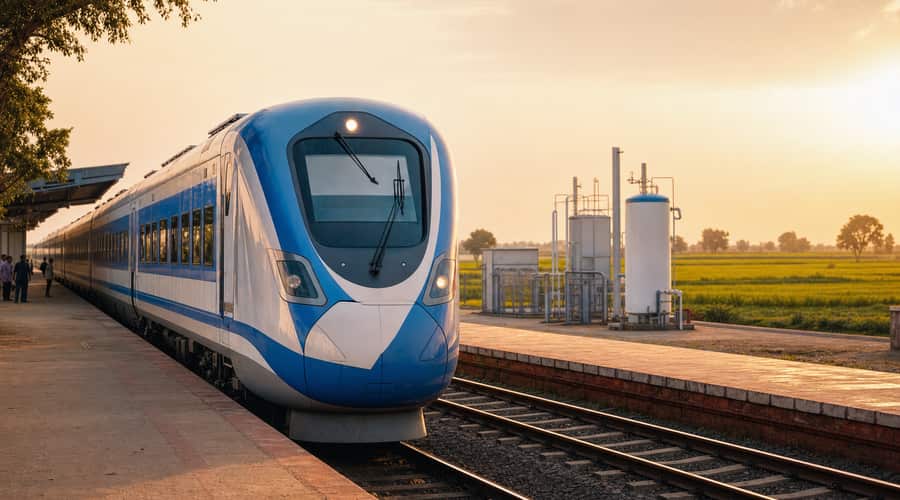
India has put its first hydrogen fuel cell train into service in Haryana, and the real test starts after the flag-off ceremony.
Prime Minister Narendra Modi flagged off India's first hydrogen-powered train from Jind railway station on Friday, sending a 10-coach train toward Sonipat on an 89-kilometer route through Haryana. It's a large machine for a pilot: two hydrogen-powered driving cars, eight passenger coaches, a rated capacity of about 2,600 passengers and an operating speed of up to 75 kph, according to details reported by the Associated Press and Indian outlets including India Today.
That size is the story. Most hydrogen trains you've seen elsewhere are small regional sets, often two or three cars, built for routes where diesel has become politically and technically awkward but full electrification still doesn't make much sense. India has gone bigger from day one. No other hydrogen passenger train now in operation is carrying this many people in one formation.
The train, branded NaMo Green Rail, uses a 1,200-kilowatt hydrogen fuel cell propulsion system with lithium ferro phosphate batteries. The basic process is clean at the point of use: hydrogen and oxygen react in the fuel cell to produce electricity, with water vapor as the exhaust. No diesel smoke. No local tailpipe emissions. For a railway network that still has diesel pockets on branch, hill and heritage lines, that gives Indian Railways something practical to test.
Jind is not a glamorous place to start. Good. The Jind-Sonipat corridor is a working rail route, not a showcase loop built for photographs. Engineers can measure fuel use, refueling time, component wear and maintenance costs while the train does ordinary passenger work across stations such as Jind Junction, Julana, Sampla and Sonipat Junction. If you want to know whether hydrogen rail can survive outside a press release, this is how you find out.
The hard part is not the fuel cell
Indian Railways has built hydrogen storage and refueling infrastructure at Jind to support the service. Reports put the storage capacity at about 3,000 kilograms, and the train carries detection systems for hydrogen leaks, heat, flame and smoke. That detail matters more than the green branding. Hydrogen can be handled safely, but it punishes sloppy systems, and railways are not laboratories with one engineer watching every valve.
The economics are less flattering. Under the Hydrogen for Heritage plan, Indian Railways has discussed 35 hydrogen trains for heritage and hill routes, with each train estimated at about Rs 80 crore and ground infrastructure around Rs 70 crore per route. The pilot itself has been reported at roughly $12 million. That is expensive compared with diesel or overhead electric service, and pretending otherwise helps nobody.
Here's the thing: hydrogen rail is not trying to beat electric trains where overhead wires already work. It's trying to replace diesel where wiring a route is either too costly or operationally awkward. Heritage and hill routes are the obvious candidates. If the Jind-Sonipat train proves reliable, those lines get a cleaner option. If the refueling and maintenance bills climb too fast, the 35-train plan will slow down. It's that plain.
Modi called the launch a global benchmark for clean rail technology at the ceremony, according to Business Today, where he also unveiled other development projects in Haryana. The political language was predictable. The engineering question is better: can a 10-coach hydrogen train run daily service without becoming a delicate special project?
India joins a small club
Germany got there first with Alstom's Coradia iLint, which entered passenger service in 2018. China and Japan have pushed hydrogen rail projects beyond the drawing board too. India's difference is scale. A 10-coach train rated for about 2,600 passengers is a different bet from a compact regional trainset carrying a few hundred riders.
Scale cuts both ways. Bigger trains need bigger fuel systems, more storage planning, tighter maintenance discipline and a stronger safety case. They also give you a better answer if the system works, because India's railway problem is not theoretical. It moves millions of people every day. A tiny demonstration train would prove less.
For now, the only hard result is one train on one Haryana route. That is enough for a launch, not enough for a verdict. Over the next several months, the useful numbers will be fuel consumption, turnaround time at Jind, unscheduled stoppages, battery performance and what the maintenance crews actually find once the novelty wears off.
Clean rail does not become real because a prime minister waves a flag. It becomes real when the same train shows up tomorrow, and the day after that, carrying passengers without fuss.
Also read: AWS billing dashboard told a customer who spent 19 cents that they owed 2.5 billion dollars • Moonshot AI's Kimi K3 Beats Claude and GPT Rivals to Top a Coding Benchmark • India's Smartphone Shipments Just Posted Their Worst June Quarter in Six Years