China's Moonshot AI just put Kimi K3 at the top of a major coding leaderboard, and investors treated it like another warning shot at the AI chip trade.
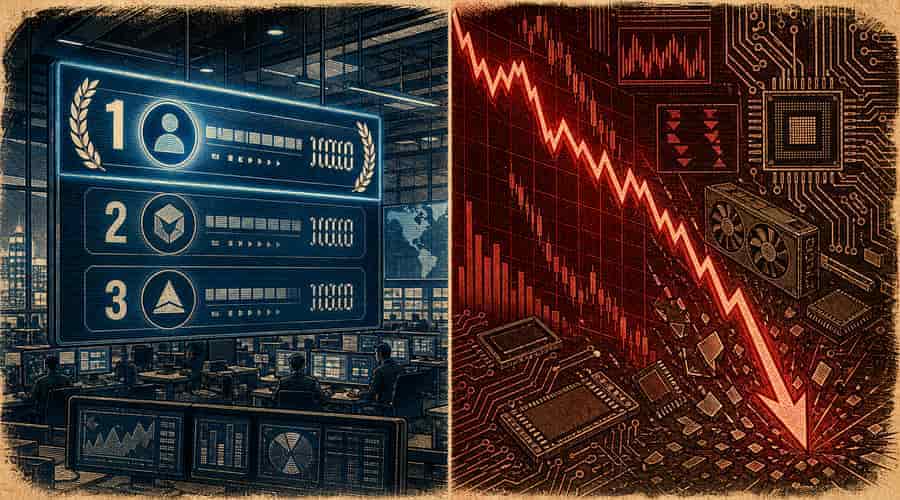
Moonshot AI began rolling out Kimi K3 on July 16, 2026, and the Beijing startup's model quickly jumped to the top of LMArena's Frontend Code Arena, the leaderboard that ranks how well AI systems build real interfaces rather than solve tidy coding puzzles. Kimi K3 scored 1,679 Elo across 1,757 votes, ahead of Anthropic's Claude Fable 5 at 1,631 and OpenAI's GPT-5.6 Sol at 1,618. GLM-5.2, Claude Opus 4.8, and Grok-4.5 trailed further behind.
That's not a marginal edge. Kimi K3's predecessor, Kimi K2.6, sat in eighteenth place on the same leaderboard. One release cycle later, Moonshot's model is first. According to Analytics India Magazine, K3 ranked number one in six of the seven front-end domains the arena measures: brand and marketing, reference-based design, data and analytics, consumer products, simulations, and content-creation tools. It lost only one category. Claude Fable 5 still holds the edge in gaming.
You don't build a 2.8 trillion parameter model by accident. Kimi K3 is a mixture-of-experts system, and Moonshot is calling it the largest open-weight model released anywhere, according to VentureBeat and Tom's Hardware. It ships with a 1 million token context window, native support for images alongside text, and a mechanism the company calls Kimi Delta Attention, built to speed up decoding on long sequences. The model also runs in an always-on "thinking mode," a reasoning layer switched on by default rather than toggled per request.
Two versions are live right now. K3 Max handles chat and agent work. K3 Swarm Max is built for large-scale parallel tasks. Both are already available through the Kimi API at $3 per million input tokens and $15 per million output tokens, with cached inputs priced at $0.30 per million, according to Moonshot's K3 launch pricing page. Moonshot is also running a top-up promotion offering 10 to 30 percent bonus credits on API recharges through August 11. Full open weights are due July 27, which is when outside developers will get a cleaner look at what Moonshot has actually shipped.
The Market Didn't Wait
The market didn't wait for the weights. The Nasdaq fell 1.4 percent on Friday and the S&P 500 dropped 1 percent, while the Dow closed down 406 points, according to the Associated Press. Taiwan's benchmark index fell more than 6 percent and Japanese markets closed down about 4 percent. Nvidia slid roughly 2 percent, and its market value briefly dipped below Apple's, handing Apple back the title of world's most valuable listed company during the session, according to CNBC and the Financial Times. AMD and Intel also fell.
The Philadelphia Semiconductor Index sank as much as 5.7 percent, extending a slide that has now pulled the SOX down more than 20 percent from its late June record. That's a bear market, by the textbook definition. Global chipmakers have shed roughly $3.3 trillion in combined value since June 22, according to reporting cited by Fortune and Yahoo Finance. Investors are calling it a DeepSeek flashback, a reference to January 2025, when a different Chinese lab's efficient model first cracked the assumption that AI leadership requires endless infrastructure spending. David Sacks and Bill Ackman both weighed in publicly as Nvidia and Micron slid, per Benzinga.
The Benchmark Has Limits
Look, the benchmark is still one leaderboard on one type of task. Frontend coding isn't the whole of enterprise AI demand, and an Elo score based on voter preference doesn't tell you what it costs to run K3 at scale inside a real company. A beautiful generated dashboard is useful. It isn't a procurement plan.
But the market isn't only pricing the benchmark. It's pricing the pattern: a Chinese open-weight model, built despite U.S. export controls on advanced chips, closing the gap with the best labs in Silicon Valley at a price developers can actually test. That's the second time in eighteen months investors have had to revisit that assumption. It won't be the last.
What happens next is straightforward to track. Moonshot's full weights are scheduled for July 27, at which point independent developers, not just arena voters, get to stress-test Kimi K3 against real production workloads. That's the number worth watching, not this week's Elo score.
Also read: India's Smartphone Shipments Just Posted Their Worst June Quarter in Six Years • Aethon Fund Launches With $50 Million Built on Retail Trading Signals • What Is an AI Agent Swarm and How These Systems Actually Coordinate