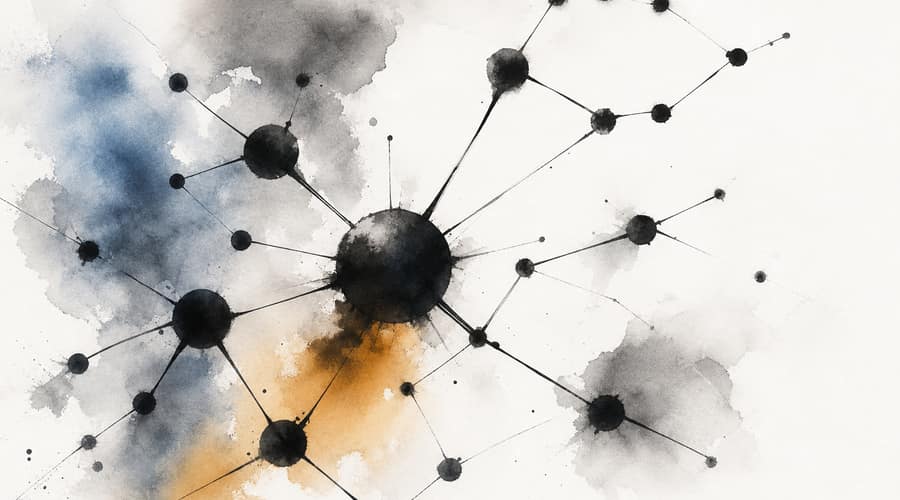
An AI agent swarm is a group of specialized AI agents working under an orchestrator that splits a task, hands off subtasks, and merges the results, and it's fast becoming the default architecture for anything more complex than a single chatbot query.
If you've been asking what is an AI agent swarm, the short answer is this: it's not one clever model doing everything, it's several narrower agents each doing one job, coordinated by a piece of software that decides who does what and when. A single agent reads your request, plans a response, and executes it end to end. A swarm splits that same job across multiple agents, each with its own prompt, tools, and memory, then stitches the outputs back together. The shift matters because single agents hit a wall fast. Ask one model to research a market, write code, test it, and summarize the findings, and you get a mediocre version of all four. Ask four specialized agents to do one job each, and you get something closer to a real team.
Almost every production multi-agent AI system you'll encounter uses some version of the same shape: an orchestrator agent that decomposes the task, and worker agents that execute pieces of it. Anthropic described exactly this in a 2025 engineering post about the research system behind Claude's web search feature, where a lead agent breaks a query into subtasks and spins up multiple subagents to search in parallel, each returning findings that the lead agent synthesizes into one answer. Anthropic reported that this multi-agent setup outperformed a single-agent baseline by 90.2% on internal research evaluations, largely because parallel subagents could cover more of the problem space in the same amount of time a lone agent would spend going step by step.
That's the appeal in one sentence: parallelism. A single agent researching five sources works through them one at a time. Five subagents can hit five sources simultaneously, and the orchestrator only has to wait for the slowest one. But parallelism isn't free. Anthropic's own writeup was blunt about the cost: multi-agent systems in their testing used around 15 times more tokens than a single chat interaction. You're not getting a smarter system for the same price. You're getting a faster, often better one, for a real markup.
Task handoff is where most of the actual engineering happens
The interesting part of agent orchestration isn't the agents themselves, it's the handoff between them. When the orchestrator passes a subtask to a worker, it has to pass enough context for the worker to succeed without passing so much that the worker gets confused or the token bill explodes. Get this wrong and you see the failure mode Anthropic flagged directly: a lead agent giving a vague instruction like "research the semiconductor industry" instead of a specific one, which sends multiple subagents duplicating the same broad search instead of dividing the work. The fix wasn't a smarter model, it was better prompting discipline, giving each subagent an explicit objective, output format, and boundary on what not to do.
OpenAI took a different approach to the same problem when it released Swarm in October 2024, an experimental framework built around what it called "routines" and "handoffs." Instead of one orchestrator managing every worker centrally, a Swarm agent can hand the entire conversation directly to another agent, which then takes over as the active agent. OpenAI was explicit that Swarm was educational, not production-ready, and the company later folded its ideas into the Agents SDK rather than maintaining it as a standalone product. That trajectory tells you something: the pattern was worth exploring, but the framework itself was less important than the lesson underneath it, that handoff logic needs to be lightweight and legible, not buried in a black box.
Frameworks like Microsoft's AutoGen and CrewAI, and LangChain's LangGraph, have all converged on some version of this same idea, agents that message each other through a shared state or a defined graph, with the developer setting explicit rules for who talks to whom and in what order. None of them have solved coordination cleanly. All of them are still fighting the same fight: how much autonomy do you give an agent before its decisions become unpredictable, and how much control do you retain before you've just rebuilt a single agent with extra steps.
Where swarm intelligence AI actually breaks down
Here's the part most explainers skip: coordination failures compound. A single agent that makes a 5% error on a step just makes a 5% error. A swarm of four agents chained together, each with a 5% error rate, fails at a meaningfully higher combined rate, because errors from one agent become the input for the next. Anthropic's engineers described debugging this as materially harder than debugging a single agent, since a failure could originate from an agent's changing prompt, its tool choices, the interaction between multiple agents, or the orchestrator's own decomposition of the task, and small changes early in the chain can produce large, unpredictable shifts downstream. They called it a new category of nondeterminism, and said traditional software debugging tools weren't built for it.
There's also a coordination tax that's easy to miss until you're paying it. More agents means more places for duplicated work, more context that has to be reconciled, and more opportunities for one agent to act on stale information another agent already overwrote. This is why Anthropic's team found multi-agent systems work best on breadth-first problems, research tasks where you genuinely benefit from parallel, independent exploration, and work worse on tightly sequential tasks where every step depends on the exact state of the step before it. If your task can be split into pieces that don't need to talk to each other much, a swarm helps. If every piece needs to know exactly what every other piece just did, you've added coordination overhead without adding real parallelism.
What this means if you're building one
The honest starting point isn't architecture, it's whether you need a swarm at all. A single well-prompted agent with good tools still beats a poorly coordinated swarm on most tasks, and it's dramatically cheaper to run and easier to debug. Reach for multi-agent AI systems when the task genuinely decomposes into independent parts and the value of parallel speed outweighs a token bill that could run over ten times higher than a single agent doing the same job slower.
When you do build one, the lesson from every team that's shipped this in production is the same: spend your engineering effort on the handoff, not the model. Give the orchestrator explicit rules for decomposing work. Give each worker a narrow, bounded task with a clear output format. And build tracing into the system from day one, because when a four-agent chain produces a wrong answer, finding out which agent caused it is the actual job, not an afterthought. The models keep getting better. Coordination is still the hard part, and it's the part nobody's solved for you.
Also read: How Free Keyword Research Tools Finally Fixed My Traffic Problem • What Is an AI Browser and How Do Agentic Tools Like Comet Work • Best AI Video Generator for Marketing: A Founder's Hands-On Ranking