Walden Robotics is only six months old, but it already has $300 million, a $1.1 billion valuation and robots doing production work inside Toyota.
Walden Robotics came out of stealth on July 15 with $300 million in funding and a $1.1 billion valuation, the company said in its launch announcement. Bloomberg and The Boston Globe both reported the raise the same day. The Cambridge, Massachusetts startup was founded in January as a spinout from Toyota Research Institute. That is fast. The more important point is what came next: Walden put machines to work instead of spending its first months polishing a demo reel.
An investor list built around the job
The seed round was co-led by Toyota, through Toyota Motor Corp, Toyota Invention Partners and Toyota Ventures, alongside Deviation Capital. Nvidia, Boeing, AE Ventures, Samsung Ventures, Prologis Ventures and CoreWeave Ventures joined the round, with financial backers including Menlo Ventures, Calibrate Ventures, Colle Capital, Shine Capital, NextView Ventures, Squarepoint Capital, One Madison Group and KAS Venture Partners. The Boston Globe described it as one of the largest robotics deals the Boston area has recorded, trailing only Motional rounds in PitchBook's data.
That is an odd cap table for a company this young, and you should read it as more than a fundraising trophy. Toyota gives Walden the factory relationship that most robotics companies spend years trying to earn. Nvidia wants the physical AI workload. Boeing knows the pain of putting hardware into production environments where failure is expensive. Prologis Ventures has a clear reason to care about warehouses. This is not a random group of logos. It points to where Walden's robots are supposed to go.
Robotics startups usually earn that kind of industrial attention after long pilots and carefully managed customer announcements. Walden got there in months. That doesn't make the company proven. It does make the launch harder to dismiss.
The robot is already on the floor
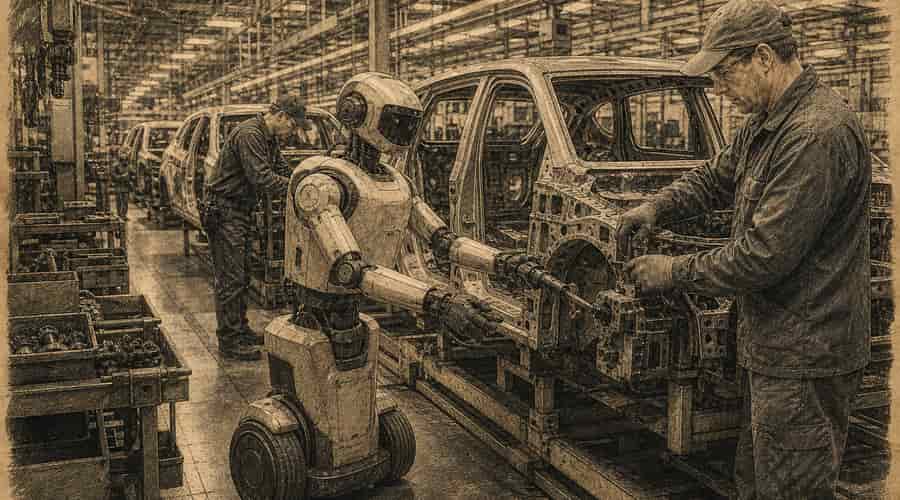
Walden says its robots have been operating in production at a Toyota factory in North America, and MT Newswires reported the machines have been there since February. Bloomberg's reporting, cited by The Next Web, said one of the robots has been working eight-hour shifts beside human teams, handling loading and unloading car parts, cleaning machinery and kitting parts for assembly. Those are not glamorous jobs. They are the jobs that decide whether a robot is useful after the camera turns off.
The robot itself avoids the most attention-grabbing part of the humanoid race. It has a humanoid torso, two arms and a wheeled base where legs would normally go. The Boston Globe reported that Walden's early robots use wheels partly because manufacturing already has approved safety standards for rolling machines, while walking robots do not yet have the same maturity of standards. Tedrake put it plainly to the Globe: the productive route in factories is a wheel base.
Frankly, that is the better bet. Legs make for a stronger product video. Wheels make for a machine that can carry larger batteries and avoid the balance problem. It can start doing work straight away, in places already built around carts, forklifts and marked factory lanes.
Underneath, Walden's robots run on what the company calls Large Behavior Models, built on work from Toyota Research Institute including Diffusion Policy. The Globe explained that Tedrake and other researchers adapted diffusion models, better known for image generation, to teach robots physical tasks from human demonstrations. Tedrake told the paper that users do not have to write new code for every task. They show demonstrations, and the robot learns the task.
That explains the speed better than any vague claim about physical AI. Walden's founding team did not start from an empty room in January. Tedrake had led a Toyota Research Institute robotics and machine learning team for nearly 10 years, according to his own launch note, and that team worked on Diffusion Policy, Universal Manipulation Interface, Large Behavior Models, OpenVLA and Drake. The startup is new. The research base is not.
None of this means humanoid robotics has solved its hardest problems. One Toyota factory in North America does not prove these systems can handle every warehouse, semiconductor plant or aerospace line Walden wants to serve. Demonstration learning still needs demonstrations. Every new task still costs time with the robot, the operators and the production environment.
You should also notice the business model. The Globe reported that Walden plans to charge customers fees to use the robots rather than sell the hardware outright, with Tedrake calling robots as a service the current path because the technology and hardware are changing quickly. That is a practical admission. Early customers are not just buying a machine. They are buying support and updates. They are buying a company willing to stay close when the robot meets the reality of a factory shift.
What Walden has, at least for now, is the rare robotics combination: a real deployment before the public launch, a Toyota lineage, and investors whose industries could actually use the product. In a field crowded with humanoid ambitions, that order matters. Work first. Valuation second.
Also read: Skyroot's Vikram-1 Becomes India's First Private Rocket to Reach Orbit • How to Prepare a Board Deck for Your First Startup Board Meeting • A Regulatory Filing Reveals DeepSeek Is Now Worth About $52 Billion