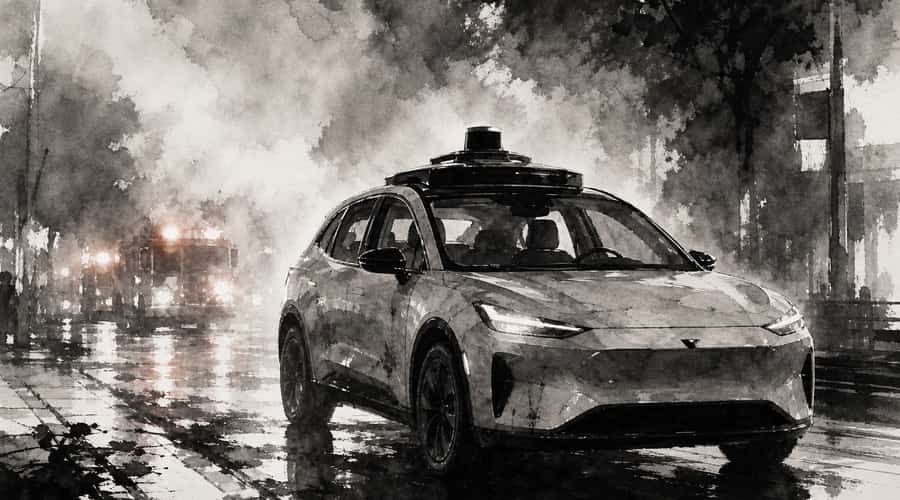
An empty Amazon robotaxi drove into heavy smoke at a Las Vegas fire scene, and Zoox's fix says something blunt about driverless cars: they still have to understand the road when the road stops looking normal.
On June 20, an unoccupied Zoox vehicle rolled toward heavy smoke covering a Las Vegas road where firefighters were working an active fire. No passengers were inside. No one had yet placed traffic cones across the scene. The vehicle entered the smoke, braked hard while trying to steer away, and came to a stop before a Zoox teleguidance employee directed it to reverse. First responders then put cones across two of the three through-lanes, according to accounts based on Zoox's filing with the National Highway Traffic Safety Administration.
Nobody was hurt. That matters. But it's also the easiest fact in this story to overuse. The recall exists for the thing that nearly happened, not the thing that didn't.
Reuters reported on July 17 that Amazon's self-driving unit would recall 105 autonomous vehicles. The reason: they may fail to detect heavy smoke and could impede emergency personnel. NHTSA's recall record, campaign 26E044000, lists the affected component as Zoox's automated driving system software. The agency says the problem can increase the risk of a crash or interfere with first responders. Its public recall data shows an April 23, 2026, start date and a July 8, 2026, end date for the affected software population. The report was received on July 10.
The fix is narrow and important. Zoox updated the software so the vehicle treats heavy smoke as a low-visibility hazard on its own, rather than waiting for the more familiar signs of an emergency scene: cones, flares, flashing lights, blocked lanes. You don't need to be a firefighter to see the problem. A road hidden by smoke is not an open road.
The cones came too late
Zoox's filing exposes a weakness that sounds technical until you picture it from the windshield. The vehicle's system was prepared to respond to markers that normally formalize a hazard. Smoke without a cone in front of it was harder. In a city, those seconds matter, because emergency scenes don't arrange themselves in the order software designers would prefer.
This is where the industry's favorite phrase, edge case, starts to do too much work. A fire scene is not some bizarre lab condition. It's a normal part of driving in a real city, like a stalled truck, a police stop, a construction crew waving traffic through, or a lane that looks open until it isn't. Humans get these wrong too, but the promise of a robotaxi is not that it will repeat our worst habits with cleaner branding.
Zoox has been here before. In March 2025, the company recalled 258 vehicles after NHTSA reviewed two incidents in which motorcyclists collided with the rear of Zoox test vehicles that braked unexpectedly hard. In May 2025, Zoox filed another software recall after an unoccupied robotaxi in San Francisco was involved in an incident with an e-scooter rider. In December 2025, TechCrunch reported that Zoox recalled 332 vehicles over software that could cause vehicles to cross a center line or block crosswalks near intersections. The details differ. The theme doesn't.
The car has to read the room.
NHTSA has stopped treating this as isolated
The timing is rough for Zoox because Washington had just put the whole driverless industry on notice. On July 8, NHTSA Administrator Jonathan Morrison issued a public letter to automated driving system developers warning about a "clear pattern" of driverless vehicles interfering with law enforcement, firefighters, and ambulance crews. WIRED reported that Morrison called those incidents "unacceptable" and told companies the agency would schedule meetings by the end of July to hear their fixes.
Waymo has carried much of that heat. WIRED reported that Austin first responders discussed a Waymo robotaxi blocking an ambulance for two minutes during the response to a downtown mass shooting, and that San Francisco officials told NHTSA the company's vehicles had blocked fire station access and frozen during difficult situations. Waymo is much larger than Zoox, but scale doesn't excuse the smaller company. It raises the bar for everyone else.
Amazon bought Zoox in 2020 in a deal reported at more than $1.2 billion, and Zoox has been offering free public rides in parts of San Francisco and Las Vegas while testing in other markets, including Austin and Miami. If you're trying to win over city officials, fire departments, and state regulators, a vehicle wandering into smoke at an active fire scene is exactly the kind of incident that follows you into the next meeting.
Frankly, the recall is the responsible move. Software recalls are now part of how autonomous vehicle companies fix behavior after real-world failures, and Zoox says the update has already been deployed across the affected fleet. But the harder question is not whether one model can be patched after one Las Vegas fire. It is whether these vehicles can be trusted before the cones go down, before a firefighter has time to wave, and before a remote employee has to tell a car to back out of trouble.
No one was injured on June 20. Good. The next test is whether that remains true when the smoke is thicker, the lane is busier, and there isn't time for the software to learn after the fact.
Also read: Base, Coinbase, Optimism and WalletConnect back new Ethereum wallet standard • Micron's Earnings Beat Sends Its Stock and the Memory Sector Soaring • Across Protocol Got Hacked on Solana and No User Lost a Cent