Agility Robotics is trying to turn Digit's warehouse hours into a public-market valuation, but the clean story is already getting messier in the filings.
Digit has spent years doing the least glamorous kind of robot work: carrying totes and moving boxes, taking the repetitive jobs off human hands in the warehouse. That's the right kind of boring. Now Agility Robotics wants Wall Street to pay $2.5 billion for it.
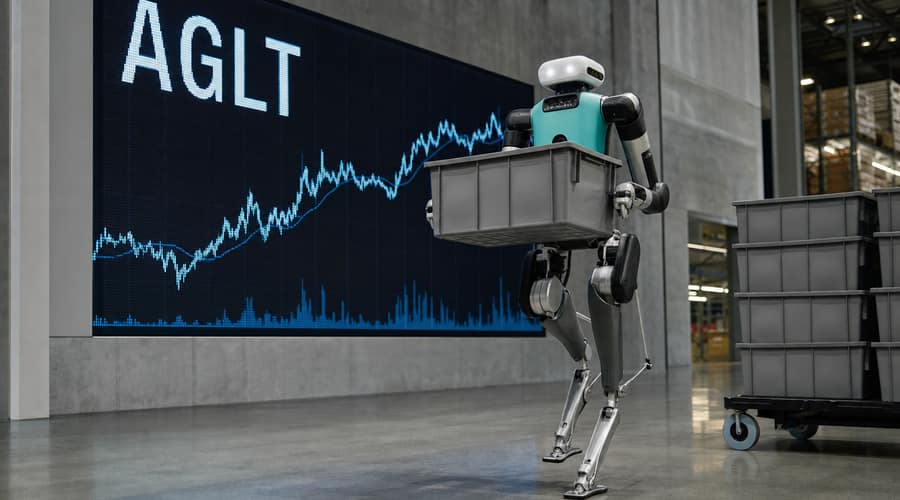
Agility announced on June 24 that it had signed a merger agreement with Churchill Capital Corp XI, the blank-check company chaired by SPAC dealmaker Michael Klein. According to the companies' announcement, the deal would bring in more than $620 million in gross proceeds, including about $420 million from Churchill's trust if shareholders don't redeem and about $200 million from a PIPE led by Foxconn. If the transaction closes in 2026, the combined company is expected to trade under the ticker AGLT on a major North American exchange.
There has already been a fresh step. On July 14, Agility and Churchill said they had confidentially submitted a draft Form S-4 registration statement to the SEC. Three days later, Agility announced a new 60,000-square-foot Fremont, California facility to serve as its Bay Area software and AI capabilities hub, with plans to hire nearly 200 people, mostly in AI and software engineering, plus field operations. You don't open that office unless you're trying to show public investors that the robot is moving from demo floor to operating plan.
Digit Has More Than a Demo
This isn't Tesla Optimus, still mostly inside Tesla's own walls. It also isn't Figure AI, which announced a more than $1 billion Series C in September 2025 at a $39 billion post-money valuation, led by Parkway Venture Capital with backers including Nvidia, Intel Capital and Brookfield. Agility is smaller. It also has something investors can count more easily.
Agility says Digit has logged more than 65,000 real-world operating hours across nine customer sites. Its active commercial deployments include Schaeffler, GXO, Toyota Motor Manufacturing Canada and Mercado Libre. Those names matter. They move this story away from the usual humanoid robotics showreel and toward a harder question: can a bipedal machine work enough hours, safely enough, to justify the money now being asked of public shareholders?
The Foxconn piece is worth watching. About $200 million of the expected proceeds is coming through a PIPE led by the Taiwanese manufacturing giant, best known for assembling iPhones for Apple. Existing Agility backers include Amazon, Nvidia, SoftBank Vision Fund 2 and DCVC, according to the company. That's not proof the model works. It does tell you serious industrial and AI money wants a seat before the company is public.
Frankly, the robot hours are the easy part to believe. The valuation is where you need to slow down.
The Public Market Will See the Gap
GeekWire reported after reviewing the merger materials that Agility remains unprofitable, with operating expenses rising to about $111 million in 2025 from $71 million a year earlier and roughly $100 million in cash burn. The same report noted that the initial filings did not yet disclose full revenue figures. That matters for a SPAC deal, because the pitch can sound concrete before the audited financial picture arrives.
The order book also needs careful reading. Agility says it has secured more than $300 million in multi-year orders for Digit v5, its next-generation robot. Good. But GeekWire's review found that the bulk of that figure traces to a single three-year contract for 1,000 robots with an unnamed customer, and the company's own disclosure says the order figure isn't current-period revenue and depends on future milestones.
That's the real issue. A warehouse robot with 65,000 hours on the clock is not the same thing as a business that can manufacture, certify, deploy and service thousands of robots at attractive margins. Agility has manufacturing operations in Salem, Oregon, and the company has talked about scaling capacity toward 10,000 units a year. The Fremont site adds software and AI muscle. Public investors will still want to see gross margin, delivery timing, customer concentration and whether Digit v5 can clear the safety and operating hurdles built into those contracts.
Agility was founded in 2015 out of Oregon State University's robotics work by Jonathan Hurst, Damion Shelton and Mikhail Jones. CEO Peggy Johnson, previously at Microsoft and Magic Leap, is now the person taking that lab-born company through the SPAC process. Both boards have approved the transaction. Shareholders and regulators still have their say.
If you're buying the story, you're buying the idea that physical AI has crossed from impressive prototype to paid warehouse labor. Agility has better evidence than most humanoid robot companies. It also has the same hard problem they all have: every promise has to show up as a machine that works for a customer, hour after hour, without the economics falling apart.
That is a tougher test than a Nasdaq bell. It always is.
Also read: Moonshot AI Pauses New Kimi K3 Subscriptions After Demand Overwhelms Its GPUs • US Companies Now Run Nearly Half Their AI Traffic on Chinese Models • China Publicly Rejects Anthropic's Claim That Alibaba Stole Claude's Data