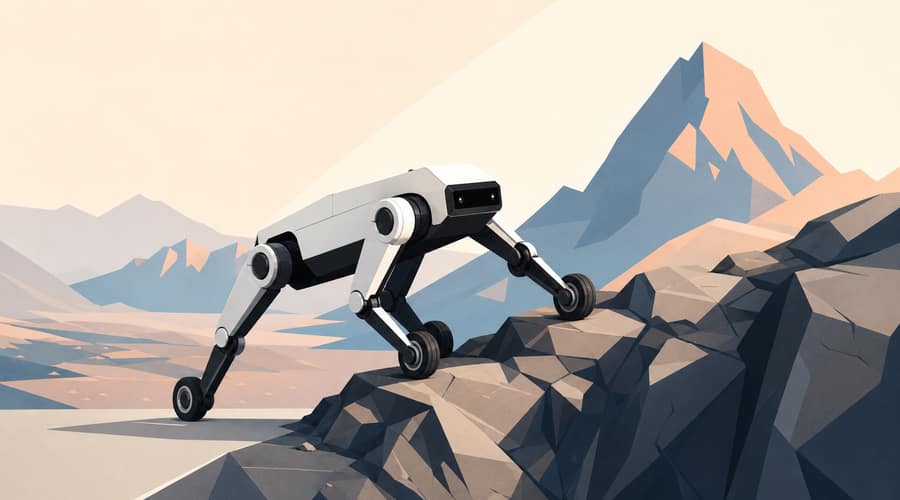
Unitree Robotics has released demo footage of the AS2-W crossing steep cliff faces and rocky streams using real-time reinforcement learning, marking a significant escalation in the Chinese firm's challenge to Boston Dynamics' dominance of industrial quadrupeds.
The video is striking. A compact robot dog rolls across flat ground on wheels, then hits broken terrain and transitions, mid-stride, into full quadruped stepping. It crosses streams. It climbs. It does this not through pre-programmed path planning but through a reinforcement learning model processing the environment in real time. It's the kind of demonstration that used to require a $300,000 Spot and a Boston Dynamics engineering team on standby. The AS2-W, Unitree's newest wheel-legged platform, suggests those days have an expiration date.
The AS2-W is built on Unitree's AS2 quadruped base, which the company unveiled in February 2026. The wheel-legged variant adds the hybrid locomotion system: wheels for efficiency on flat surfaces, legs for adaptability everywhere else. Specs include an 8-core CPU with an optional Intel i7 upgrade, dual LiDAR for environmental mapping, up to 25kg payload capacity, IP54-rated weather protection for rain and dust, and a 12km operational range per charge. The robot weighs 18kg. It can climb 40-degree slopes. The AS2 base platform starts at around $36,700 through distributors, with the AS2-W priced at a premium above that, according to listings from the robotics dealer network.
Boston Dynamics' Spot starts at $75,000 for the base unit. Fully configured with sensors and service contracts, real-world deployments have run anywhere from $150,000 to $375,000, based on publicly available procurement records. That price point has kept Spot largely in the domain of well-funded energy companies, defense contractors, and research institutions willing to treat a quadruped robot as capital infrastructure.
Unitree isn't just undercutting on price. The architectural approach is genuinely different. Spot's locomotion uses a combination of model-based control and learned policies developed in-house over nearly a decade, with Boston Dynamics only recently releasing a public reinforcement learning research kit for Spot via NVIDIA Isaac Lab. Unitree has been training RL policies on its hardware and shipping them in production robots for years, building an open-source training ecosystem through its unitree_rl_gym repository that covers everything from the Go2 to the G1 humanoid. The AS2-W cliff demo is the latest output of that pipeline: a policy trained in simulation, deployed on hardware, tested on real terrain.
The difference matters for the buyer calculus. Boston Dynamics offers a mature, well-supported platform with deep enterprise integration. Unitree offers a faster iteration cycle, dramatically lower upfront cost, and increasingly comparable outdoor capability. For startups building robot-as-a-service products around inspection, logistics, or construction site monitoring, that's not a close call.
Which startups are doing the math
The robot-as-a-service model only works when hardware cost drops below a threshold where recurring revenue can actually justify deployment. The numbers are blunt. At $75,000-plus per unit, Spot demands either a large fleet customer willing to sign multi-year contracts or an enterprise buyer absorbing the cost as a capital item. At sub-$40,000, a startup can deploy a unit, charge for inspection hours or data subscriptions, and reach break-even in a reasonable timeframe.
That's the math Unitree's price point unlocks. Infrastructure inspection startups monitoring pipelines, bridges, or wind turbines can now put a wheel-legged quadruped with dual LiDAR and IP-rated weatherproofing into the field at a cost that fits a venture-backed business model. The AS2-W's 12km range per charge matters here too: a single deployment covering a kilometer of pipeline or a multi-acre construction site doesn't require a recharge mid-mission.
The construction sector is the clearest near-term target. Progress monitoring on large sites currently relies on a combination of drone flyovers and manual walkthroughs. A quadruped with a LiDAR stack can do what a drone can't: enter structures, navigate staircases, and operate in GPS-denied environments. At Spot's price, that use case pencils out only for the largest general contractors. At Unitree's price, it becomes a conversation for mid-size project managers.
Frankly, the comparison that matters most for investors isn't AS2-W versus Spot. It's AS2-W versus where Spot was three years ago. Boston Dynamics spent roughly a decade and hundreds of millions in R&D getting Spot to commercial readiness. Unitree has closed most of that capability gap at a fraction of the cost and is iterating faster. The AS2 platform launched in February. The AS2-W demo dropped in July. That's five months from announced platform to hybrid terrain robot on a cliff face.
Boston Dynamics declined to comment on competitive positioning. Unitree did not respond to a request for additional technical detail on the AS2-W's RL training methodology by publication time. What the footage shows, though, is self-evident: a robot that costs less than most luxury SUVs, running an AI-trained locomotion policy in real time, on terrain that would have been a serious engineering challenge for any commercial platform two years ago.
Also read: Former SentinelOne executives raise $100 million to stop rogue AI agents before they own your enterprise • Samsung put USDC into 241 million Galaxy phones and Circle got the distribution win crypto has been chasing for years • India ordered GitHub to delete Jack Dorsey's Bitchat and exposed exactly why it can't be stopped