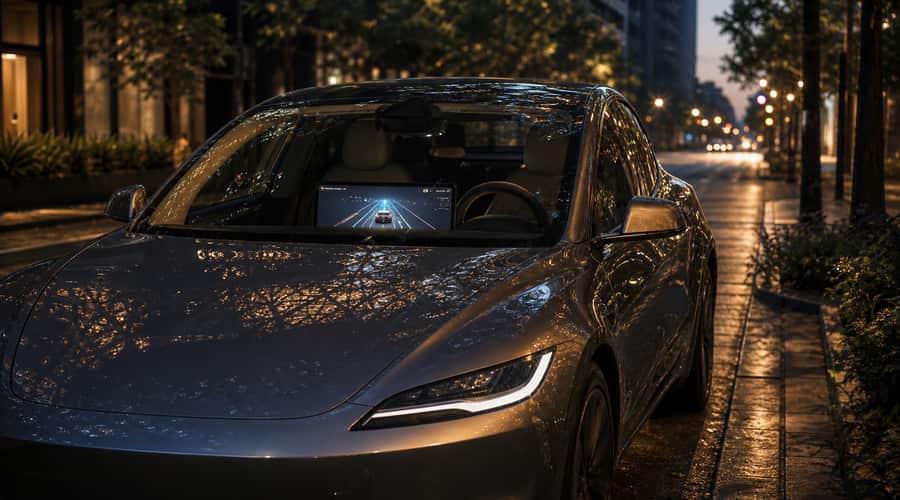
Tesla's FSD v14 Lite update gives HW3 owners a better supervised system, but it doesn't fix the old promise. If you paid for Full Self-Driving on the claim that the car already had the right hardware, this update still leaves the biggest part undelivered.
The update is real. For HW3 owners who've been waiting, it's also noticeable. Tesla Oracle reported that software version 2026.20.6.11 started reaching larger waves of Hardware 3 vehicles on July 23, after earlier limited builds had gone to testers. Brake confirmation to start FSD from park can now be disabled. Arrival Options show up on the screen. Speed Profiles are available more broadly. The release notes point to fewer false slowdowns, smoother steering, better lane centering, and improved handling around merges, pedestrians, traffic lights, and vehicle cut-ins.
That's useful. It isn't autonomy.
Tesla's own support language still says Full Self-Driving is supervised, requires an attentive driver, and doesn't make the vehicle autonomous. That is the line HW3 owners have to sit with. The company sold cars for years around the claim that they had the hardware needed for future full self-driving, and TechCrunch reported Elon Musk saying at Tesla's 2019 Autonomy Day that all cars then being produced had the hardware necessary for full self-driving. Some buyers paid as much as $15,000 for the package before Tesla moved FSD in the U.S. to subscription only.
The promise HW3 can't meet
The harder fact came in April. Not a Tesla App reported after Tesla's Q1 2026 earnings call that HW3 vehicles won't be capable of unsupervised Full Self-Driving. The problem isn't a menu setting or a delayed model release. It's hardware. MarketWatch also reported this week that Musk said it will make sense for Tesla to upgrade older vehicles with cameras to next-generation hardware, after Tesla had already outlined trade-in discounts and computer-and-camera replacements for certain HW3-equipped cars.
Look at the split. If you bought FSD outright, Tesla has pointed to a free retrofit path. If you subscribed, you're not in the same position. Not a Tesla App estimated a paid hardware upgrade could land around $3,000 to $5,000, largely because replacing computers and cameras across older cars is labor-heavy. That number isn't a Tesla price list, so you shouldn't treat it like one. It is still the range owners are watching.
For a customer, the distinction matters. A free software update is welcome. A paid hardware bill is different.
Ashok Elluswamy, Tesla's head of AI software, had signaled the rollout before the broader push, writing on X that the 2026.20.6.10 build was likely going to wide release, according to Not a Tesla App and EVwire. The next point release, 2026.20.6.11, became the wider one. That makes the update feel more credible than the usual rumor-cycle chatter, because it lines up with release notes, OTA tracking, and Tesla's own Q2 language that FSD v14 Lite had begun deployment for AI3 vehicles in the U.S. and South Korea.
But the Lite suffix is doing real work. Tesla Oracle described the build as a distillation of HW4 v14 behavior into HW3's compute limits. That's a clever engineering answer to an aging fleet. It's not the same as saying HW3 can do what HW4 can do. The release notes themselves say the update lets HW3 learn from HW4 v14 as a guide. They don't say the cars have become unsupervised robotaxis.
The retrofit question is now the story
Tesla's Q2 numbers show why the company wants this dispute contained. Barron's reported that about 1.5 million drivers are paying for FSD, up from 1.3 million at the end of the first quarter, and that more than half of new car sales in North America included FSD subscriptions. MarketWatch put the figure at 1.48 million active FSD users, up 56% from a year earlier. Tesla has momentum there. It doesn't want millions of older owners turning into a public accounting problem.
And there are millions of them. Electrek described FSD v14 Lite as the first major update for roughly 4 million HW3 vehicles that had been stuck on older FSD software since early 2025. Even if only a fraction of those owners bought FSD outright, the retrofit workload is not small. Cameras, computers, service appointments, eligibility rules, used-car ownership records, regional approvals, all of it becomes the dull operational work behind Tesla's autonomy pitch.
Cybercab makes the gap harder to ignore. Tesla rolled the first Cybercab unit off the line at Gigafactory Texas in February, and other reports say production moved from early units into continuous manufacturing after the Q1 call. The vehicle has no steering wheel and no pedals. It belongs to the AI4-era fleet Tesla is building around unsupervised service, not to the HW3 cars parked in customers' driveways.
So v14 Lite is a good update and an incomplete answer. If you own an HW3 Tesla, your car should drive better with it. It should feel less frozen in time. But if you paid for Full Self-Driving because Tesla told you the hardware question was already settled, the practical question is no longer whether the software improves. It does. The question is whether Tesla will make the hardware promise whole without asking the oldest believers to pay twice.
Also read: Japan's industrial AI machine is running while Western investors are still looking at the scoreboard • A single Oracle PeopleSoft bug gave ShinyHunters two weeks to ransack 100 universities before anyone noticed • Guillermo Rauch says AI agents now trigger more than half of all Vercel deployments