
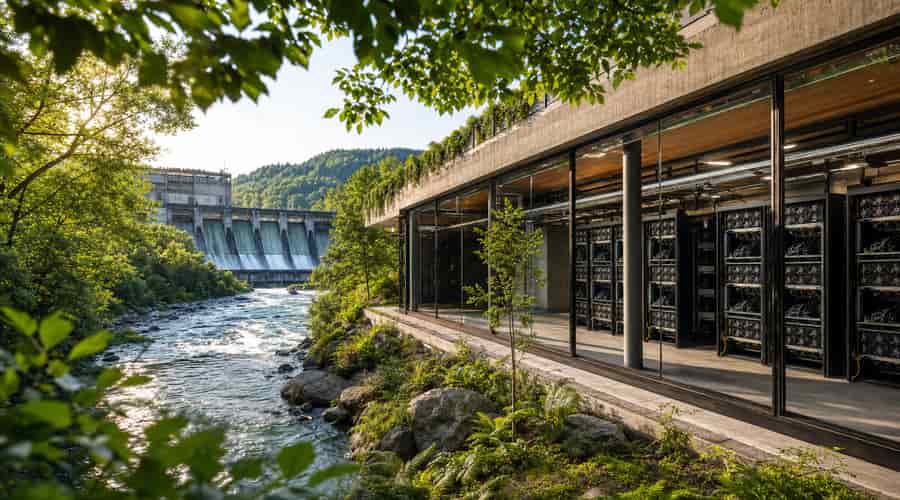
Cambridge's mining data doesn't end the Bitcoin energy fight, but it does make the old coal-first attack look stale. Hydropower now leads the renewable side of the network, and miners are following cheap electricity with far more discipline than their critics usually admit.
For years, the environmental attack on Bitcoin was the easiest one to land. Critics could cite energy consumption, point to coal-heavy mining - and close the conversation before anyone reached the second chart. That argument is weaker now. According to the Cambridge Centre for Alternative Finance's April 2025 Digital Mining Industry Report, sustainable sources accounted for 52.4% of the electricity used by surveyed Bitcoin miners, made up of 42.6% renewables and 9.8% nuclear. In 2022, Cambridge put that sustainable share at 37.6%.
Hydropower is the big piece. Cambridge put it at 23.4% of the mining electricity mix, ahead of wind at 15.4% and solar at 3.2%. Natural gas is still the single largest individual source at 38.2%, and coal hasn't disappeared at 8.9%. So don't oversell this. Bitcoin mining is cleaner than the old reputation suggests, but it isn't clean enough to pretend the argument is finished.
The Cambridge sample matters because it wasn't a loose industry talking point. The survey covered 49 mining firms operating in 23 countries and representing about 48% of global mining activity. The report also estimated Bitcoin mining's annual electricity use at 138 TWh and related emissions at 39.8 MtCO2e. Those are large numbers. You can believe Bitcoin has a stronger energy story and still admit the network uses a serious amount of power.
Paraguay shows why miners follow water
The geography of the shift is not random. Paraguay has become one of the clearest examples because it sits on huge hydroelectric resources from Itaipu, Yacyreta, and Acaray. Hashrate Index's May 2026 review put Paraguay at about 4.3% of global Bitcoin hashrate, roughly 43 EH/s, making it the fourth-largest mining jurisdiction behind the United States, Russia, and China.
That didn't happen because Paraguay became a crypto branding exercise. It happened because power was cheap and abundant. Hashrate Index said industrial electricity that once sat around $0.03 per kWh has moved into roughly the $0.037 to $0.050 range, with higher deposits and tougher utility terms pushing out weaker operators. That's the useful detail. The miners with capital and long-term infrastructure still have a reason to stay. The smaller operators don't all survive the same math.
HIVE Digital is the cleanest corporate example. In March 2025, the company completed its acquisition of Bitfarms' 200 MW hydro-powered Yguazu site in Paraguay, adding it to a previously announced 100 MW project in Valenzuela. In October 2025, HIVE said it had signed a further 100 MW hydroelectric expansion at Yguazu, with full commissioning targeted for Q3 2026. That would bring its Paraguay renewable capacity to 400 MW.
Paraguay's state utility is also experimenting in a way that would have sounded odd a few years ago. Reports from Bitcoin Magazine and regional outlets in March 2026 said ANDE signed a memorandum of understanding with Morphware to explore a government-led mining pilot using confiscated machines from illegal operations. The pilot plan centered on redeploying seized rigs at utility-controlled sites near substations. That is a very practical turn: take machines that were draining power illegally and put them under the utility's own meter.
The wider mining map has changed too. After China's 2021 crackdown pushed hashrate out of the country, miners rebuilt capacity in places where power contracts and political risk worked better - cooling conditions too. CoinShares' Q1 2026 mining report still put the United States, China, and Russia at the top of the hashrate table, but it also named Paraguay, Ethiopia, and Oman among the newer top-10 entrants. The industry didn't become virtuous overnight. It became more ruthless about electricity costs.
The ESG case is changing
The ESG objection has been one of the most durable barriers to Bitcoin's institutional acceptance. Spot Bitcoin ETFs have already opened the asset to a much larger pool of investors, but environmental screens still matter for pensions, family offices, and funds that have to explain their holdings to committees. CoinDesk reported that U.S. spot Bitcoin ETFs recorded $1.32 billion in net inflows in March 2026, their first positive month since October 2025. Money is coming back, even after a hard drawdown.
Regulation is forcing the same issue. Under MiCA, the EU requires crypto-asset service providers to publish information on the principal adverse climate and environmental impacts of the consensus mechanisms behind the assets they offer. ESMA's own guidance frames those disclosures around energy use and emissions - greenhouse gases, water, waste. If you're a miner attached to hydro power in Paraguay or another low-carbon site, disclosure is less of a threat. It becomes part of the pitch.
The United States is moving on a different track. The GENIUS Act, signed into law on July 18, 2025, created a federal framework for payment stablecoins, not Bitcoin mining. Still, it sits inside a broader Washington shift toward writing crypto rules instead of treating the whole sector as radioactive. That helps infrastructure companies because capital prefers known rules, even imperfect ones, to permanent uncertainty.
Here's the thing: Bitcoin critics still have a real argument if they focus on total electricity use, local grid strain, or the fossil fuel share that remains. Cambridge still has natural gas at 38.2%. Coal is still there. But the specific claim that Bitcoin mining is mainly a coal-burning business no longer fits the best available data. If you want to attack Bitcoin's energy use now, you need a sharper argument than the one that worked in 2021.
The next phase will be decided in power contracts, not conference panels. Paraguay has a 2027 ANDE contract cliff, according to Hashrate Index, and HIVE's Q3 2026 expansion target gives investors a concrete milestone to watch before then. The miners that can prove low-cost, low-carbon power will have a better story for regulators and allocators. The ones that can't will be left arguing from yesterday's numbers.
Also read: BitMart announces it is shutting down as BMX token crashes over 60% and withdrawal fears grip users • Washington puts Bitcoin in the same program as Palantir and Anduril, treating it as geopolitical infrastructure • Bitcoin is clinging to $64,000 as $312 million in liquidations and ETF outflows signal a market under real pressure