
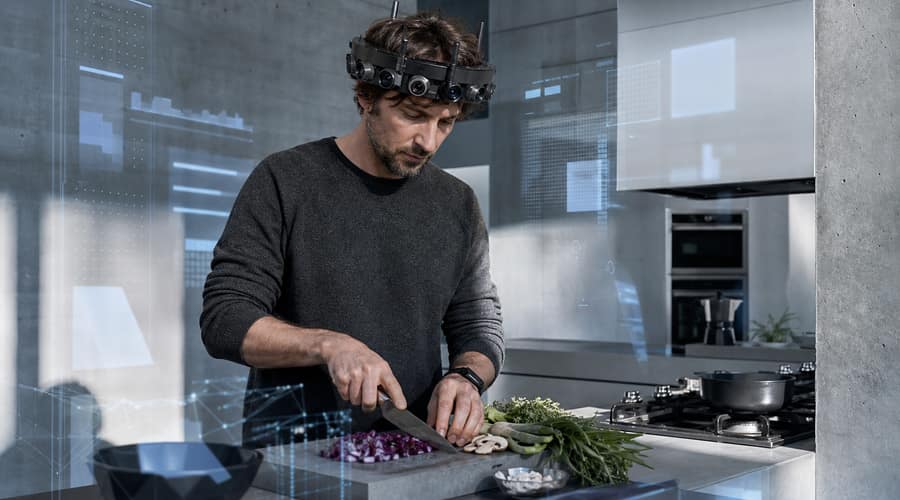
Ropedia has raised $22 million more because robotics has a simple problem: robots cannot learn real-world chores from internet text.
The pitch sounds odd until you think about your own hands for a moment. Ropedia wants people to wear a crown-shaped camera rig while they move through normal work, so its software can capture first-person video, depth, audio, camera pose, hand motion, full-body motion and the timing between all of it. That is HOMIE, short for Human-centric Omni Interaction and Experience. It is not the robot. It is the training ground.
The Singapore company was founded in the second half of 2025 by CEO Zhaoxi Chen, CTO Fangzhou Hong and Chief Scientist Ziwei Liu, an associate professor at Nanyang Technological University. It raised an $8 million seed round in March 2026, then announced a $22 million pre-Series A this week, taking total funding to $30 million. That is quick work. According to SiliconANGLE's reporting, earlier backers included super angels tied to Google, Nvidia, a16z and Amazon. The new money, per TNGlobal, will go into data collection across Southeast Asia and North America, manufacturing more wearable capture hardware, and expanding teams in Singapore and the U.S.
The robot data gap is real
The LLM boom had the open internet to feed on. Physical AI does not. If you want a humanoid robot to fold, grasp, pour, pass, pause or recover when something slips, you need records of actual bodies doing those things in actual rooms. A text model can learn from a page. A robot needs the motion, the timing, the geometry - how the hand moves, when it slows, and where in space everything ends up.
Ropedia's claim is that HOMIE cuts collection costs by up to 50 times compared with traditional motion-capture methods. That figure should be treated as a company claim, but the logic is clear enough. Traditional motion capture often means a studio, calibrated sensors and trained operators. HOMIE moves with the person, whether the task is in a kitchen, a factory floor or a hospital ward. That changes the cost base. It also changes the kind of data you get.
The company's Xperience-10M dataset is the concrete piece here. Its public Hugging Face dataset card says it contains 10 million interaction experiences and 10,000 hours of synchronized first-person recordings, with six video streams, stereo depth, camera pose, hand motion capture, full-body motion capture, IMU data and language annotations. The card also lists 2.88 billion RGB frames, 720 million depth frames and about 1 petabyte of total data. Those numbers are why this story is more than another robotics funding notice.
You can see the target. Ropedia is trying to own the messy layer between humans doing things and robots learning how those things work.
The race is not only about robots
Humanoid robotics is full of louder names. Figure, 1X, Apptronik and Physical Intelligence have all drawn attention because their products look like the future people were promised years ago. Ropedia is selling something less photogenic. It is selling the raw material those companies need before the robots become useful outside demos.
That gives the company a strong opening, but not a permanent one. Any well-funded competitor can put cameras on a head. The harder question is whether Ropedia can turn raw streams into clean, licensed, model-ready data faster than rivals can copy the hardware idea. The moat, if it exists, sits in annotation quality, dataset breadth, customer relationships and the boring operational discipline of collecting useful data again and again.
Frankly, $30 million is enough to make Ropedia visible. It is not enough to make the market belong to it. If a major robotics lab, cloud provider or model company decides human-experience data is strategic, Ropedia will need more than first-mover optics. It will need customers who keep coming back because the data actually improves robot performance.
There are useful signs. SiliconANGLE reported that Chen said Ropedia supplied more than half of the data sources used to train MolmoMotion, a 3D motion-forecasting model from the Allen Institute for AI. The same report said the company plans a second-generation HOMIE device next month and has an eventual target of as many as 10,000 devices. That is the right kind of detail: not a slogan, but a production goal you can later check.
The story now moves from fundraising to proof. Ropedia has to show that more head-mounted cameras can produce better robot behavior, not just bigger datasets. That is where this market will be decided. Not in the press release. In the moment a robot handles the real world without needing a human to rescue it.
Also read: How to Write a Startup Investor Update That Gets Replies • European drone startups are raising billions while the old defense giants scramble to keep up • Baseten built the fastest GLM-5.2 API on earth and the playbook tells you where inference is heading