
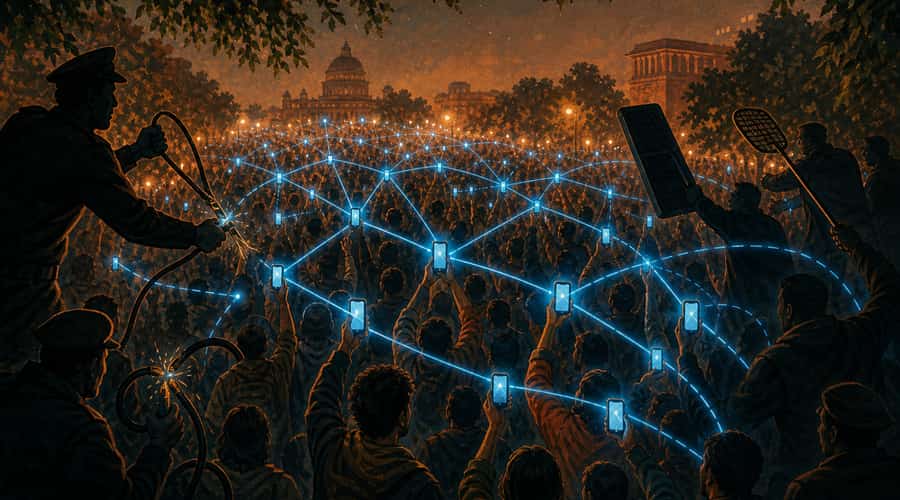
India's cybercrime agency gave GitHub three hours on July 23 to delete Jack Dorsey's Bluetooth mesh messaging app Bitchat, citing surveillance evasion , and the move triggered 91,000 downloads in five days, with India accounting for 85% of them.
The order landed at 11:16 pm. Notice No. 11072601011432, issued by India's Cybercrime Coordination Centre (I4C) under the Ministry of Home Affairs, instructed Microsoft-owned GitHub to disable access to three Bitchat repositories , including the Android application and its release files , within three hours. The stated reason: Bitchat's Bluetooth mesh architecture lets phones relay encrypted messages peer-to-peer with no internet, no servers, and no accounts, which "significantly impedes lawful interception, attribution and investigation by law enforcement agencies." The app, the notice claimed, posed a "substantial risk of misuse by anti-national elements, terrorist organisations and organised criminal groups."
The timing tells the real story. Since July 17, the Ministry of Home Affairs had suspended mobile internet around Jantar Mantar in New Delhi at least five times, cutting connectivity within a 1.5-kilometer radius as tens of thousands of students camped there demanding accountability for the leaked NEET medical entrance exam. When the shutdowns went up, protesters turned to Bitchat. It worked exactly as designed: messages hopped from handset to handset over Bluetooth, through a dead zone the government had deliberately created. So the government went after the tool.
Jack Dorsey's response on X was three sentences: "The Government of India does not like technologies like Bitchat and wants it taken down." Short. Accurate. The understatement did more work than a press release would have.
India's Internet Freedom Foundation condemned the order as unconstitutional and authoritarian on July 24. Their argument is specific and hard to dismiss. The I4C invoked Section 79(3)(b) of the Information Technology Act, 2000, an intermediary liability provision designed to compel platforms to remove user-generated content that is illegal. Bitchat's repositories contain no illegal content. They contain source code. The IFF argues the government was legally obliged to use Section 69A , the actual blocking provision , which carries procedural safeguards and judicial oversight the three-hour emergency notice bypassed entirely.
The legal paradox goes deeper than one misapplied statute. Bitchat is open-source software, released by Dorsey in July 2025. Code, once public, is trivially mirrored. As of Friday, the app remained available on major app stores, and Sensor Tower data reported by TechCrunch showed that the censorship attempt had the opposite of its intended effect: downloads jumped 32-fold in a single day on July 19, before the formal removal order, once Indian users began sharing the app among themselves inside the protest zone. By the time I4C sent its notice, the horse was not just out of the barn , it had been reproduced on hundreds of other servers.
This is the core impossibility governments keep running into with decentralized, open-source infrastructure: there is no chokepoint. You can lean on GitHub. GitHub can comply. The code still exists. The IFF put it plainly , you cannot delete Bluetooth.
What this means for crypto's role in civil resistance
Bitchat is not, strictly speaking, a cryptocurrency application. But it is Bitcoin-adjacent in the most meaningful sense: it was built by Dorsey, whose Block Inc. is one of Bitcoin's most prominent corporate champions, and it inherits the same architectural philosophy , no central server, no single point of control, no CEO to call and pressure into compliance. The I4C notice explicitly names this as the threat. It is not that the app carries illegal messages. It is that the app cannot be switched off.
That is the property that makes censorship-resistant mesh networking genuinely threatening to any government that uses internet shutdowns as a crowd-control tool. India is not alone in this. As Chainalysis and other researchers have documented, crypto and crypto-adjacent infrastructure keep turning up in exactly these contexts , not because criminals prefer them, but because anyone operating under state surveillance finds decentralization useful. The Bitchat case is the clearest real-world demonstration yet of what "censorship resistant" actually means when governments treat the internet as a lever.
Frankly, the three-hour deadline made the situation worse for the government than doing nothing would have. Giving an emergency instruction to remove widely mirrored open-source code is less an enforcement action than a public announcement that the app works. India's 91,000 downloads in five days , 85% of Bitchat's entire global install base in that window, according to Sensor Tower , are a direct result of the order itself. Governments that rely on information blackouts tend not to account for what happens when the blackout becomes the story.
GitHub had not publicly confirmed compliance as of Friday. India's Education Minister Dharmendra Pradhan, whose resignation the Jantar Mantar protesters are demanding, did not comment. The repositories, as of multiple reports, remained accessible through mirrors and app stores. The three-hour clock ran out. The code did not.
Also read: Waymo tells Uber it's going solo in Austin and Atlanta when their contract expires in 2028 • SanDisk was the S&P 500's biggest winner in 2026 until the memory chip market broke • Washington threatens to sanction Chinese AI models but American startups are already switching sides