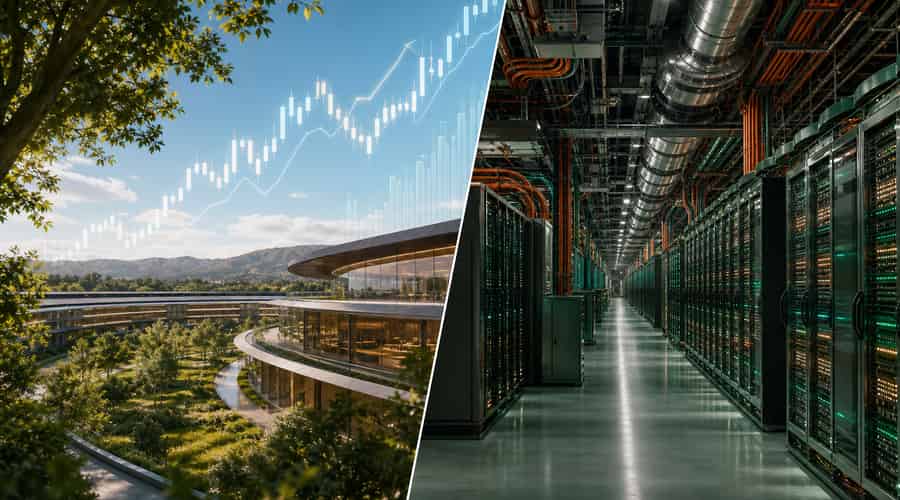
Apple briefly passed Nvidia on July 17 because investors are rewarding the one megacap tech company that hasn't turned AI into an open-ended construction project.
Here's the number that makes the whole thing stark: Apple spent $12.7 billion on capital expenditures in fiscal 2025. Amazon, Alphabet, Meta, and Microsoft, taken together, spent roughly $416 billion in the same period. Yet Reuters reported that Apple briefly overtook Nvidia on July 17 to become the world's most valuable company again, with a market value around $4.88 trillion.
That wasn't random. It was a verdict.
The same week gave investors a cleaner comparison. Alphabet reported Q2 2026 results on July 22 that beat estimates on nearly every operational line. Its own earnings release put revenue at $119.8 billion, up 24% from a year earlier, while Google Cloud revenue rose 82% to $24.8 billion. Fine numbers. The market looked straight past them.
What it saw was the bill. MarketWatch reported that Alphabet's quarterly capex reached about $45 billion, roughly double the year-earlier figure, and the company raised full-year 2026 capex guidance to between $195 billion and $205 billion. Business Insider also reported negative free cash flow of $5.9 billion for the quarter. Alphabet shares fell nearly 7% after the results. Meta had already given investors the same headache in April, when Reuters reported that it lifted 2026 capex guidance to $125 billion to $145 billion from $115 billion to $135 billion.
Apple chose capacity over concrete
Apple's position here wasn't built by accident. While Alphabet, Meta, Amazon, and Microsoft treated AI infrastructure as a land grab, Apple kept a tighter hand on the shovel. On Apple's Q4 2025 earnings call, finance chief Kevan Parekh said the company would keep using a hybrid model, building out its own Private Cloud Compute while also using third-party capacity. That's the important detail. Apple didn't refuse AI spending. It refused to act as if owning every server was the only way to compete.
CNBC reported in May that Apple's R&D spending crossed 10% of revenue for the first time in at least 30 years, with fiscal second-quarter R&D at $11.42 billion. So this isn't a story about Apple doing nothing. Don't buy that version. The company is spending more on AI talent, chips, and software - Private Cloud Compute included. It just isn't asking investors to swallow $200 billion of annual capex while waiting for the revenue model to become obvious.
The contrast shows up in cash flow. Apple had about $129 billion of trailing free cash flow, and Baird analyst William Power raised his price target to $330 on an Outperform rating before Apple's July 30 fiscal Q3 2026 earnings. Investing.com reported that Baird called Apple a "port in the storm" for software and megacap tech capex. That phrase works because it names the trade investors are making: Apple is expensive, but at least you can see the cash.
Apple's stock has gained nearly 23% in 2026, according to Forbes, while Nvidia was up just over 7% when Apple briefly passed it. Nvidia may still deserve its AI premium. It sells the chips everyone else is buying. But the market's patience with the buyers is thinner now, especially when each earnings call seems to bring a larger data center number.
The frugal bet still has to work
Apple didn't make the purist's AI bet. It partnered with OpenAI for ChatGPT access inside Apple Intelligence and kept most of the heavier work inside its own Private Cloud Compute, with on-device processing handling everything it could. It also starts with an installed base of more than 2 billion active devices, a distribution advantage that Alphabet can't simply buy with another data center campus and Meta can't recreate inside a quarterly capex guide.
That's the strength. It is also the risk.
Apple Intelligence still hasn't produced the kind of must-have feature that forces a huge iPhone upgrade cycle. The delayed Siri overhaul remains a real mark against the company. Its July 30 fiscal Q3 report will matter because investors are now paying for Apple as the careful AI winner, not just the iPhone company with a services annuity. If services growth or iPhone demand disappoints, that rich valuation will look less like discipline and more like forgiveness.
Frankly, the risk cuts both ways. Alphabet and Meta are not lighting cash on fire for sport. If AI demand keeps accelerating and owned infrastructure becomes a durable advantage, today's skepticism will look too cautious. But if monetization stays uneven and capex keeps rising, Apple's restraint won't look like lateness. It will look like the cleaner business decision.
For now, roughly $4.9 trillion says the market prefers the company that can spend without sounding desperate.
Also read: Nvidia bets $1.5 billion on Amkor to break its chip packaging bottleneck; TSMC beat every earnings record and Wall Street sold the stock anyway; Waymo tells Uber it's going solo in Austin and Atlanta when their contract expires in 2028