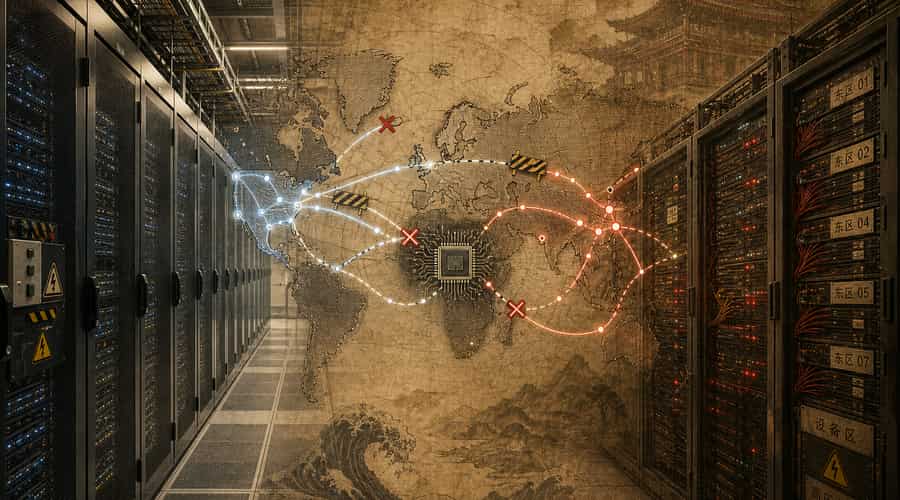
Anthropic's CEO published a formal position on open-weight AI models on July 27, 2026, drawing a sharp line between Western open-source releases and Chinese frontier models like Kimi K3, which he says changes the calculus entirely.
There's a lobby letter circulating in Washington right now, and Dario Amodei didn't sign it. By July 27, Anthropic was the only leading frontier AI company that had not endorsed an industry-wide campaign defending open-weight AI models from regulatory restrictions. Jensen Huang's coalition had grown to 50 signatories. Nvidia, Microsoft, Meta, Palantir, all lined up. Not Anthropic. So Amodei did what you do when silence starts speaking too loudly: he published his position directly.
"To summarize my and Anthropic's position," he wrote on July 27, "we have not and are not advocating for a ban on open-weights models as a category." That sentence is doing a lot of work. It's a clarification, not a reversal. What Amodei is actually arguing is narrower and, frankly, more interesting than either side of the open-source debate wants to admit.
His real targets are distillation and chips. Distillation, the process of training a smaller model on outputs from a larger one, is what he says allows China to build frontier-level systems that its restricted chip supply shouldn't make possible. Stop industrial-scale distillation, he argues, keep powerful chips out of authoritarian hands, and require mandatory safety testing for all sufficiently capable models regardless of whether they're open or closed. That's the actual policy ask. A blanket open-weight ban isn't it.
The proximate cause of all this is Moonshot AI's Kimi K3, a 2.8 trillion parameter mixture-of-experts model whose weights landed on Hugging Face on July 16. The benchmarks are the uncomfortable part. On the Artificial Analysis Intelligence Index, Kimi K3 scores around 57, sitting fourth overall behind Claude Fable 5 at roughly 60 and GPT-5.6 Sol at 59. On GPQA Diamond, a graduate-level reasoning benchmark, it scores 93.5 against Fable 5's 92.6. It took the top spot on Arena AI's Frontend Code Leaderboard with a score of 1,679 to Fable 5's 1,631. As Decrypt reported, it beats Claude Fable and GPT-5.6 Sol on key coding benchmarks. And it's free to download.
That last part is the point. Kimi K3 isn't just competitive. It's open-weight and competitive, released without the safety restrictions Anthropic builds into its own models. You don't need an API contract or usage policy compliance. You download it, you run it, you do what you want with it. For a CEO who has written at length about catastrophic AI risk, that's not an abstraction.
Five days before Amodei published his position, Axios reported that Anthropic and OpenAI had aligned their Washington messaging to caution policymakers specifically against Chinese open-weight releases, pressing officials privately to treat individual Chinese models as national security cases. U.S. officials, according to that reporting, appear more inclined toward case-by-case review than a blanket prohibition, which is roughly where Amodei's position also lands.
The open-source debate was never really about open source
The industry letter Amodei declined to sign argued that open-weight models expand access, competition, and customer control. He actually agrees with that. What he rejected was a separate claim in the letter: that open-weight models necessarily make AI safer or give cyber defenders an advantage over attackers. That's the part he called out directly, and the distinction matters. You can be pro-open-source and still think an adversarially released frontier model from a Chinese lab without any safety evaluation is a different problem than Llama running on a developer's laptop.
The harder question is whether Amodei's preferred tools can actually work. Chip export controls have been a centerpiece of U.S. AI policy since 2022, and Kimi K3's existence is a stress test of that approach. A 2.8-trillion-parameter model competitive with U.S. frontier systems, built under compute constraints, suggests distillation is doing exactly what Amodei fears. The controls aren't failing entirely, but they're not holding a clean line either.
What this means for founders building on AI infrastructure is less philosophical than it sounds. The open-weight model stack you're evaluating isn't one monolithic category anymore. A domestically released open model with documented safety testing is a different risk surface than a frontier-class Chinese model dropped on Hugging Face with no restrictions. Amodei is trying to get policymakers to see that difference before regulation treats them the same. Whether Washington can actually write rules that make that distinction, and enforce them, is the part nobody has a clean answer to yet.
Also read: The EPA just gave AI data centers a pollution exemption that may not survive a courtroom • OpenAI's first hardware product sold out in 12 hours and is now flipping on eBay for $1,850 • A federal judge dismissed Google's DMCA lawsuit against SerpApi and handed a green light to web scrapers everywhere