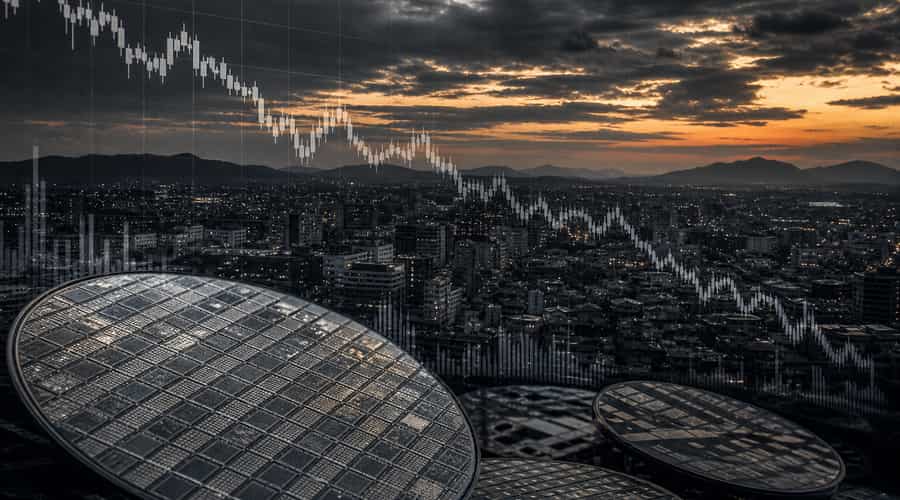
A magnitude 7.1 earthquake hit Kumamoto just as investors were dumping Asian chip stocks. The quake didn't cause the selloff, but it exposed how little room the AI trade has left for bad news.
The timing was brutal. A powerful earthquake struck Kumamoto Prefecture at about 4:27 p.m. local time on July 28, according to the Japan Meteorological Agency, reaching the maximum 7 reading on Japan's seismic intensity scale in Uki City and Hikawa Town. JMA issued a tsunami advisory for areas facing the Ariake and Yatsushiro seas in Kumamoto, Fukuoka, Saga and Nagasaki prefectures.
Reuters reported that the quake knocked out power to thousands of homes and stopped rail services, including JR Kyushu trains. Kyushu Electric Power said about 40,000 homes had lost power. Japan's nuclear regulator reported no abnormalities at nearby nuclear plants. That's what markets notice first: electricity, rail, plant inspections. Not speeches. Not sentiment.
Sony and TSMC both have semiconductor operations in the region. Reuters reported that a Sony spokesperson said the company was checking the situation, while TSMC did not immediately respond to Reuters' request for comment. One important correction is needed here: early public intensity maps did not show only intensity 1 to 2 around the chipmaking area. Yahoo Japan's JMA-based quake data showed Kikuyo, where TSMC's JASM plant is located, at intensity 5 strong. ASCII.jp reported the same reading for Kikuyo. That doesn't prove a production outage. It does mean you shouldn't wave the risk away.
The AI trade was already under pressure
The earthquake didn't start the fire. It landed in a room already full of smoke. The Wall Street Journal reported on July 27 that Nvidia was in talks to provide a financial backstop of up to $250 billion for OpenAI's data center project in Pike County, Ohio, with the wider project cost put above $500 billion. The Journal also reported that Nvidia was discussing a separate arrangement to help finance OpenAI's purchase of Nvidia chips, potentially costing another $350 billion.
That detail matters. Axios framed the concern as circular financing: Nvidia helping fund a customer that would then buy Nvidia hardware at enormous scale. CNBC's own headline called the potential $250 billion backstop another strike against the AI trade. Investors didn't need much more encouragement to sell.
Nvidia shares fell about 5% in the U.S. session, according to the Journal, and the selling moved straight into Asia. Reuters reported that Samsung Electronics fell as much as 9.5% and SK Hynix as much as 10.9% in early Seoul trading. Yonhap later reported that the KOSPI closed down 10.84% at 6,023.66 after a 20-minute circuit breaker was triggered at 10:14 a.m. in Seoul.
Japan was hit too. The Financial Times reported that the Nikkei 225 fell 4.4%, while Kioxia dropped more than 18%. Kioxia already had its own wound: Jiji Press reported earlier this month that a Texas federal jury awarded Viasat $229 million in damages after finding Kioxia companies violated patent claims. Tokyo Electron, Lasertec and Advantest also sold off hard as investors dumped names tied to AI servers, memory, lithography, testing and the wider semiconductor buildout.
The selloff wasn't discriminating. Any name exposed to AI infrastructure spending took the hit, which in Asia means a large part of the semiconductor supply chain. If you own this trade, you already know the problem. The market has stopped treating AI capex as a guaranteed river of future profit and started asking who pays the bill if the returns arrive late.
Kumamoto now carries more than local risk
Kyushu has become one of Japan's most important chip regions by policy choice, not by accident. TSMC's Japan Advanced Semiconductor Manufacturing plant in Kumamoto started volume production in late 2024, and TSMC's own materials describe JASM as a Kumamoto subsidiary backed by Sony Semiconductor Solutions, Denso and Toyota as minority shareholders. Sony also has image sensor operations in the prefecture. Japan wanted a stronger domestic chip base. Kumamoto is a big part of that plan.
Here's the thing: concentration looks efficient until something shakes it. A single earthquake doesn't tell you that Japan's semiconductor strategy is flawed, and it certainly doesn't tell you that TSMC or Sony will suffer lasting damage. But it does remind you that fabs are not abstract entries in an AI spending model. They are buildings, tools, clean rooms, power lines, engineers and local transport networks.
The practical disruption from this quake may still prove limited. Reuters had no immediate report of major nuclear issues, and the first corporate checks were still under way. But markets were already pricing in fragility across the AI-semiconductor complex before the ground moved in Kumamoto. Add an intensity 5 strong reading in the town hosting TSMC's JASM plant, and the day's selling starts to look less like a clean valuation reset and more like a stress test.
The harder question will outlast this week. Nvidia's reported OpenAI financing talks have forced investors to examine whether the AI boom is being funded by real end demand or by an increasingly tangled loop of supplier financing and customer debt. The Nikkei slid, the KOSPI triggered a circuit breaker, and a major quake hit Japan's chip heartland - all on the same day. That made the question impossible to ignore. Frankly, that's the market's job. It reprices what people were too comfortable owning.
Also read: Gold slips to $4,044 as a firm dollar and Fed wait-and-see mode keep bullion in a tight range • Nvidia is now bankrolling the company that buys its chips and the numbers are getting hard to ignore • Nvidia is financing a $50 billion Texas data center that will run on its own chips